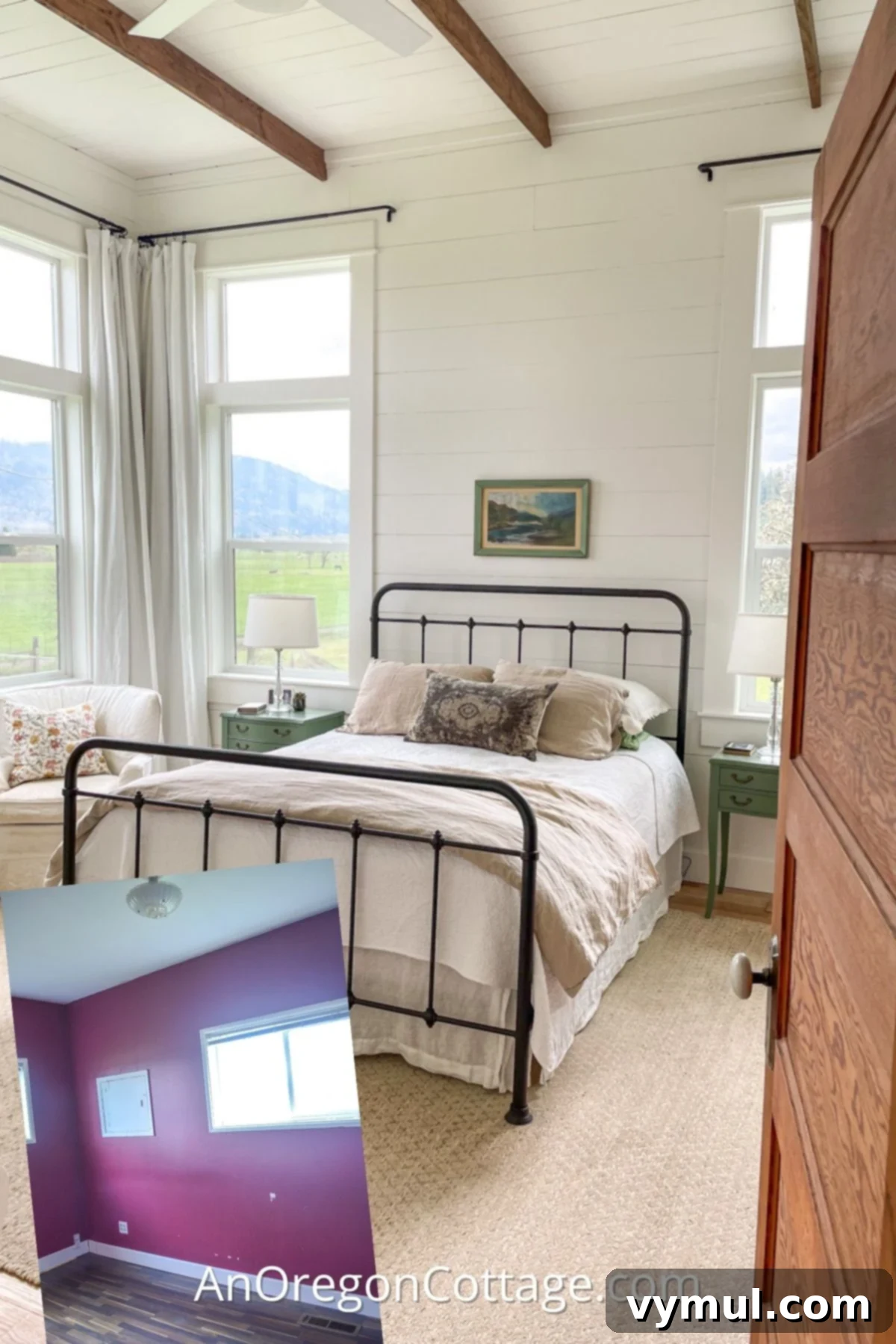
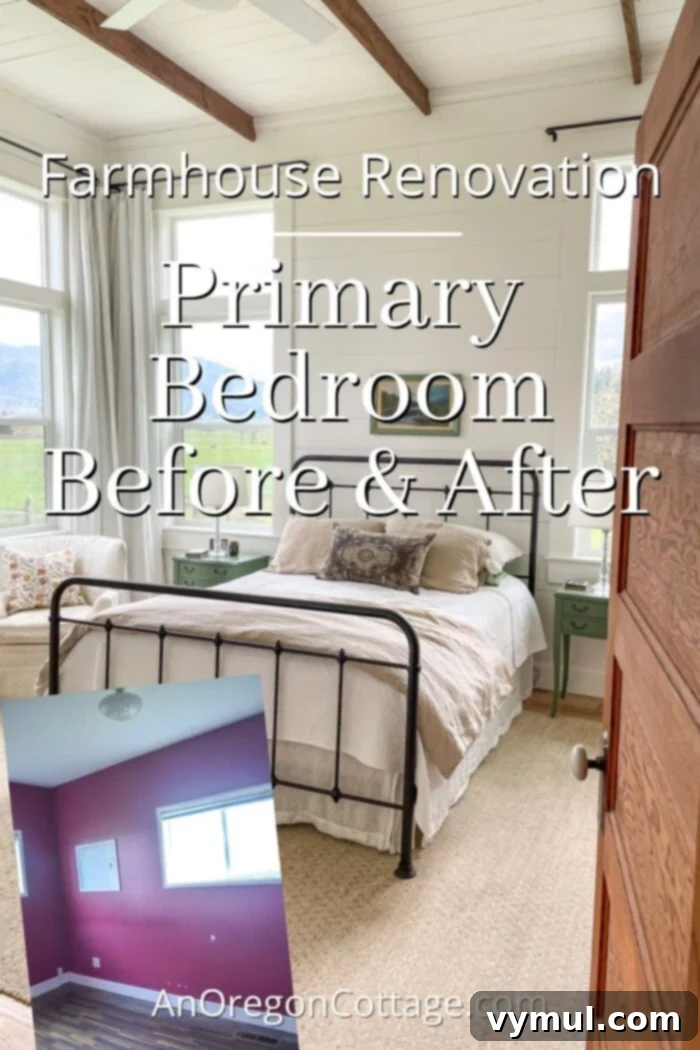
Dramatic Farmhouse Primary Bedroom Transformation: Before & After Our 100-Year-Old Home Renovation
The dramatic primary bedroom before and after for our 100+ year old farmhouse represents the most extensive remodel on the main floor. This ambitious project included an eight-foot bump-out extension, the creation of a brand new walk-in closet, the installation of numerous large windows to capture the breathtaking views, and a series of heartfelt DIY projects designed to restore and enhance the old house’s inherent character. This transformation truly breathed new life into a space that was once cramped and underutilized, turning it into a cherished retreat.
Some links in this article are affiliate links, meaning if you click on them and make a purchase, I will receive a small commission at no additional cost to you. Your support helps me continue sharing these renovation journeys!
We’ve finally arrived at the grand finale of our main floor renovation series for our beloved 1900s farmhouse – the primary bedroom! This particular space underwent perhaps the most profound transformation of all, evolving from a modest, narrow room into a serene and spacious sanctuary. It has truly become a wonderful haven where we can unwind with a good book, and we eagerly anticipate both the quiet evenings and bright mornings spent within its walls.
If you’re just joining us on this journey, be sure to catch up on the other parts of our farmhouse before-and-after series to see the full scope of our renovation:
- Living Room-Dining Room (this also includes some introductory insights and background to our extensive remodel)
- Kitchen
- Hall & Laundry Room
- Main Bathroom
- Primary Bedroom
- Exterior (including foundation work & the new addition)
The main bedroom, in its current state, probably evokes the most “wow” reactions from visitors seeing it in person. While I still believe the kitchen transformation was the most dramatic before and after on the main floor in terms of sheer functional overhaul, the primary bedroom’s aesthetic impact is undeniable. This is largely due to the expansive banks of windows that flood the room with natural light and the soaring high ceiling, which collectively set it apart from the other rooms. This distinctiveness, as you’ll soon discover, turned out to be both a blessing and a bit of a challenge.
Do we absolutely adore how this room materialized? Oh, without a doubt! The first few nights after we finally moved back in, we couldn’t stop remarking on how it felt like we were enjoying a luxurious stay at an AirBnB somewhere far away, rather than in our own home. It truly felt like a vacation every single day.
However, if I had the opportunity to revisit certain decisions, would I approach things differently? Well… yes, as you’ll learn in detail as we delve into the specifics below. Renovation, after all, is a journey of learning, and sometimes those lessons come with unexpected twists and turns.
Farmhouse Primary Bedroom Before and After Video Tour
Note: I’ll provide sources to everything I can, including paint colors, furniture, and hardware, at the very end of this reveal article, making it easy for you to find similar items for your own home projects.
Our Farmhouse Bedroom Renovation Journey: Expanding the Primary Retreat
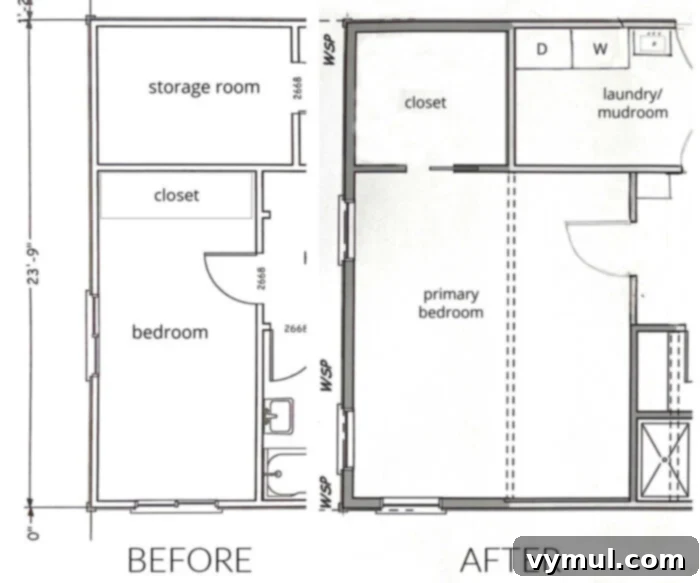
Our vision for a spacious and functional primary bedroom on the first floor necessitated a significant structural change: bumping out the back of the house. The original room was incredibly narrow, measuring a mere 7.5 feet wide. When we first toured the farmhouse, a queen bed was squeezed into this space, but its head and foot almost touched the opposing walls. This layout meant that one person literally had to climb over the other to get in and out of bed – a far-from-ideal situation that made the room feel incredibly cramped and impractical for daily living.
Initially, we believed an additional eight feet would be sufficient to transform this restrictive space into a truly spacious primary bedroom, complete with the coveted walk-in closet. As shown by the dotted lines on the floor plans above, we strategically allocated two of those eight feet to widen the adjacent main bathroom, further enhancing the functionality of our main floor. An eight-foot extension sounds straightforward, doesn’t it? After all, you frequently read about homeowners effortlessly adding a few feet here and there to their homes. We quickly learned that “easy” is a relative term in the world of renovation, especially with an older home.
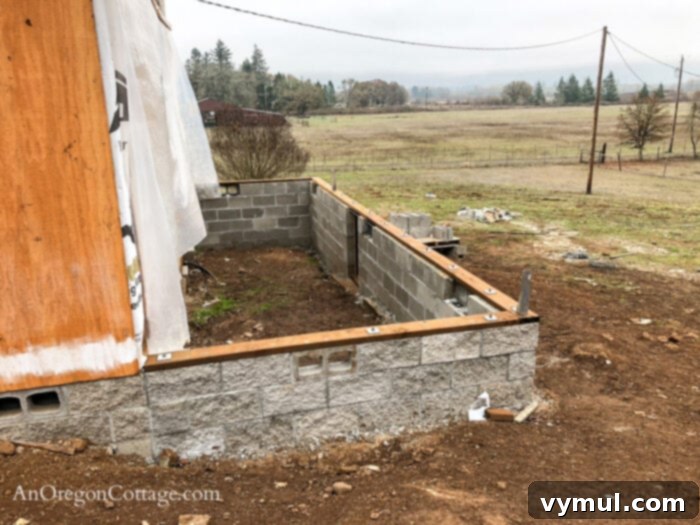
However, anyone who has navigated the bureaucratic maze of county or city building permits can attest that there is absolutely nothing “easy” about such an undertaking. The process proved to be a lengthy and often frustrating ordeal. This complex permitting process, coupled with the challenges of coordinating skilled professionals, led to both the foundation work and the bump-out extension taking an entire year to complete. We had to diligently search for architects to draw up the precise plans, meticulously obtain all the necessary permits, find experienced contractors for the foundation work, and then secure a team to construct the new framing for us.
Each step presented its own set of hurdles. Finding reliable, experienced people proved difficult. The county initially raised objections to our proposed plans, necessitating revisions. Furthermore, adding a new foundation to a century-old house presented unique engineering and construction challenges that few professionals seemed to readily know how to tackle. It was a true test of patience and perseverance, but ultimately, our determination prevailed.
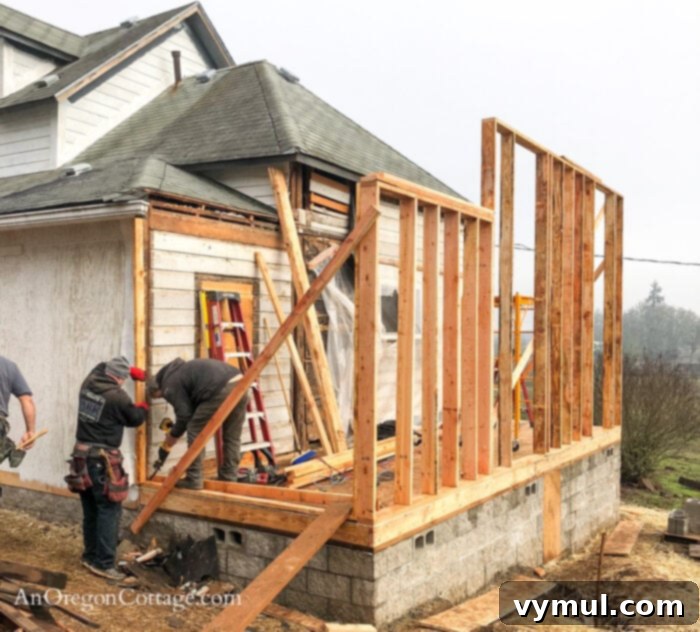
Despite all the obstacles and delays, we successfully navigated the external construction phase, completing the foundation and framing of the extension. This significant milestone finally brought us to the most exciting part for us: the interior finishing work, where our vision for the primary bedroom could truly begin to take shape. It was a moment of immense relief and anticipation, as we were finally able to put our personal stamp on the space.
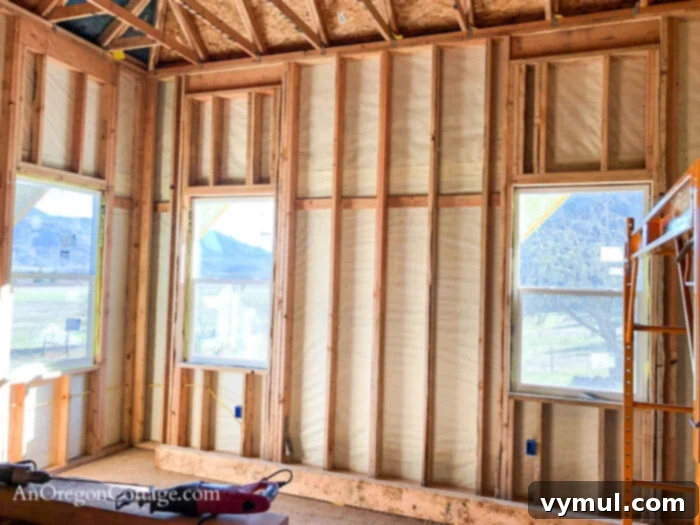
Which brings us to the major thing I regret from this entire renovation project:
Unnecessarily raising the ceilings beyond the already generous 9-foot height we had in the original farmhouse structure.
Our primary bedroom now boasts an impressive 11-foot high ceiling. I believe the primary reason I impulsively said “yes” to the builder’s suggestion, without truly thinking through the implications, was the pervasive influence of social media. We are constantly inundated with images of dramatic, soaring ceilings on platforms like Instagram and Pinterest, where everyone “ooohs” and “aaahs” over their majestic beauty. It’s easy to get caught up in the allure of what looks good online.
However, once I gave the go-ahead, the problems and unforeseen expenses directly associated with that extra two feet of ceiling height began to accumulate rapidly and relentlessly:
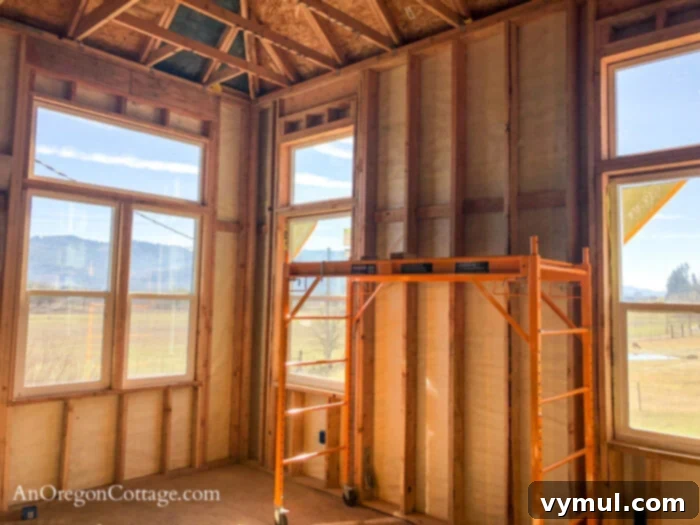
- Once the standard 3×5 foot windows were installed, they appeared disappointingly small and disproportionate within the vast expanse of the 11-foot walls (you can see this clearly in the photo above). To rectify this, we had to purchase additional transom-sized windows and incur the significant cost of having them installed above the existing ones, adding another layer of complexity and expense (see photo below).
- All the electrical wiring had been roughed in at the standard 9-foot ceiling level. This meant extensive rework was required, including extending all existing wires and adding another junction box in the small attic section that remained – more labor, more materials, more cost.
- The elevated ceiling meant we completely lost all the precious attic storage space that would have otherwise been directly above the room. This was a particularly painful loss, as it represented about the only potential storage area in the entire, otherwise storage-limited, farmhouse.
- To simply work on the higher walls and ceiling, we had to invest in specialized equipment: a much taller ladder and a rolling scaffold. These were not only additional expenses but also cumbersome to maneuver and store.

- The cost to finish the walls was approximately 25% more than it would have been with standard 9-foot ceilings, simply due to the increased surface area and labor involved. Furthermore, the additional trim required for the now-extended windows significantly inflated the price, especially since we chose to use high-quality finger-jointed pine for its durability and classic aesthetic.
- The price of custom curtains to adequately fit the now approximately 10-foot long windows was astronomical. To avoid this exorbitant cost, I ended up purchasing linen and blackout fabric and painstakingly making some simple panels, which are merely clipped to rings. And yes, you can imagine the grumbling and frustration involved in handling those enormous swaths of fabric!
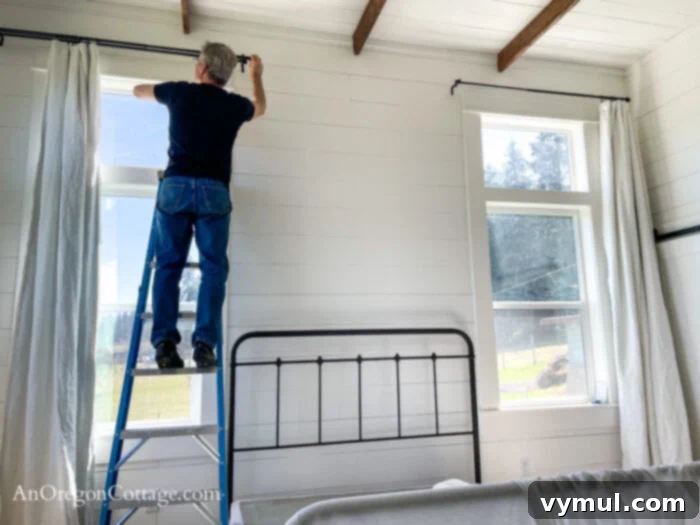
- Hanging curtains is rarely a fun task, but performing it at an increased height compounded the difficulty and turned it into a truly exhausting endeavor.
- Every single time you need to perform a routine task – changing a light bulb, reattaching a fallen curtain clip, or even simply dusting a cobweb – you are forced to retrieve and set up the special tall ladder or scaffold, making even minor maintenance a significant chore.
While I acknowledge the undeniable beauty and impressive look of the high ceilings, and we do enjoy the grand feeling they impart, I would honestly never opt for such a design choice again in a future renovation. This decision, I’ve realized, inadvertently made the room feel too distinct and somewhat out of sync with the simpler, more humble character of the rest of our farmhouse – an important consideration I completely overlooked in the initial excitement of the builder’s suggestion.
Farmhouse Primary Bedroom Before and After: A Visual Journey
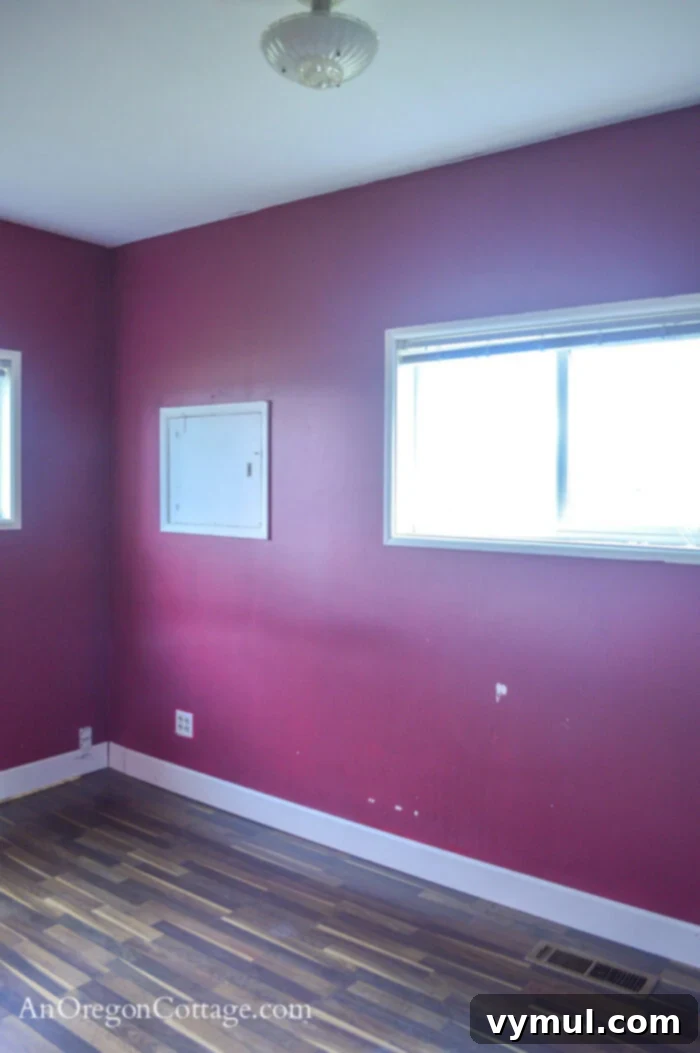
This image captures the back wall of the primary bedroom as it appeared from the doorway before our extensive renovation began. It gives you a sense of the original, somewhat enclosed space.
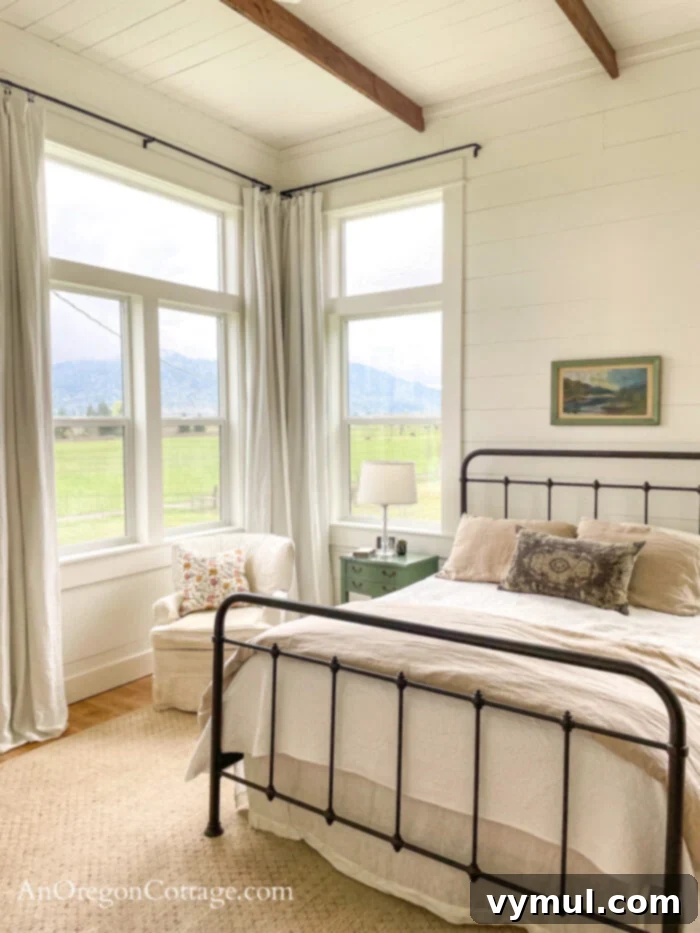
And here is the same captivating view after the transformation. It’s immediately evident why we were so eager to open up this room to the stunning exterior views! The large windows now perfectly frame the natural beauty outside, bringing it directly into our living space. To add a touch of classic farmhouse character and to help visually “cozy up” the expansive tall ceilings, I undertook a DIY project: distressing and staining 2×6-inch fir boards to mimic exposed rafters. It’s a detail that beautifully complements the farmhouse aesthetic. You can watch our video showing how we accomplished this easy DIY project here.
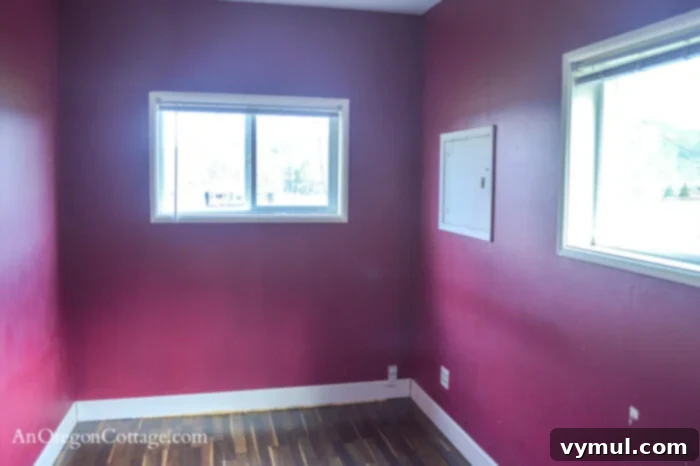
The photograph above vividly illustrates just how incredibly narrow the original room truly was – a mere seven and a half feet across. It highlights the necessity of our bump-out expansion to create a functional and comfortable primary bedroom.
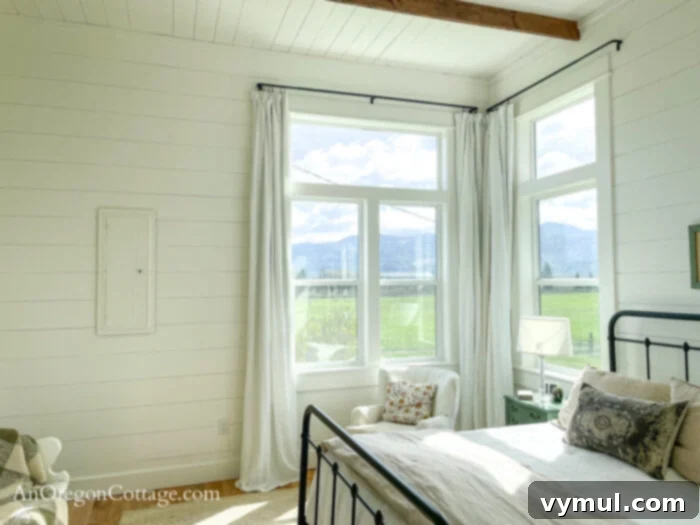
This is the same east wall now, completely transformed. Unfortunately, stringent building code regulations prevented us from placing a window any closer than four feet to the main electrical box. The cost and complexity of relocating the entire electrical box to the other side of the house were prohibitive, so we found ourselves with an unavoidable electrical box in our primary bedroom. However, my clever husband, Brian, is currently designing a custom ladder that will elegantly hold blankets and quilts, effectively concealing the box. I envision this creative solution not only as a functional cover but also as a lovely, colorful accent piece that will add to the room’s unique charm.

This image shows the other side of the room before the renovation, featuring the original built-in closet shelving. While it was a practical use of space for its time, its condition clearly indicated it had seen better days and was ready for a modern, functional update.
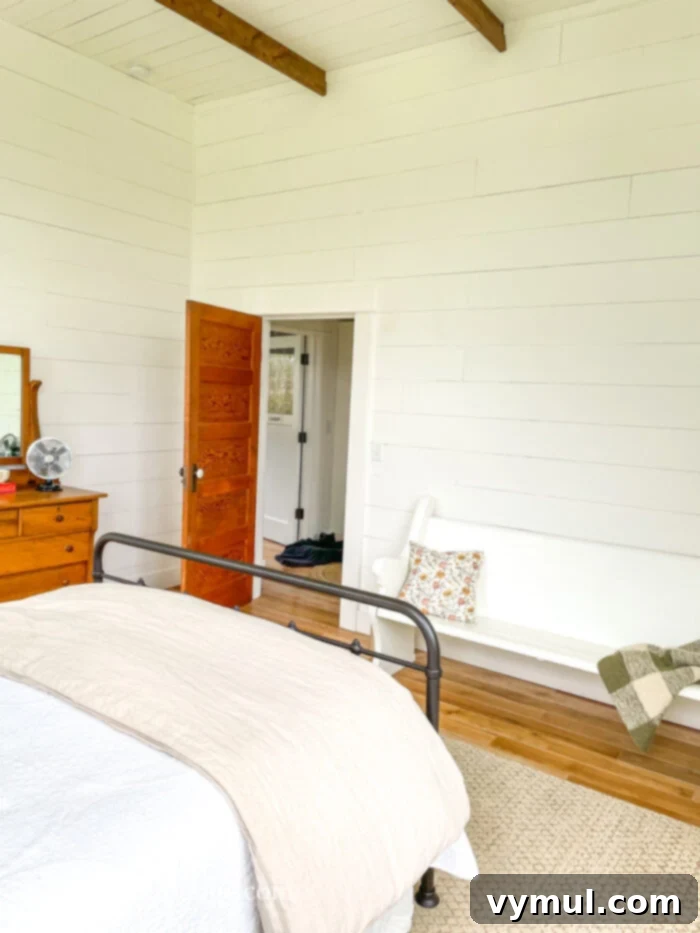
I believe this “before and after” comparison of the door leading into this room provides one of the most striking illustrations of just how significantly higher the ceiling is now. It truly emphasizes the sheer verticality of the space: so much wall! Despite the challenges associated with the high ceilings, I absolutely adore the rich contrast created by the old, salvaged wood door and the vintage dresser in this room. These pieces add immense character and a sense of history. The new wood floors, which seamlessly extend from the rest of the house, also contribute to the cohesive and warm aesthetic.
I do wish our old church pew were still its original wood finish, but it had to live on our porch at our previous house, where it sadly began to deteriorate. To save it from complete ruin, we diligently screwed, filled, and patched it, necessitating a painted finish. It definitely needs a new color, though – I’m still contemplating the perfect shade to complement the room. Oh, and I’m currently curating a collection of thrifted and vintage oil-painted landscapes for a gallery wall above the pew. This display will not only add visual interest but also help break up the expansive white wall space, infusing the room with more personality and warmth.
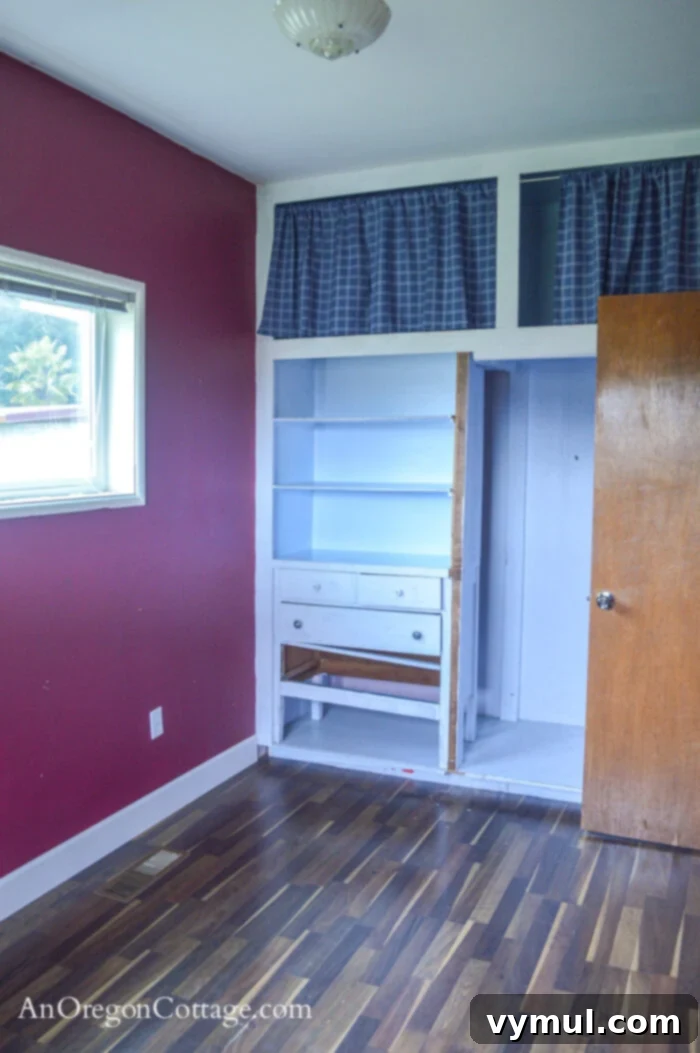
Here’s another perspective of the original closet wall before its transformation, showcasing the limited space and outdated design.
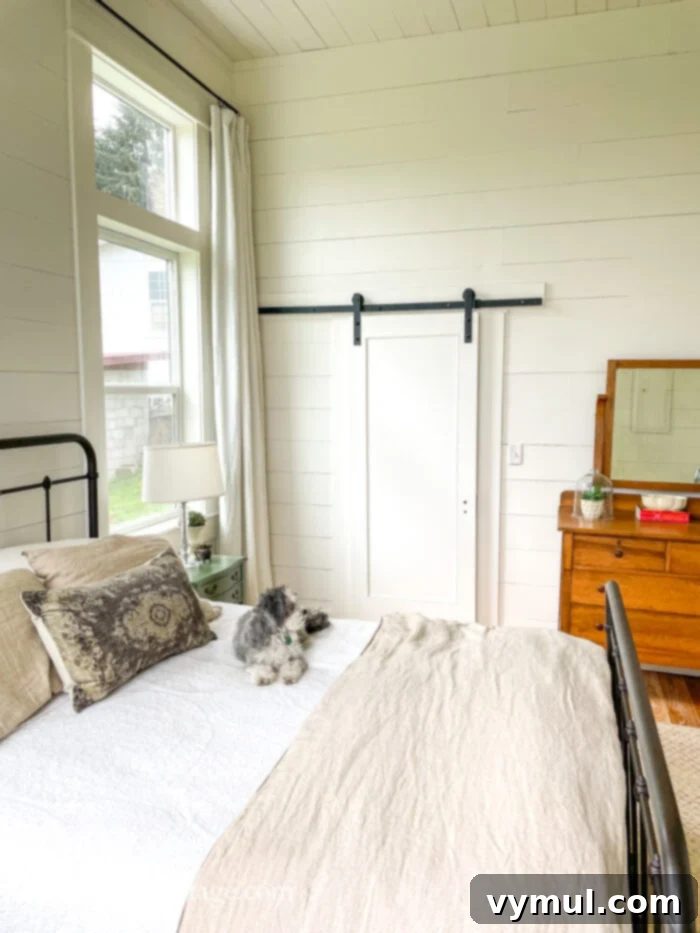
And this is the same wall after the renovation – though it’s important to note that the original wall ended roughly where the dresser is now positioned. The crucial eight feet we added with the bump-out extension provided us with the necessary space to create this beautiful and functional walk-in closet, a feature we desperately needed. During our search for vintage doors from a house being remodeled in town (you’ve already seen two of them stripped and repurposed as the entry door to this room and the main bathroom), we stumbled upon a gem: a single-pane door with a full-length mirror elegantly inset on the other side. Score! I instantly knew it would be absolutely perfect for the closet door, with the mirror facing inwards for practical use. We hung it with classic barn door hardware, and I truly LOVE having that mirror conveniently located right where I get dressed each morning. (Note: I’m still on the hunt for a period-appropriate vintage knob that would perfectly complement this door and its character!)
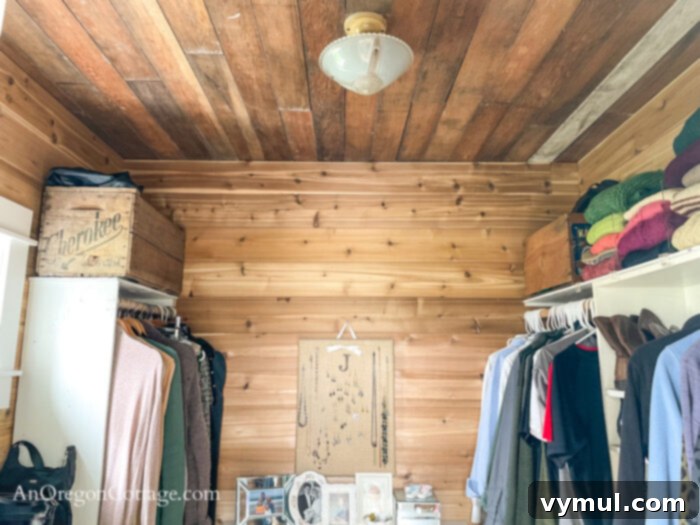
Inside the walk-in closet, we opted to line the walls with aromatic cedar tongue and groove planks. This choice was only marginally more expensive than hiring someone to tape and mud sheetrock, and it offered a significant advantage: we had been experiencing problems with moths in another old house on the property, so the natural moth-repelling properties of cedar were a huge draw. The ceiling of the closet was beautifully clad in reclaimed wood that my brother ingeniously sourced (and graciously installed for us, along with the cedar!).
A Funny Story About the Light Fixture:
In the video tour, I confidently mentioned that this charming closet light was the original fixture we had discovered in the primary bedroom – because, at the time, that’s genuinely what I believed!
However, as Brian was meticulously editing the video footage, he had a hilarious realization: we had inadvertently installed a vintage light fixture that my friend had specifically bought for us right here in the closet! And, to add to the comedy, the actual original bedroom light had ended up being installed in the pantry!
Oops. Yep, if you scroll back up through the photos, you can indeed see that they are not the same fixture. It was a classic “oops” moment in the chaos of renovation. Oh, well, at least we DID reuse the original, just not quite in the sentimental spot we thought we did!

Here’s another favorite feature within our walk-in closet, a truly wonderful last-minute addition: this small, square window. It is absolutely WONDERFUL not to have to switch on an artificial light in the middle of the day when you pop into the closet to grab something. Furthermore, it’s incredibly nice to have the soft, natural light illuminating the space when you’re trying on clothes in the mirror, providing accurate colors and a pleasant ambiance. Plus, beyond its practical benefits, isn’t it just incredibly cute and charming, adding a touch of unexpected delight to the space?

The final “before” shot once again provides a glimpse of the back wall, which, through our dedicated efforts and the strategic bump-out, has been completely transformed and now presents this stunning view:
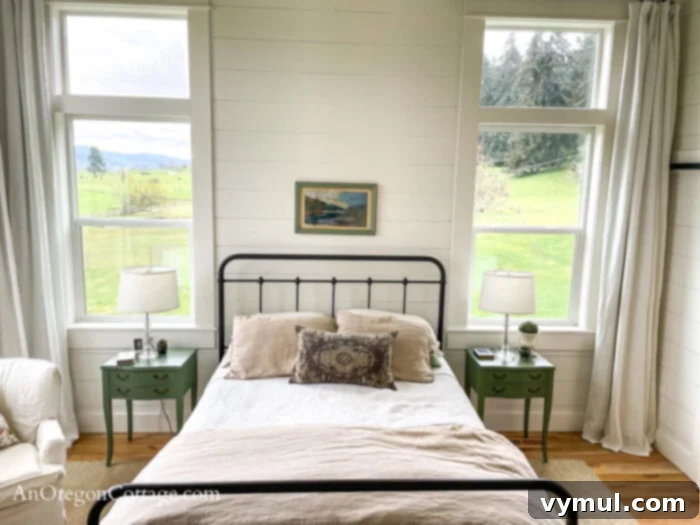
No, I assure you, I absolutely do not get tired of gazing out of these expansive windows! They offer a constantly changing, beautiful vista that brings so much life and tranquility into the room. The vintage watercolor painting positioned above the bed was a fortunate find years ago at an antique store; I was delighted to discover that its frame was already painted that perfect shade of green. It was one of those serendipitous moments when I hung it up and realized it coordinated flawlessly with the custom-painted green nightstands, creating a cohesive and serene aesthetic.
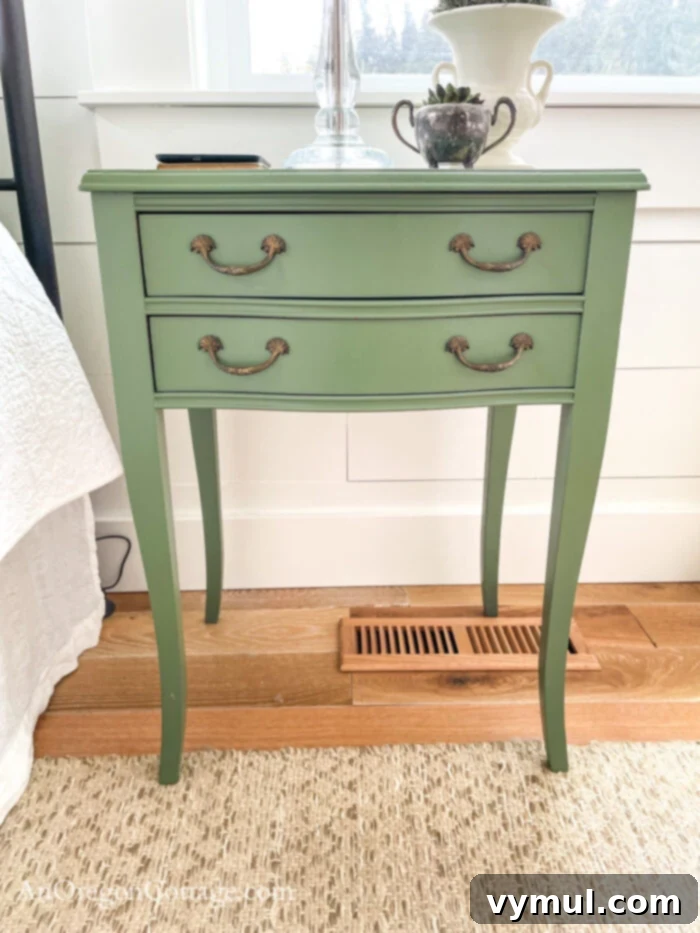
Speaking of the nightstands, they represent another one of our favorite DIY projects from this renovation, one that turned out significantly better than I had ever anticipated.
I had fully intended to create a comprehensive before-and-after feature for this project, complete with all the initial photos, but somehow, I’ve managed to lose every single “before” picture – seriously, arrrgg! So, you’ll have to use your imagination to picture these charming side tables. They originally belonged to Brian’s grandmother, then his mother, and in their initial state, they featured a peeling and faded brown wood finish. They also had a practical but visually heavy shelf positioned about halfway down the legs, and, to my personal dismay, three sides of rather “frou-frou” scalloped edges bordering the tabletop. The scallops were simply too ornate for my taste, and shelves, in my mind, mostly just collect dust. My goal was a look that was simple, elegant, and timeless. In fact, when they were first offered to us, I politely declined the tables. That is, until I began researching the cost of acquiring both new and old nightstands. Yikes, things are expensive!
So, we decided to give these family heirlooms a new lease on life. Brian skillfully cut off both the shelf and the scalloped edges. After that, I diligently filled any remaining gaps with wood putty and then spent a considerable amount of time sanding them down to a smooth, refined finish. I began the painting process by spraying them with a high-quality primer. It was truly a moment of revelation when I sprayed them with the same custom green paint I had used for our kitchen island and main bathroom cabinet. Suddenly, I could envision precisely how wonderful and elegant they were going to look (by the way, I used this same inexpensive handheld paint sprayer that I previously reviewed, and I’m happy to report it still works great all these years later!). The original brass pulls, with their years of beautiful, natural patina, are just the perfect finishing touch. Sigh. They look incredibly pretty against that vibrant green, don’t they?
Farmhouse Primary Bedroom Sources
Below, you’ll find a comprehensive list of sources for materials and decor used in our primary bedroom renovation. I’ve done my best to link to exact products or very similar alternatives where the original is no longer available.
Paint for Walls and Trim: Simply White, Benjamin Moore (We had it matched at Home Depot with Behr Premium paint for durability and cost-effectiveness)
Green Paint for Nightstands: Custom green, named ‘Boxwood’. I had this mixed according to the specific formula found in this helpful article on Miss Mustard Seed’s blog
Window & Door Trim: 1×4″ primed finger jointed pine boards (chosen for their stability and smooth finish)
Wood panelling for walls: Utility Panel, 1/8 in. x 4 ft. x 8 ft (a great way to add texture and character)
Flooring: 3/4″ Viking Hardwood Essence Oak 5″ Wide 3/4″ Thick Solid Hardwood (regrettably, this exact product is no longer available). You can find similar solid hardwood options on this page at FloorsToYourHome.com (They provide awesome service and a wide selection, I really recommend checking there to find something that suits your needs)
White Ceiling Fan: Our exact model is no longer available, but this Hunter Dempsey LED Ceiling Fan is a very similar style and functionality.
Metal Vintage Style Bed: My exact metal bed frame is no longer available, but this is a similar style from the same retailer where I originally purchased ours (Alternatively, if I were buying today, I might even go for this fun and unique style now).
Bedding: Queen Linen Bed Set from H&M (they consistently offer some of the best prices for quality linen!)
Decorative Pillow: The exact cover is an old Pottery Barn item that is no longer sold.
Barn Door Hardware: SmartStandard 6ft Heavy Duty Sturdy Sliding Barn Door Hardware Kit (a reliable and robust choice)
Curtain Rods & Clips: We used a Room Darkening Blackout Curtain Rod for functionality and paired it with 1.26 diameter curtain rings with clips for easy hanging and a clean look.
Linen Fabric (for DIY curtains): Middle weight bleached linen from Fabrics-store.com (excellent quality for DIY projects)
Blackout Lining (for DIY curtains): Hanes Drapery Lining Blackout Eclipse White (essential for achieving a dark sleeping environment)
Be sure to let me know what you think of our extensive primary bedroom renovation in the comments section below or connect with us on Facebook or Instagram! If you know someone who’d enjoy following our farmhouse renovation series, please feel free to share this post – your support and engagement mean the world to us!

MORE ABOUT THE 1900 FARMHOUSE RENOVATION
Interested in seeing more of our journey restoring this charming 1900s farmhouse? Explore these additional posts detailing other parts of the property and our ongoing progress:
- Our New Farmhouse Fixer – The Comprehensive Before Tour
- Exterior Farmhouse Fixer Before Tour: Unveiling the Potential
- Farmhouse Fixer Yard Tour Before: A Blank Canvas
- Farmhouse Fixer Year 2 Review + Video: Progress and Insights
- Farmhouse Progress Year 3 (+ Full Tour): Significant Strides
Disclosure: This article contains affiliate links, which means I may earn a commission on sales made through these links. This does not, however, alter your purchase price. Your support helps sustain this blog and allows me to continue providing valuable content. Please click here to read our full disclaimer and advertising disclosure policy for more information.