Your Monthly Guide to Good Things: Travel, Reads, Home Finds, and More
Welcome to our monthly roundup of delightful discoveries and cherished experiences! Each month, we curate a list of exceptional things to see, meaningful stories to read, practical items to buy, and engaging content to watch. This edition brings you highlights from a breathtaking national park adventure, a surprising pain relief solution, a handy pet gadget, and a collection of honest book and movie reviews.
Please note: Some links in this article are affiliate links. If you click on them and make a purchase, I may receive a small commission at no additional cost to you. These commissions help support this blog and allow me to continue sharing valuable content.
Happy July, everyone! Here in the Pacific Northwest, we’re finally embracing the full swing of summer – though our recent trip reminded us that even summer can come with unexpected rain, as you’ll read below! Despite a few soggy moments, the season is truly upon us, bringing with it a sense of vibrant growth and cherished family time.
Every morning, I find immense joy in strolling through our thriving garden. It’s a true pleasure to witness the daily transformation and abundance it offers. Just this morning, I harvested a sweet onion, a generous handful of crisp peas, tender broccoli florets, and fresh lettuce, along with a beautiful selection of cutting flowers to create a cheerful table centerpiece. There’s something incredibly grounding and satisfying about cultivating your own food and beauty.
Looking ahead, we’re eagerly anticipating some precious family moments this month. Our calendar is dotted with plans for relaxing days by the lake, joyful birthday celebrations, and plenty of delicious barbecues under the summer sky. It’s truly that special time of year when memories are made and bonds are strengthened. I sincerely hope your July is also filled with wonderful plans and many “good things” to look forward to!
Discovering Good Things This Month

An Adventure in North Cascades National Park & Stehekin
Recently, we embarked on a week-long road trip to the magnificent North Cascades National Park in Washington state. The drive was quite a trek for us, roughly eight hours northeast (and a slightly shorter seven hours heading home via the western route). This park holds a unique distinction as one of the least visited national parks in the United States. Its remoteness and challenging accessibility contribute to its pristine, untouched feel; the most dramatic vistas of these “American Alps” often require hours or even days of strenuous backpacking.
However, even for those preferring less arduous excursions, like our family, there’s still an incredible amount of beauty to absorb. Shorter hikes and scenic drives offer stunning perspectives of the rugged, glacier-capped peaks and verdant valleys that define this region.
The North Cascades isn’t just one park; it’s an intricate complex. It comprises the main national park, thoughtfully divided into northern and southern units by the North Cascades Highway, along with two distinct national recreation areas: Ross Lake and Lake Chelan. This map provides a clear illustration of its impressive scope.
Our adventure began at Lake Chelan, where we left our vehicle to embark on a picturesque ferry ride. Our destination was the far end of the lake, home to the charming, secluded town of Stehekin, nestled within the southern reaches of the North Cascades National Park Complex. The ferry journey itself was an experience, taking about 1.5 hours just to reach the Stehekin Lodge where we had reservations. We started our ferry ride midway up the lake, which stretches a remarkable 50 miles in total! From the lodge’s deck, we were greeted with a view that instantly took our breath away:
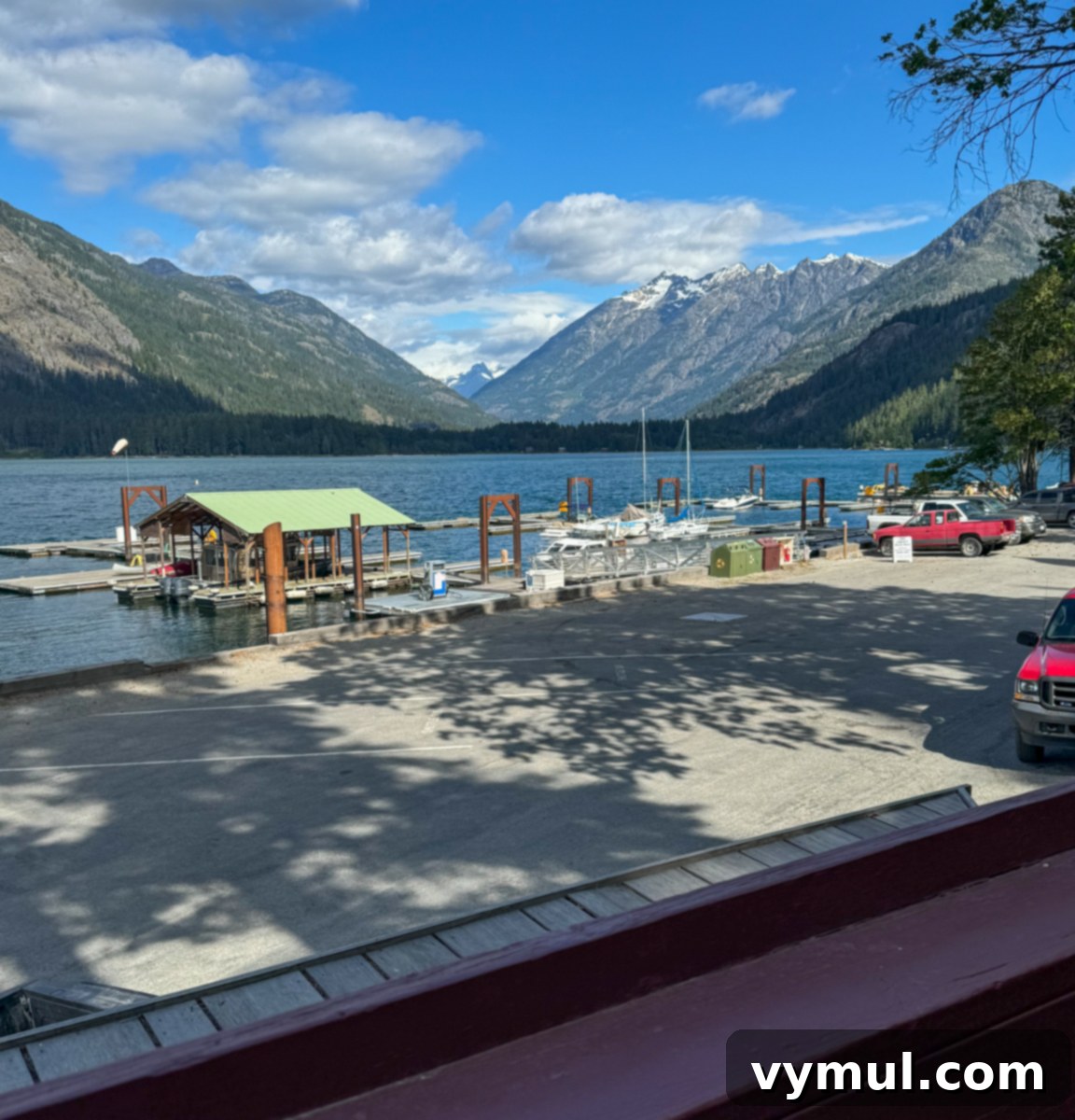
Our room also boasted a similar, awe-inspiring view, and the weather during our two-day stay there was absolutely perfect. I wholeheartedly recommend Stehekin Lodge – the rooms were comfortable, the staff exceptionally friendly and helpful, and the restaurant served delicious meals. Since visitors aren’t permitted to bring cars to Stehekin (though locals do have them), we opted for a guided tour to maximize our sightseeing in the limited time we had. This immersive tour allowed us to explore various fascinating landmarks, including a historic 1912 homestead complete with a thriving apple orchard, the quaint one-room log cabin schoolhouse (and the newer one-room school still in active use today), and the truly spectacular Rainbow Falls:

After our memorable time in Stehekin, we journeyed back down Lake Chelan by boat and then headed north through the park along scenic Highway 20. This route treated us to continuous views of the craggy, imposing mountains that truly define the “American Alps” moniker:
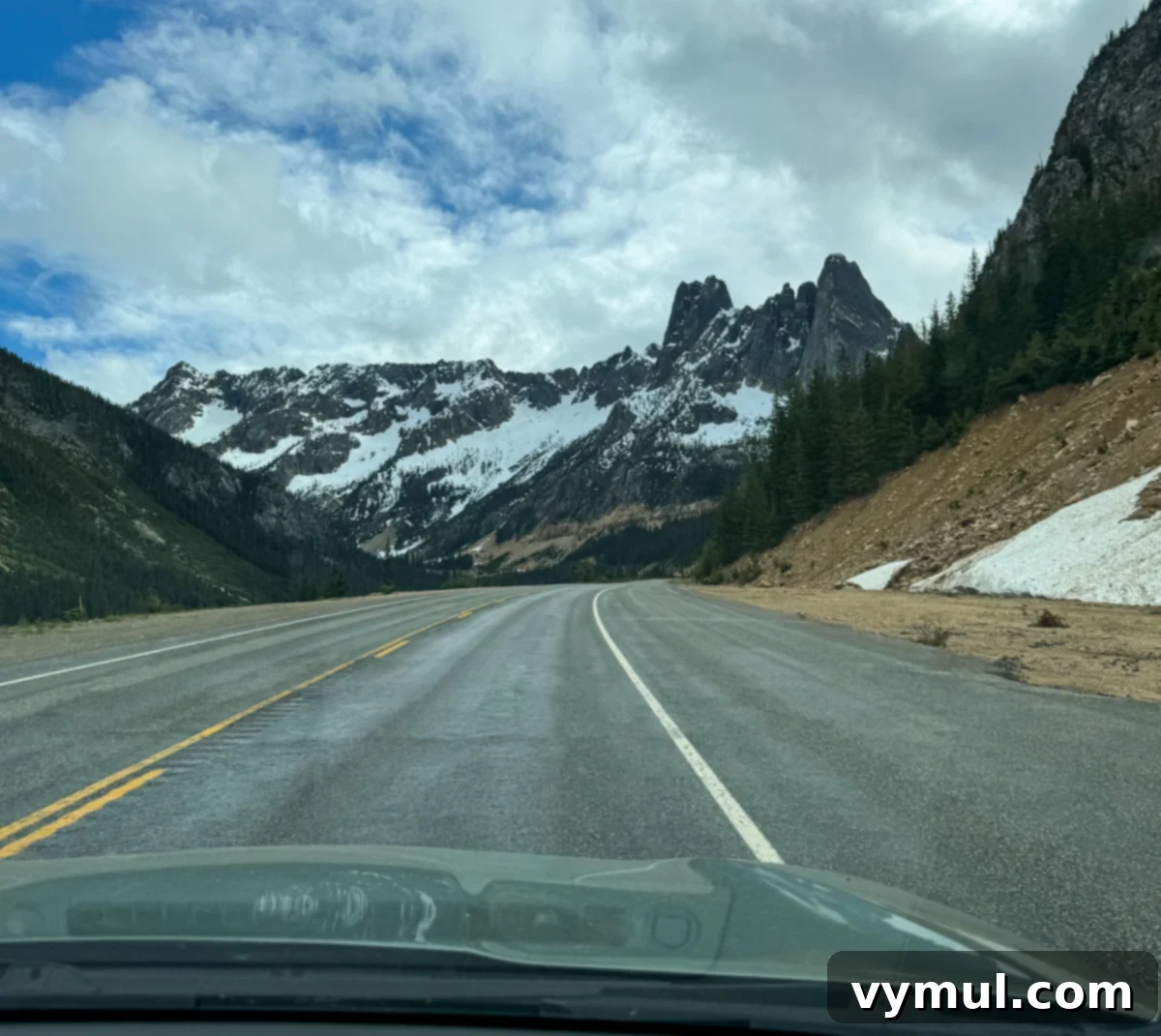
We made frequent stops at various lookouts and scenic overviews, though we didn’t take many photos initially. Our plan was to return the following day for several shorter hikes in the area, anticipating even more breathtaking photo opportunities.
However, those clouds you can observe in the pictures? The next day, they intensified significantly. They grew larger and, unfortunately, descended lower, ultimately obscuring all the majestic mountain tops we had just driven over eight hours to witness. To add to the dramatic scene, the rain at lower elevations even added a fresh dusting of snow to the peaks above stunning Lake Diablo:

Yes, while much of the rest of the country was sweltering under heat domes, we in the Pacific Northwest found ourselves bundling up! Despite the uncooperative weather, we managed to squeeze in a couple of hikes. One memorable trek led us up to “Thunder Knob,” offering intermittent views of the lake – and on occasion, glimpses of the mountains through the shifting clouds:
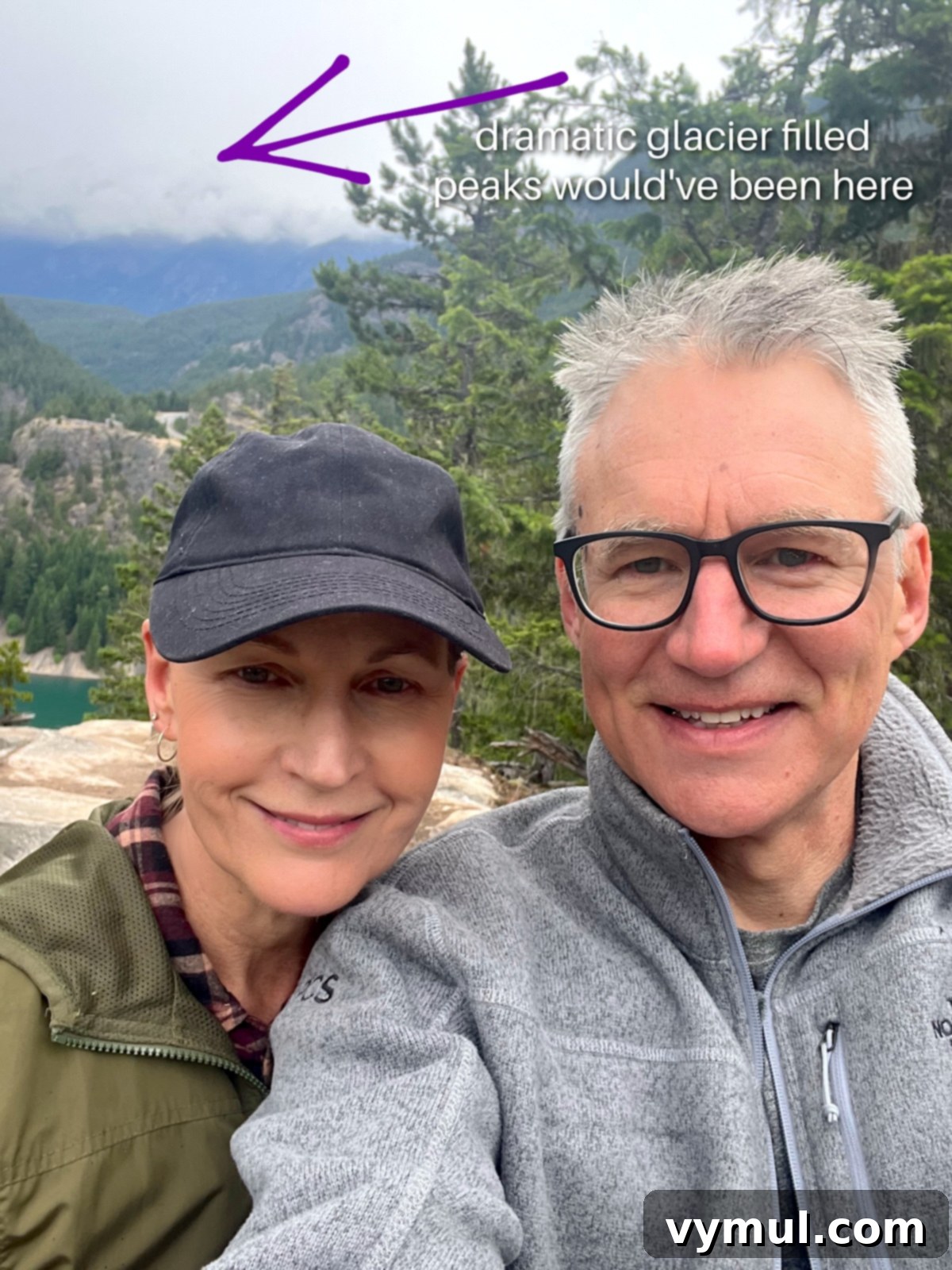
This cloudy, rainy pattern persisted for the entirety of our two planned hiking days. However, I’m incredibly grateful we had those initial days with beautiful, clear weather at Stehekin. The entire region is undeniably stunning, and even with the less-than-ideal conditions, we enjoyed exploring many interesting small towns along the way. The charming, western-themed town of Winthrop, in particular, left a lasting impression. So, despite our rainy interlude, I absolutely recommend a visit to the North Cascades if you ever get the chance – its natural grandeur is truly unforgettable!
Effective Pain Relief for Sore Hands
I believe I mentioned this incredible find to my newsletter subscribers a few months back, but it truly bears repeating because it has made such a significant difference in my life. This particular essential oil blend has genuinely worked wonders on my hands. For several years, I’ve struggled with persistent aching in my hands, especially after knitting for extended periods. The relief it provides is, frankly, nothing short of amazing to me!
Initially, I was skeptical. Could simply rubbing essential oils on my skin truly alleviate such consistent pain? To truly put it to the test and confirm its effectiveness, I deliberately held off on reordering when my first bottle ran out. The result? The noticeable pain that had been absent for months returned in full force! This unequivocal experience prompted me to immediately order two more bottles, especially since they were on sale. It seems almost unbelievable, yet the myriad positive reviews from people experiencing similar relief corroborate my own experience. I can confidently say I won’t be without it again.
A small but important caveat: My dad, a keen golfer, experiences a great deal of arthritic pain in his hands. He recently tried this same essential oil blend, but unfortunately, it didn’t provide him with the same level of relief as it did for me. This suggests that while it’s incredibly effective for some, it might not be a universal solution for everyone. However, given that it’s an affordable option, I wholeheartedly believe it’s worth trying to see if it brings you the same surprising comfort it brought me.
Taming the “Yippy Dog” with Sound Relief
Our sweet little dog, Jynx, possesses a bark that, while full of spirit, can be incredibly piercing and shrill. If you know what I mean, it’s the kind of high-pitched yelp that seems to cut right through you. What makes it particularly challenging is her tendency to bark at virtually everyone – even at my husband, Brian, when he simply walks through the door before she fully registers his presence. Furthermore, Jynx doesn’t always stop on her own, even when faced with someone she knows intimately. Often, I literally have to pick her up to get her to cease, which isn’t always feasible depending on the situation.
So, when a friend enthusiastically recommended a sound-based anti-barking device that had proven effective for their own dog, I was eager to give it a try with our little Jynx. I appreciated its simple design and, crucially, that it’s rechargeable – a significant preference over models that rely on multiple AAA batteries, which often feel excessive for such a compact gadget.
After using it for a while, I can report that this device genuinely helps to slow down her barking and significantly reduces the intensity of her loudest yelps. While it doesn’t halt her barking entirely – I often need to press the button multiple times for her to finally settle – it provides much-needed intervention. Unlike my friend’s experience, where her dog seemingly learned to bark less over time, Jynx doesn’t appear to retain the “lesson” to reduce her overall barking frequency. However, I am more than happy for any assistance in managing her vocal outbursts. For anyone dealing with similar barking issues in their canine companion, I believe this device is absolutely worth the investment, offering a quick and harmless remedy to a common pet challenge.
June Reads: A Literary Journey
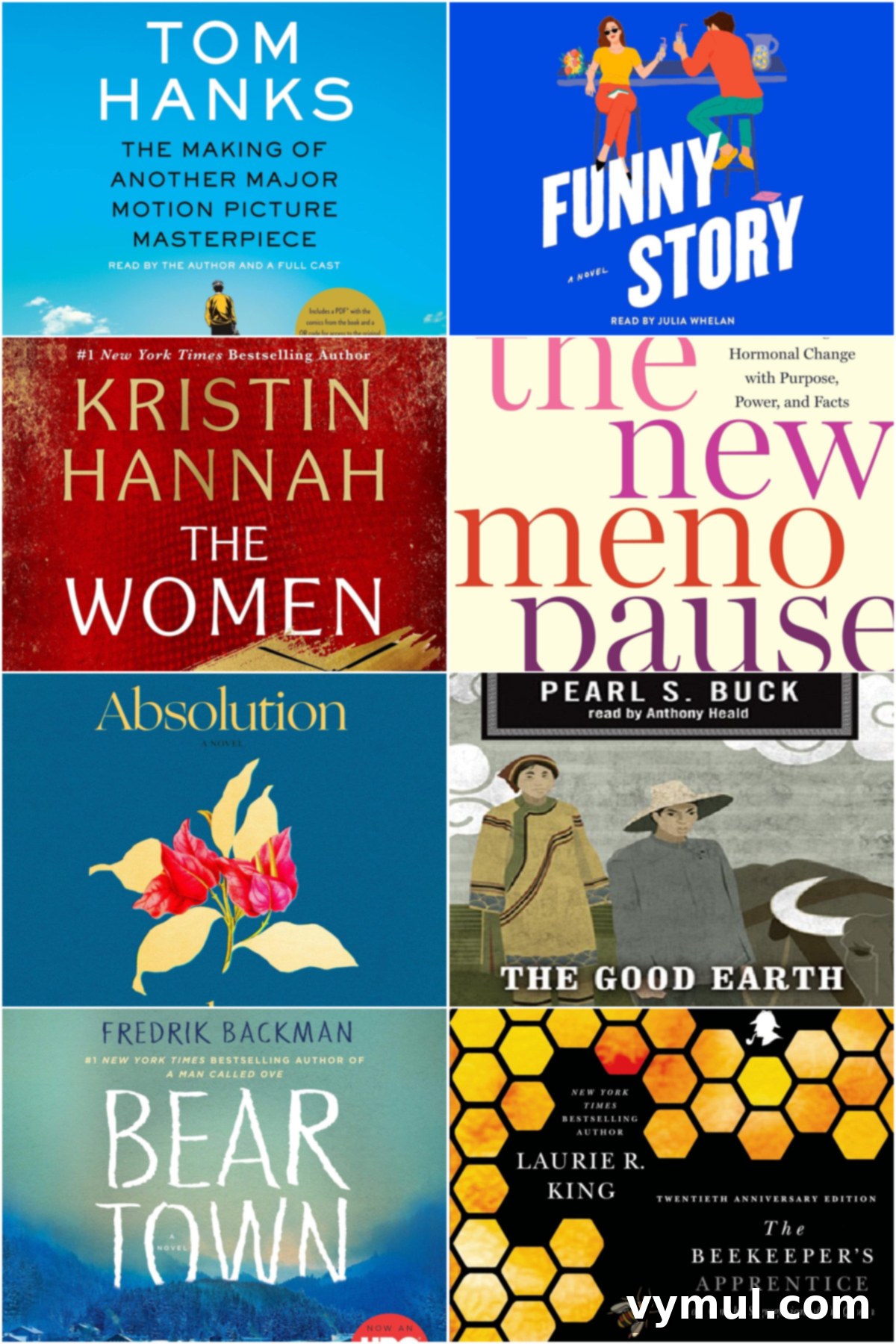
This past month was filled with a rich array of books, each offering a unique journey. Here’s a look at what I delved into:
The Making of Another Motion Picture Masterpiece, Tom Hanks. I thoroughly enjoyed this insightful and entertaining read, especially listening to the audiobook, which was narrated by Tom Hanks himself. The story spans over 50 years, beginning before World War II, intricately weaving together characters whose lives culminate in the creation of a movie based on a WWII graphic novel. Hanks, with his extensive experience, clearly understands the nuances of a movie set. While some of the technical filmmaking details were complex, it was all incredibly interesting to learn how a major motion picture comes to life, and the various challenges that can arise. I particularly admired the way he skillfully connected seemingly disparate threads, revealing their profound relationships by the story’s end.
Funny Story, Emily Henry. While I’ve enjoyed Emily Henry’s previous works, her last novel, Happy Place, didn’t quite resonate with me. This one, however, I absolutely adored – it might even earn a spot on my year-end favorites list! The book possessed genuine emotional depth (though the initial scene of the protagonist discovering her fiancé’s infidelity and throwing objects at his car felt a bit overly cinematic). I could truly empathize with the devastation the main characters experienced at the outset. The progression of their relationship felt gradual, authentic, and entirely believable. This novel beautifully tugs at the heartstrings, delivering all the elements we seek in a good romance: laughter, tears, profound joy, and enduring love.
The Women, Kristin Hannah. This book presents a complex challenge to review. As expected from Kristin Hannah, the writing is masterful, and her characters possess an undeniable grip on the reader, evoking deep empathy. Many scenes remain vividly etched in my mind, particularly the harrowing depictions of the medic outpost in Vietnam. This brings me to my dilemma: the narrative is relentlessly bleak, culminating in an ending that is, at best, only vaguely hopeful. It chronicles the journey of a young, naive woman who volunteers as a nurse in Vietnam during the early years of the war. Her experiences are overwhelmingly negative, punctuated only by the strong bonds she forms with other women. She faces deception, betrayal, loss, and ultimately, vilification upon her return home. The trials just keep coming. While I don’t demand constant sunshine and roses in literature, and I recognize Hannah’s powerful intent to highlight the forgotten sacrifices of these nurses, by the latter half of the book, I found myself questioning if anything positive would ever happen to this poor character. It’s a powerful but emotionally draining read.
The New Menopause, Mary Claire Haven, MD. This book is a much-needed and invaluable addition to the conversation surrounding menopause. Dr. Haven provides a refreshing perspective, integrating current studies and offering practical recommendations for women navigating all stages of this significant life transition. She expertly clarifies much of the confusing and often contradictory information that has previously circulated, presenting a truly helpful “toolkit” of strategies to address the various symptoms and challenges associated with menopause. Her central argument powerfully emphasizes the critical need for increased research and funding for women’s health at this stage, underscoring the profound and far-reaching effects of menopause. Furthermore, she advocates strongly for Hormone Replacement Therapy (HRT), clarifying its benefits and necessity at specific ages and stages, dispelling common misconceptions.
Absolution, Alice McDermott. I had this book, set just before the onset of the Vietnam War and the burgeoning political tensions surrounding it, on hold for months based on an online recommendation. Coincidentally, it became available right after I finished The Women. While I wouldn’t typically choose two Vietnam-themed books consecutively, fate had other plans. This novel focuses on the wives of the initial American personnel – intelligence officers and other military staff – deployed to Vietnam. It was an unusual narrative, primarily told through lengthy letters written over 40 years later, which made it challenging to follow at times. Certain aspects were unsettling, particularly the portrayal of the era and how wealthy American women interacted with the native population. While it told a story, I struggled to grasp its central purpose or overarching “why.” There was no satisfying closure or profound “aha!” moment for me, even by the conclusion. Every time I anticipated a clear plot development or a deeper reason for the narrative, the flashback simply revealed another segment of the story, leaving me with a sense that nothing truly significant transpired.
The Good Earth, Pearl S. Buck. This classic has sat on my bookshelf for literally years, a testament to its enduring presence. I finally committed to reading it during our recent trip. Honestly, I didn’t particularly care for it. Despite winning the Pulitzer Prize for Fiction in 1932, and offering a chronicle of a young farmer’s life in rural China spanning 30 years from when he takes a wife, its portrayal of humanity felt stark. The protagonist is a hard man, especially towards his wife, exhibiting only fleeting moments of compassion over the decades. They endure immense hardships – devastating weather, crop failures, and famine – yet also achieve incredible highs, eventually becoming a wealthy family, primarily due to his unwavering reverence for land above all else. Overall, I found it another challenging read, concluding with a rather sad fate for both the wife and the farmer.
Beartown, Fredrik Backman. From the acclaimed author of A Man Called Ove, a book that landed on one of my “best of” lists for its core themes of hope and love, comes Beartown. This novel is a stark contrast – not at all that kind of book. It tells a difficult story, unflinchingly presenting hard truths that leave little room for hope, though a thread of family love does manage to shine through. Beartown is a small, struggling rural town whose only perceived salvation lies in its junior hockey team (in this sense, it vaguely reminded me of Friday Night Lights). However, the narrative quickly descends into darkness as the town turns on the teenagers involved in a central conflict, placing an overwhelming amount of pressure and importance on the game over fundamental morality and what is right or wrong. This aspect of the story was particularly challenging to read. While it offers a somewhat resolved ending for certain plot points, I wouldn’t characterize it as happy. (There are two other books set in Beartown, but I don’t feel compelled to read them after this experience.)
The Beekeeper’s Apprentice, Laurie R. King. This is a fascinating 20-year-old book (and the first in a series that now boasts 18 books and counting!) that I only recently discovered. It ingeniously reimagines an older, “retired” Sherlock Holmes living a quiet life in the countryside, immersed in experiments, writing, and beekeeping. It’s there that he encounters a precocious, orphaned teenage girl named Mary Russell, whose intellect and deductive reasoning strikingly mirror his own. Recognizing her potential, he embarks on teaching her the intricacies of his craft. The story is told from Mary Russell’s perspective, chronicling their partnership from their initial meeting through her college years and the various cases they become involved in. I thoroughly enjoyed this unique take on the iconic character, feeling that the author did a remarkably believable job of emulating the style of Sir Arthur Conan Doyle’s Sherlock Holmes narratives while maintaining the integrity of Holmes’s character. It’s an intriguing premise executed with skill, though I don’t anticipate reading the subsequent books in the series.
Watching: A Critical Review of “Hitman”
Our viewing habits were quite limited last month, and unfortunately, the few things we did watch didn’t particularly impress us. However, there’s one film I feel compelled to address – “Hitman” on Netflix – not because it was good, but precisely because it’s garnering effusive reviews, and my family and I vehemently DISAGREED with its core message. In fact, we found it deeply problematic.
My husband, Brian, our daughter, and I watched it together (fast-forwarding through the explicit sex scenes, of course), and our consensus was unanimous: we simply could not condone a movie that seemingly suggests that killing people to achieve your desired outcome is acceptable. Seriously, the plot involves the protagonists killing two individuals, and especially concerning is the final murder, which the audience is apparently supposed to find humorous and applaud as the catalyst for the main characters’ getting together. This left us utterly bewildered.
What is going on? Why are so few reviewers highlighting this glaring issue? The characters commit murder and then, remarkably, go on to live a seemingly idyllic life. We see them later with two children, lightheartedly reminiscing about how they’ll eventually explain to their daughter how they met. The sheer cringe factor was off the charts.
It’s truly terrible, and I’m profoundly disheartened to continually read only positive feedback about this film – praising Glen Powell’s charm, his impressive impressions, and so on, completely glossing over the fundamental moral bankruptcy. Some critics have likened “Hitman” to classic film noir, where an ordinary person is inadvertently drawn into a life of crime. However, a crucial distinction in virtually every classic film noir is that crime never pays. The protagonists invariably end up in a worse state than when their criminal journey began, serving as a cautionary tale.
Is this truly where we’ve arrived as a society? Are we now expected to laugh and applaud characters who commit murder simply because the victims might be unlikable? It’s a disturbing trend. Ugh.
Okay, I’ll step off my soapbox now. After all, this is supposed to be a list of “GOOD things,” right? Ha!
That concludes another edition of our Monthly Guide to Good Things!
If you’re eager to explore more of my personal recommendations and discoveries, you can find all previous “Good Things Lists” here. I’d absolutely love to hear your thoughts – have you tried any of these recommendations, or do you have any “good things” you’d wholeheartedly recommend to me and other readers? Please share your insights in the comments section below!
Disclosure: This article contains affiliate links, meaning that if you make a purchase through them, I may earn a commission based on sales. Rest assured, this does not affect the price you pay. For a comprehensive understanding of my full disclaimer and advertising disclosure policy, please click here.