
The 13 Best Books of 2021: Your Ultimate Guide to Must-Read Novels and Nonfiction
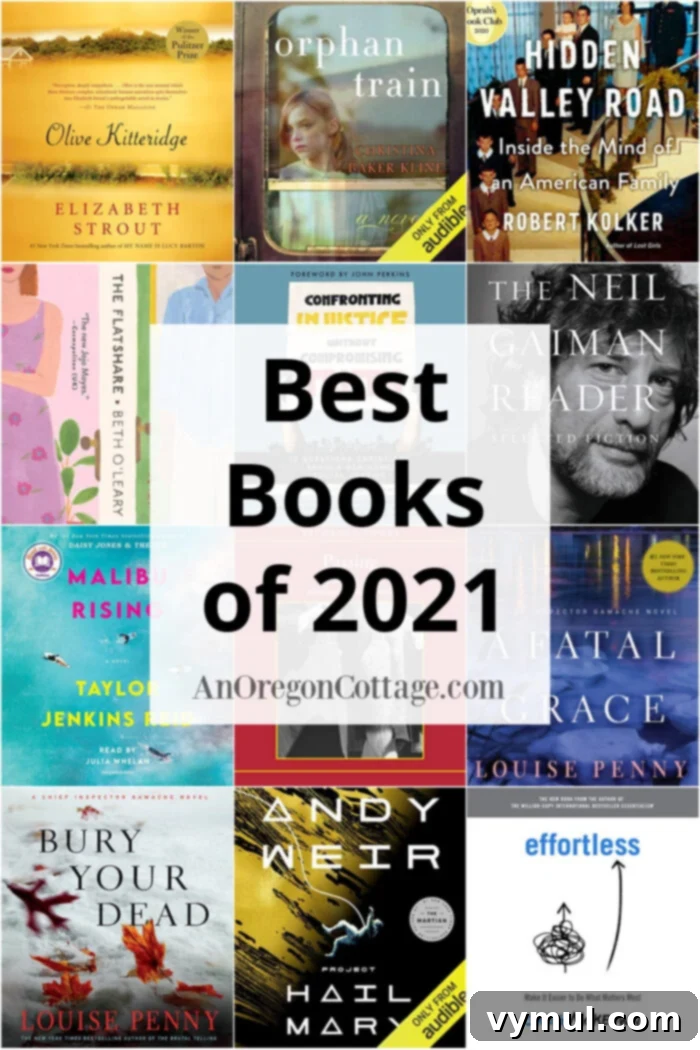
Dive into the top 13 books I enjoyed reading in 2021, featuring a diverse collection of genres including captivating historical fiction, thought-provoking nonfiction, engaging literary fiction, cozy mysteries, and imaginative sci-fi. There’s truly something here for every reader looking for their next great escape or insightful journey!
Some links in this article are affiliate links. If you click on them and make a purchase, I may receive a small commission at no additional cost to you. This helps support the content I create.
As the year came to a close, many readers reflected on their literary journeys, often describing 2021 as a “weird reading year.” For me, however, it unfolded much like any other, filled with a satisfying mix of compelling narratives, a few books I ultimately set aside (a practice I’ve happily embraced in my reading life), and a significant number of truly exceptional reads. My literary landscape for 2021 continued to be shaped by the genres I consistently gravitate towards: primarily historical fiction and Christian nonfiction, complemented by a selection of engaging literary and popular fiction titles.
Exploring New Literary Horizons: The Rise of Cozy Mysteries in 2021
Perhaps the most distinctive shift in my reading habits for 2021 was the surprising embrace of a genre I had previously overlooked: “cozy” mysteries. For years, fellow readers and beloved book bloggers had recommended various series, urging me to give them a try. Intrigued, I finally ventured into two highly acclaimed series: the Inspector Gamache series by Louise Penny and the Maisie Dobbs series by Jacqueline Winspear.
Initially, my intention was merely to sample the first book from each series, just to satisfy my curiosity and say I’d experienced them. However, as often happens with truly captivating stories, I found myself thoroughly drawn in. Two books from one series ultimately earned a spot on my coveted “best books” list, while the other series captivated me with its rich historical settings, intricately developed characters, and compelling mysteries.
These particular mystery series resonated with me in a way that typical thrillers or crime novels often don’t. Here are the key elements that made them stand out:
- Absence of Graphic Content: Foremost among my reasons is the complete lack of gory details or sensationalized violence. The focus is rarely on the act of the murder itself, which typically occurs off-page. Instead, the narrative centers on the intricate process of solving the case through intelligent deduction and investigation.
- Exceptional Character Development: Both authors excel at crafting deep, multifaceted characters. Even from the very first books, I found myself invested in their lives, eager to follow their journeys and uncover more about their backgrounds and motivations. This strong character focus creates a lasting connection.
- Stories Beyond the Case: Each book offers more than just a single mystery to solve. Often, additional subplots unfold, either related to other cases or exploring the personal lives and relationships of the recurring characters. This layered storytelling adds depth and keeps the reader engaged beyond the central puzzle.
- Immersive Settings as Characters: The settings are not mere backdrops; they become integral “characters” in themselves. Whether it’s the biting cold of a Montreal winter or the poignant atmosphere of post-WWI England, the environment is vividly portrayed, influencing the mood and progression of the plot.
My Personal Criteria for the Best Books of the Year
In 2021, I read or listened to a grand total of 90 books. My selection process for this “best books” list is quite straightforward, yet effective. I maintain a running list on my phone using a simple notes app. When I finish a book that I absolutely loved, I immediately mark it with an asterisk.
Want to supercharge your reading habit and enjoy more books, even if you feel short on “reading time”? (That elusive luxury, right?) Then be sure to explore last year’s best book list. There, I share the five practical strategies that helped me transform my reading habits from zero books in 2015 to consistently reading 90-100 books annually in recent years. It’s truly achievable!
Towards the end of the year, I revisit this asterisked list. I reflect on each title to see if it still holds the same impact and emotional resonance for me. If a book continues to stand out, it earns its place on the final “best books” list. Occasionally, I might also add a book that I didn’t initially asterisk but which has lingered in my thoughts, indicating its profound impact. Furthermore, I consult any notes I’ve diligently recorded in my Book Notes Journal – an excellent resource for preserving memorable quotes, insightful ideas, and key takeaways.
Remarkably, for the past four years, my final selection has consistently totaled 13 books. This year, as I finalized the list, it was 13 again! You might think it was planned, but it’s a happy coincidence.
My criteria for a book to earn a spot on this exclusive list are comprehensive and focus on deep engagement:
- Lingering Impact: How much the book continues to occupy my thoughts long after I’ve finished reading it.
- Personal Transformation: The degree to which it impacted me emotionally, intellectually, or spiritually.
- Enlightenment and Learning: What new perspectives it offered about the world, other people, or even myself.
- Pure Enjoyment: The sheer pleasure and entertainment I derived from the reading experience.
Without further ado, let’s delve into the books that truly shone for me in 2021. They are presented in the order I read them throughout the year, rather than any ranking.
My Top 13 Books of 2021: A Detailed Review
1. Olive Kitteridge by Elizabeth Strout
Olive Kitteridgeby Elizabeth Strout is a book I had heard lauded for years. I finally picked it up from the library as an audiobook to accompany me during my farmhouse renovations last winter. What I didn’t initially realize was that it’s a collection of interconnected stories, penned by Strout over several years and published in various literary outlets. A list at the book’s end details where and when each story first appeared.
The true connective tissue of these narratives isn’t solely Olive, as I first assumed (though she is the most prominent figure), but rather the charming, sometimes harsh, town of Crosby on the rugged coast of Maine. Published in 2008, this book rightfully earned a Pulitzer Prize. The stories generally follow a chronological progression, yet they skillfully jump forward by many years at times, offering glimpses into different phases of the characters’ lives.
I genuinely enjoyed this book, and its 2019 follow-up, though the original held a special place. What made it so compelling was the initial ambiguity surrounding Olive’s character. She isn’t immediately likable; in fact, she can be quite prickly and difficult. However, through the series of stories, we gain profound insights into the complexities of aging and the human condition, fostering immense sympathy for her. We witness Olive’s gradual growth, her increasing self-awareness, and a deeper understanding of her impact on those around her. This portrayal of real life and aging, often overlooked in literature, certainly deepened my compassion for older individuals.
2. The Orphan Train by Christina Baker Kline
For lovers of historical fiction, it will come as no surprise that I was deeply moved by The Orphan Trainby Christina Baker Kline. This novel, based on the very real and often heartbreaking orphan trains, beautifully brings a poignant piece of American history to life. My appreciation for historical narratives truly flourishes when authors manage to immerse you so completely in a bygone era.
These trains operated from the late 1800s through the early 1900s, transporting an astonishing 200,000 parentless children from the bustling East Coast cities to the predominantly agricultural Midwest. While babies and toddlers were often adopted into loving families and treated as true children, older children, who constituted a significant portion of these passengers, frequently found themselves subjected to conditions akin to indentured servitude, providing cheap labor for farmers and others in need.
The author meticulously researched this period, stating that every historical detail in this book is meticulously rooted in fact, though the central story of the main character, a “train rider,” is a work of fiction. The narrative gracefully oscillates between 2011 and the protagonist’s life, beginning in the late 1920s. While I personally found the historical segments of the “train rider’s” journey the most compelling and immersive, the contemporary storyline, though a bit distracting at times, ultimately provided a meaningful reflection on a life fully lived. Overall, it stands as a truly remarkable and important book.
3. Hidden Valley Road by Robert Kolker
Hidden Valley Roadby Robert Kolker is a profoundly fascinating non-fiction account centered on the Galvin family, a household with twelve children, six of whom were diagnosed with schizophrenia starting in the late 1950s and 60s. Kolker delves deeply into the family’s history, tracing back to the parents’ early lives, which imbues the narrative with a deeply personal and human dimension. Readers truly empathize with the entire family as the affected sons begin to exhibit symptoms in their teenage years and early twenties.
Beyond the family’s story, the book offers an insightful look into the evolving field of mental health and the understanding of schizophrenia itself. It highlights how definitions and treatments have changed over the decades, often failing both patients and their families. However, the Galvin family’s extraordinary cooperation with researchers proved pivotal, contributing significantly to advancements in treatments and methodologies. Their legacy has left an indelible mark not only on the research community but also on countless individuals and families impacted by schizophrenia.
4. The Flatshare by Beth O’Leary
Oh my goodness, I absolutely adored The Flatshareby Beth O’Leary! This wonderfully charming book captured my heart with its inventive concept, delightful characters, and the absolutely brilliant narration of the audiobook. The setting is bustling London, where exorbitant rents drive two individuals, each with their own financial challenges, to an unconventional living arrangement: they decide to share a flat and, astonishingly, the same bed, but never at the same time.
The male protagonist works night shifts and spends weekends at his girlfriend’s place, while the female protagonist works during the day. This schedule is designed to ensure they never actually cross paths in person – the ultimate flatshare setup! Since the flat is technically rented by the female lead’s girlfriend, they literally don’t meet for a considerable portion of the story.
However, sharing a living space necessitates communication. They begin leaving an increasing number of handwritten notes for each other – discussing everything from shared meals to where belongings should be stored. It was incredibly endearing and fun to witness their friendship blossom through this charming, old-fashioned communication method. I was utterly captivated, eagerly anticipating their eventual real-life meeting, and found myself listening whenever I had a spare moment!
The novel also features well-developed secondary characters and engaging storylines, including a subplot involving a verbally abusive ex-boyfriend, which introduces a touch of real-world pathos. The audiobook narration was exceptional, told from the alternating viewpoints of the two main characters, with a male and female narrator bringing their voices to life, complete with wonderful English and Irish accents.
5. Confronting Injustice Without Compromising Truth by Thaddeus J. Williams
Confronting Injustice Without Compromising Truthby Thaddeus J. Williams is an exceptionally insightful and vital book. I discovered it unexpectedly while browsing my Hoopla library app, and I am profoundly grateful that I did. While written from a Christian perspective, this book illuminates the origins of our current, often unforgiving, societal culture and offers practical guidance on how to navigate it.
The core message revolves around treating everyone as image-bearers of God, fostering respect and understanding. It was genuinely eye-opening to recognize how quickly our society has shifted from the “no-judgment-zone” ethos of the 1990s to the contemporary environment where judgment and “cancel culture” seem omnipresent. The book powerfully argues for the essential role of mercy and compassion for all. I found myself re-reading sections of this book to internalize its wisdom and even purchased a copy for my daughter, recognizing its importance for a broader audience.
6. The Neil Gaiman Reader by Neil Gaiman
Imagine 27 hours of pure auditory bliss, with Neil Gaiman himself reading 52 of his compelling short stories and excerpts from longer works, spanning his career from 1984 to 2018. That’s precisely what The Neil Gaiman Reader offered. My husband, Brian, and I immersed ourselves in this collection over three months, listening exclusively during our car drives. Gaiman is an author we deeply admire on both an artistic and intellectual level. He possesses an unparalleled ability to craft vivid characters and conjure fantastical descriptions, bringing his imaginative worlds to life with incredible prose. Moreover, we consistently seek out his audiobooks when he is the narrator, as his delivery is simply phenomenal – we initially thought he was a professional actor!
While we don’t adore every single piece he’s ever written (some lean too heavily into horror or contain elements I find distasteful), such instances are rare. A vast majority of his short stories are thought-provoking, often delving into profound aspects of human nature. We thoroughly enjoyed most of this expansive reader. If you’re new to Gaiman’s work and curious, I highly recommend starting where we did: with Neverwhere. This accessible fantasy perfectly showcases why he is such a beloved and acclaimed author. It was so excellent that it made my best books list for 2019.
7. Malibu Rising by Taylor Jenkins Reid
I can officially declare myself a devoted fan of Taylor Jenkins Reid, as her recent works consistently deliver captivating reads. Malibu Rising initially didn’t sound like a story that would seize my attention: it follows four wealthy siblings in Malibu as a dramatic party unfolds one fateful night. However, Reid’s prowess as a storyteller is undeniable. This novel is fundamentally a deep dive into the complexities of a family, skillfully weaving through their backstories across different years, all converging on the night of the pivotal party. By about chapter two, I was completely hooked, eagerly snatching every moment I could to devour its pages!
Set in the 1980s, the narrative touches upon themes of drugs, sex, and infidelity, but it’s crucial to note that none of these are depicted graphically; they are handled with a “closed door” approach, mentioned without explicit detail. The true heart of the story lies in the family dynamics and each sibling’s journey toward self-acceptance and coming to terms with their famous, often absent, father. Despite an ending that felt a bit abrupt, almost as if it dropped off a cliff, its inclusion on my top books list comes as no surprise, much like Reid’s previous masterpiece, Daisy Jones & The Six, did last year.
8. Passing by Nella Larsen
Written in 1929, Passingby Nella Larsen is a masterful, concise novella exploring themes of racial identity and societal perception. The story introduces us to Irene Redfield, a light-skinned Black woman living in Harlem in the 1920s with her Black doctor husband. During a visit to Chicago, near her childhood home, she has an unexpected encounter with an old childhood friend, Clare Kendry, who had vanished years prior. Irene soon discovers that Clare has been “passing” for white, living a life married to a wealthy white man who is unaware of her true racial heritage. The narrative subtly veers into a mini-noir territory as Irene, despite her reservations, finds herself drawn into Clare’s complicated life, unable to fully extricate herself from her old friend’s persistent re-entry.
The relationship between these two women deepens, building towards an unpredictable conclusion. I was completely unaware of where the story was headed until the shocking twist at the very end. It was so unexpected that I had to rewind and re-listen to confirm what I had just heard. A book that leaves you pondering its implications long after the final page is a definite sign of its quality, and Passing certainly achieved that. It has since been adapted into a Netflix movie, which is high on my watch list!
9. A Fatal Grace (Chief Inspector Gamache Novel 2) by Louise Penny
While the first book in Louise Penny’s Chief Inspector Gamache series of “gentle” murder mysteries was enjoyable enough to make me continue, it didn’t quite reach my “best of” list. However, it laid the groundwork for the compelling character arcs and intricate murder-solving that would soon captivate me. What truly hooked me into the series were the recurring characters, especially as the author skillfully drops hints about their thoughts, backgrounds, and personal lives, creating a continuous sense of wonder that often carries into subsequent books.
A Fatal Grace, the second installment, introduces a new, rather dysfunctional family to the quaint village of Three Pines – a family not particularly beloved by the locals. When the mother is murdered, Gamache and his team spring into action to unravel the crime. Beyond the central mystery, an overarching storyline begins to unfold, revealing antagonists within the police force who are actively working towards Gamache’s downfall, adding a layer of suspense and personal stakes.
While some of the minor characters might lack nuance and certain murder resolutions can be relatively straightforward, it’s the cumulative effect of these elements that makes the series compulsively readable. This particular book solidified my desire to continue with the series; it creates an undeniable pull to discover more about Chief Inspector Gamache’s evolving life and the ongoing saga of Three Pines.
10. Bury Your Dead by Louise Penny
Having now read seven books in this extensive series, I can unequivocally state that Bury Your Deadby Louise Penny stands as my favorite by a significant margin. The sheer depth of plot, the intensity of emotion, and the masterful way revelations unfold grippingly elevates this book. Its brilliance begins with a mysterious incident involving Inspector Gamache and his team that occurred prior to the book’s opening. We are kept in the dark about the exact nature of this event, but its physical and mental fallout is slowly and painfully revealed throughout the narrative.
Adding to the complexity, there’s a continuation of a case from the previous book, which readers previously believed to be resolved. Meanwhile, a new, compelling mystery emerges in the brutally cold city of Quebec, where Gamache has retreated to recover. The exploration of Quebec’s rich history, both old and new, proved fascinating, shedding light on persistent themes of discrimination. The palpable presence of snow and extreme cold almost transforms into an additional character, lending a vivid, atmospheric quality to the entire story.
11. Project Hail Mary by Andy Weir
Oh. My. Goodness. Project Hail Maryby Andy Weir is absolutely phenomenal! Written by the acclaimed author of The Martian, this book delivers many of the elements my husband, Brian, and I cherished in Weir’s previous work: meticulously researched science that renders the sci-fi plausible, gripping outer space settings, and the compelling struggle of a lone individual striving for survival. However, Project Hail Mary amplifies these themes with the added stakes of a potential Earth meltdown, seemingly insurmountable odds, and the introduction of an alien species unlike any I’ve encountered in literature.
I feel constrained from revealing too many details, as the joy of this book lies in its unfolding surprises. Nevertheless, I can confidently say that everyone I know who has read it, even those who typically shy away from science fiction, absolutely adores it. The story exudes a profound sense of humanity and camaraderie that effortlessly transcends genre boundaries. And the ending – a twist I genuinely did not foresee – is nothing short of perfection.
It’s often a challenge for authors to follow up a highly successful debut with an equally strong second (or third) novel. While I didn’t read Weir’s second book, as its premise didn’t appeal to me and reviews were mixed, I believe Project Hail Mary surpasses even The Martian in its brilliance. It truly is that good.
12. Effortless by Greg McKeown
Effortlessby Greg McKeown resonated deeply with me on so many levels, much like his previous transformative work, Essentialism: The Disciplined Pursuit of Less. The most significant takeaway, which truly struck a chord, was this profound realization:
“Life doesn’t have to be as hard and complicated as we make it.”
Indeed! I particularly appreciated the book’s structured format. McKeown first articulates a common problem, then illustrates how others have successfully navigated similar situations, and finally provides actionable steps readers can take for change. At the conclusion of each section, he conveniently reiterates these steps, making it incredibly easy to follow along, even when listening to the audiobook narrated by the author himself. I meticulously compiled a list in my book journal of practical insights I intend to implement, including:
- Embracing “Good Enough”: Learning to produce adequately good work and resisting the urge to endlessly tweak and perfect (a challenge for a self-professed perfectionist like me).
- Implementing a Gratitude Trigger: Any time I find myself complaining, immediately counteracting it by articulating something I am grateful for – a truly brilliant habit.
- Conquering Procrastination: Overcoming the inertia of perfectionism by identifying and taking the smallest, most obvious first step.
- Defining “Done for the Day”: Creating a clear list of daily tasks and, crucially, stopping work once those tasks are completed.
With such powerful, actionable advice, it’s clear why this book earned its place on my top list!
13. Gaining Ground by Forrest Pritchard
Gaining Groundby Forrest Pritchard tells the compelling story of a man’s journey to revitalize his family’s generational farm in the 1990s, after decades of decline. Despite having very little initial knowledge, Pritchard bravely stumbled his way towards success in raising organic, grass-fed meat and poultry. This transformation was far from instantaneous, requiring several years and numerous setbacks. His candid and engaging stories of trial and error are precisely why this book secured its spot on my “best books” list.
Many of his anecdotes are unforgettable – the opening story about the meager amount the farm received for a truckload of corn is particularly jaw-dropping. Pritchard’s narrative profoundly altered my perspective on organic farming. Learning practical new insights, such as the potential long-term cost-effectiveness of buying hay versus raising it oneself, expanded my view of the world. This continuous process of discovery and intellectual expansion is a core reason I cherish reading, and it’s what ultimately propels a book onto my esteemed list of top 13 reads.
You certainly don’t need to be a farmer or gardener to thoroughly enjoy this book; it’s a compelling read for anyone who appreciates thoughtful narratives about food production and sustainable living.
There you have it – my carefully curated list of the top 13 books I had the pleasure of reading in 2021.
As a friendly reminder, you can always find detailed reviews of every book I read each month in my monthly Good Things Lists, alongside other personal updates and discoveries I’m enjoying.
Did any of these excellent books make your own “best of” lists for 2021? Do you have any incredible reads you absolutely loved that I should consider adding to my ever-growing reading list? Share your thoughts in the comments below!
Looking for More Great Book Suggestions?
Explore my previous top book recommendations to keep your reading queue full:
- Best Books of 2020: Discover My Top Reads from Last Year
- 13 Best Books of 2019 (+ 2020 Reading Challenge Books): Essential Picks
- 13 Best Books Read in 2018: My Favorite Literary Journeys
- The 13 Best Books I Read in 2017: Unforgettable Stories
- Best Books Read in 2016: A Look Back at Inspiring Reads
Disclosure: Affiliate links are included in this article. Should you make a purchase through these links, I may earn a commission based on sales, but this will not affect your purchase price. Click here to read our full disclaimer and advertising disclosure for more information.