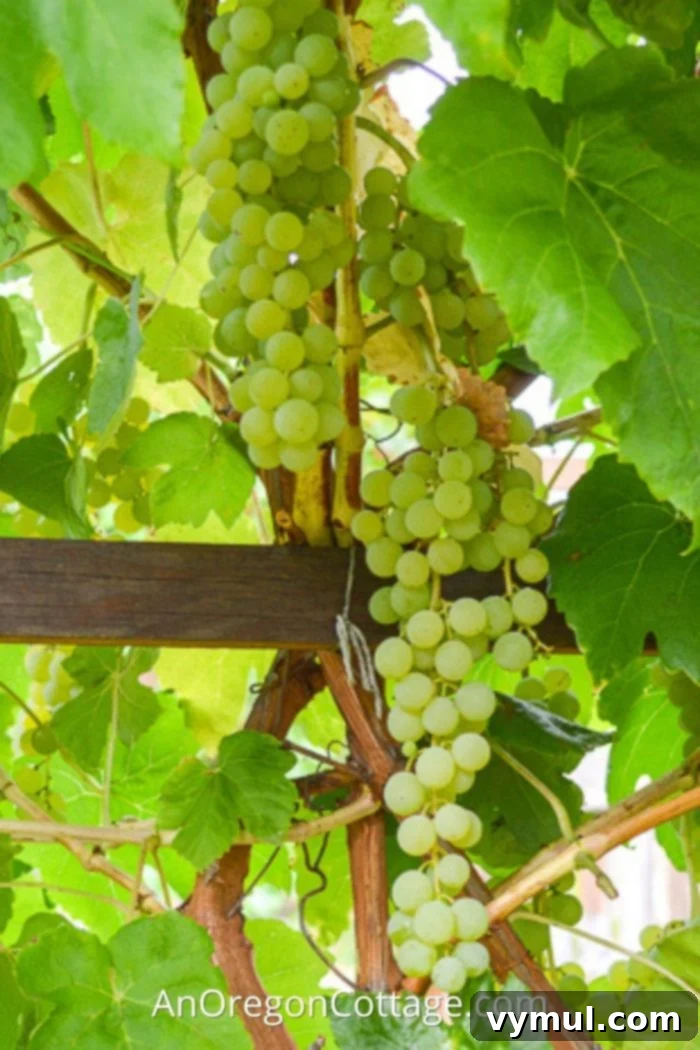
Growing Delicious Table Grapes: An Easy & Rewarding Guide for Abundant Harvests
Are you dreaming of luscious, sweet grapes fresh from your own backyard? Imagine stepping outside to pluck ripe, juicy table grapes right off the vine. Growing table grapes is not only easier than you might think, but it’s also incredibly rewarding, offering both beautiful garden aesthetics and an abundance of delicious fruit. This comprehensive guide will walk you through everything you need to know, from selecting the best varieties and building sturdy structures to mastering the art of pruning, ensuring you achieve a successful harvest year after year.
Some links in this article are affiliate links, and if you click on them, I will receive a small commission at no extra cost to you. Your support helps maintain this site.
Many aspiring gardeners contemplate growing grapes for fresh eating but are often deterred by misconceptions about the effort involved. Based on my experience cultivating grapes at three different homes, I can confidently tell you that they are among the most low-maintenance yet highly gratifying fruits you can add to your garden!
Beyond the delightful fruit, grapevines offer unparalleled beauty to any outdoor space. I’ve always integrated our grapevines with arbors, strategically placing them over patios and walkways. The visual appeal they add to the garden is simply captivating. Years ago, when we constructed a large grape arbor over the seating area of our Portland bungalow, my primary goal was shade. By the second year, the vine provided perfect shade, and when grape clusters began to form, the sight was truly picturesque. To my absolute surprise, the arbor became laden with fruit every year thereafter, despite our minimal intervention beyond annual pruning.
A plant that requires only a single annual maintenance session? That’s precisely the kind of gardening commitment I appreciate.
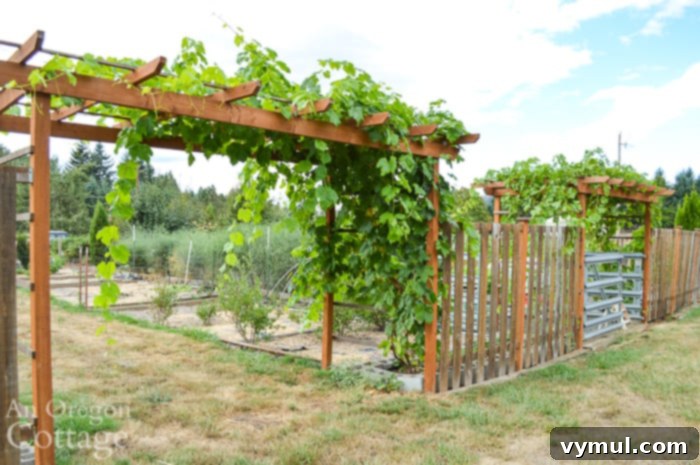
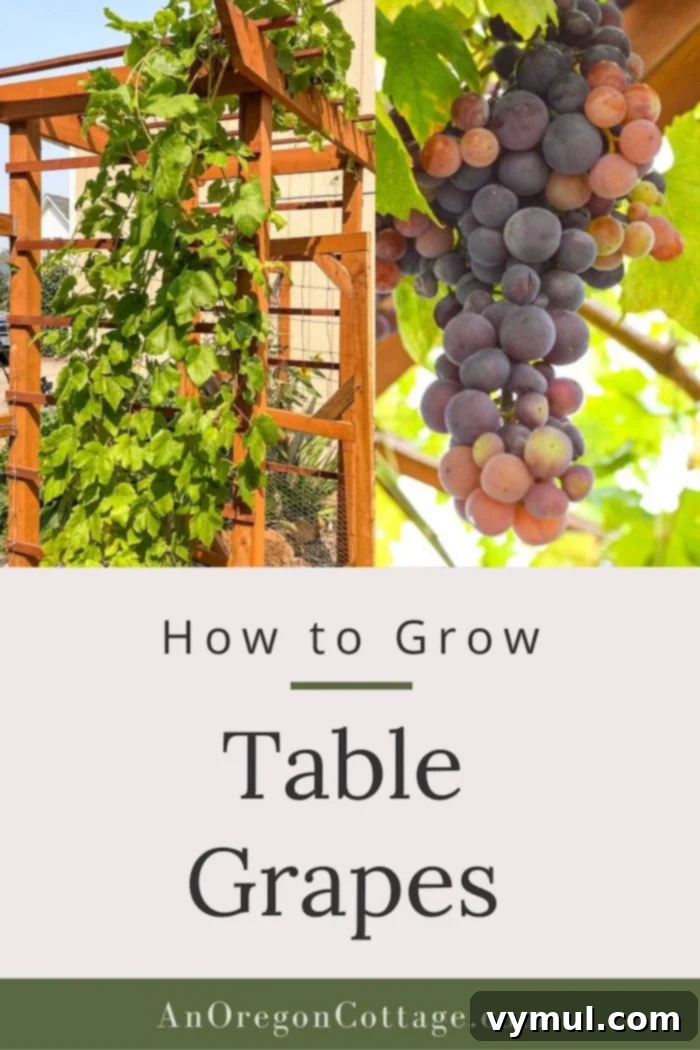
When designing the garden for our previous cottage, I knew I wanted to incorporate grapes again. We built two substantial arbors, visible in the photo above, marking the entrances to our raised bed vegetable garden and berry patch. The following spring, I planted one bare-root seedless table grape on each arbor. We allowed them to grow freely for the first year, then performed a hard prune in the second year’s winter. The photo captures their magnificent growth and surprising fruit production by their third summer!
Choosing the Right Location and Preparing the Soil
For optimal growth and abundant fruit production, grapevines demand as much sunshine as you can provide, ideally 6-8 hours of direct sunlight per day. Select a south-facing location if possible. Once you’ve identified a sunny spot, prepare the soil thoroughly. Grapes thrive in well-draining soil with a pH between 5.5 and 7.0. Amend heavy clay soils with organic matter like compost to improve drainage, or incorporate topsoil if your existing soil is poor. A generous amount of compost worked into the planting area will provide essential nutrients and improve soil structure, setting your grapevines up for success.
Sturdy Structures For Growing Grapes
One critical lesson I’ve learned is that mature grapevines develop large, robust trunks and exhibit substantial growth each year. Therefore, the structure you choose to support them must be exceptionally sturdy and well-anchored.
Whether you opt for a traditional trellis system, similar to those used for wine grapes, or prefer to train them along a patio cover or over an arbor like ours, it’s crucial to consider cementing the posts into the ground. The immense weight of a mature grape plant, particularly when loaded with fruit, can easily compromise an unstable structure, especially when subjected to strong winds. Arbors not only provide excellent support but also create a beautiful focal point, offering shade and an inviting atmosphere in your garden.
Planting Table Grapes
Once your structure is in place and your soil is prepared, it’s time to plant your bare-root or potted grapevines. Dig a hole that is wide and deep enough to accommodate the root system without crowding. If planting bare-root, spread the roots out evenly. For potted plants, gently loosen the root ball. Plant the vine at the same depth it was in the nursery, or if bare-root, ensure the graft union (a slight bulge on the lower stem) is above the soil line in colder climates, or at soil level in milder regions.
After planting, select the strongest shoot to become the main vine or trunk. Gently tie this lead shoot to your support structure, ensuring it’s loosely secured to prevent damage as it grows. Water thoroughly after planting. The growth rate you can expect should be similar to our observations:
- First Summer: With proper care, your young vines should grow vigorously, potentially reaching the top of their arbors or trellises. Focus on establishing a strong root system.
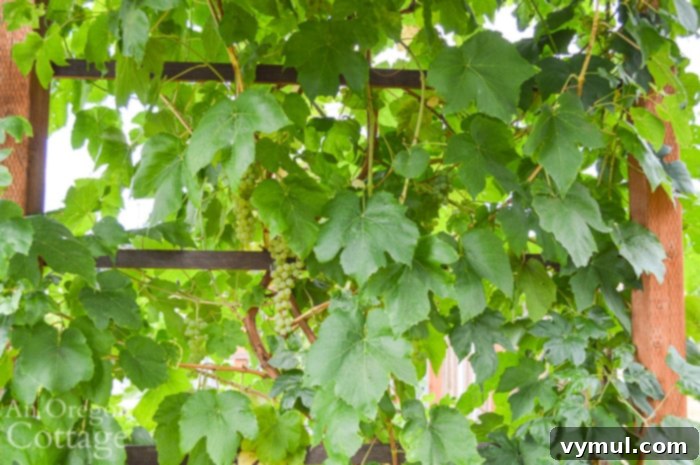
- Second Summer: You’ll notice significantly more growth. One of our red varieties completely covered the top of its arbor, while the other green grape variety just made it over the top.
- Third Summer: Prepare for explosive growth! At this stage, you may need to perform light summer pruning to direct shoots and maintain the desired shape and coverage, ensuring the plant doesn’t become unruly.
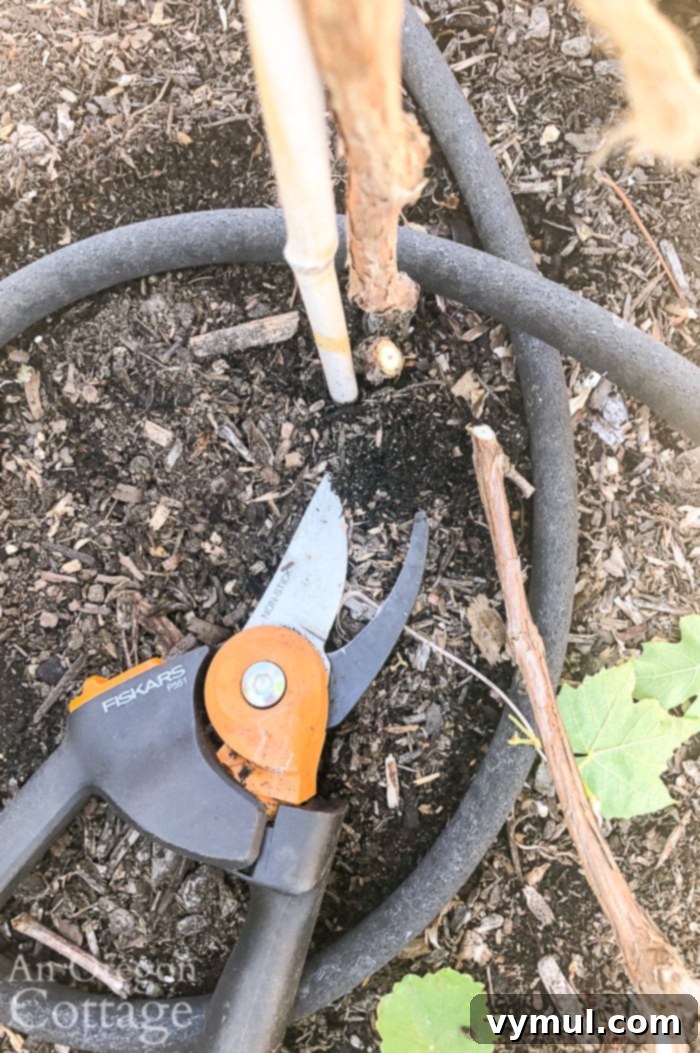
Mastering How to Prune Table Grapes
Pruning is arguably the most crucial annual task for grapevines, vital for maximizing fruit production, preventing overbearing (which can lead to smaller, lower-quality fruit and stress the plant), and maintaining the vine’s health and vigor. When we talk about pruning grapes, we mean a severe, definitive cut – you will typically remove 85-90% of the previous year’s growth each winter.
For table grape production, cane pruning is widely recommended over spur pruning, primarily because it’s often simpler for home gardeners and encourages more fruit on varieties like ours. This is the method we’ve consistently used.
Pruning Year 1: Establishing the Foundation
The primary goal during the first year is to develop a robust root system and establish a strong main trunk. To achieve this, identify the strongest, healthiest shoot and train it upwards to become your main trunk. The general recommendation is to remove all other shoots, directing the plant’s energy solely into root development and trunk growth. If the plant produces more shoots during the first summer, these should also ideally be removed.
However, here’s a practical note: we have never strictly followed this first-year pruning guideline for any of our vines. Our objective also included achieving good arbor coverage quickly. By allowing more initial growth, we still harvested substantial amounts of grapes in subsequent years. So, you have the flexibility to choose an approach that aligns with your specific goals for coverage versus strict yield optimization in the very first year!
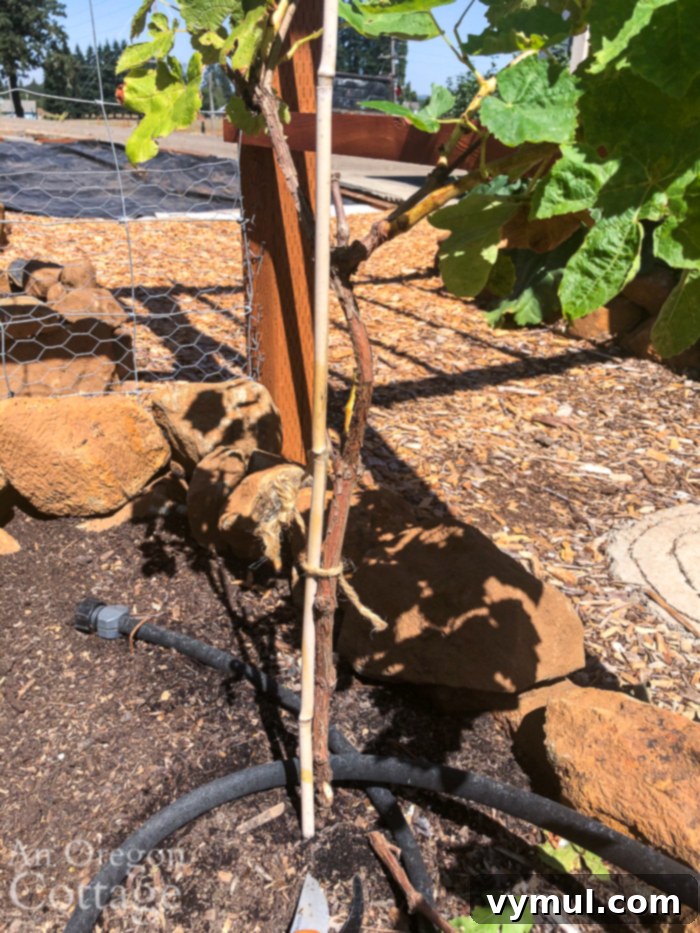
Regardless of your summer approach, during the plant’s first dormant winter (typically January-March), you must rigorously cut off all shoots except the single main trunk you’ve chosen. Then, securely tie this main trunk to your trellis or arbor.
PRO TIP: If your arbor’s first horizontal support is too high for the young trunk to reach, use a temporary stake to support the trunk as it grows vertically up the side. This provides stability until it can be tied to the permanent structure.
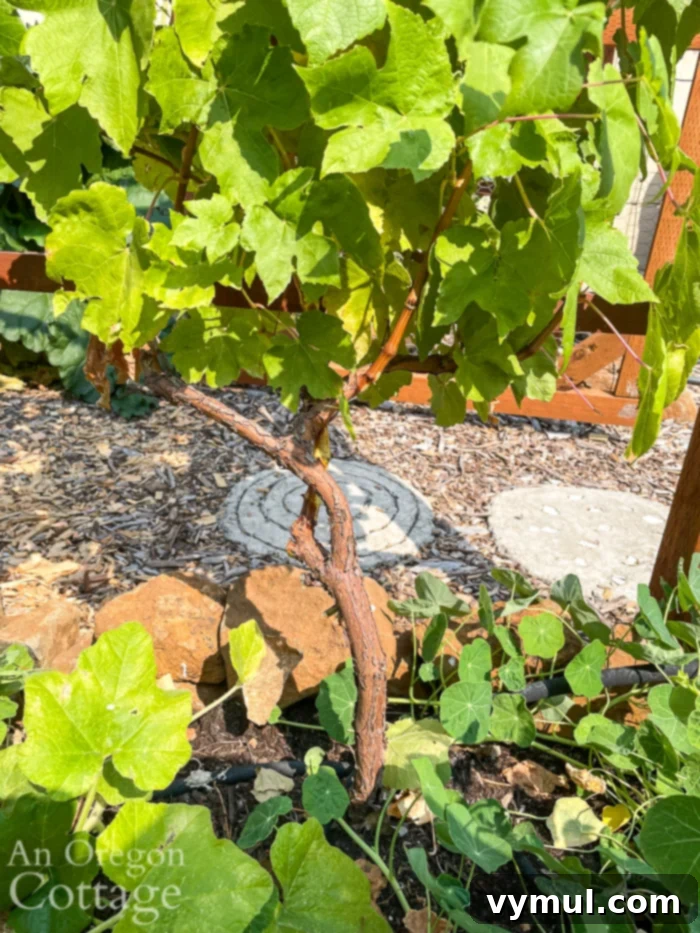
Pruning Year 2: Developing Fruiting Canes
During the second growing season, the recommendation is to select two strong, healthy shoots that emerge from the top of your main trunk. These will become your primary fruiting canes for the following year. Train these two shoots along your trellis or over the arbor, and remove all other competing shoots. If any fruit begins to develop in this first year of establishment, it’s best to remove it so the plant can dedicate its energy to growing strong roots and vigorous canes.
Again, similar to Year 1, we often diverge slightly from this strict pruning during the growing season. As seen in the photo above, we tend to let the plant grow, only removing the lowest shoots from the trunk to encourage good coverage over the arbor. Our focus remains primarily on the dormant pruning.
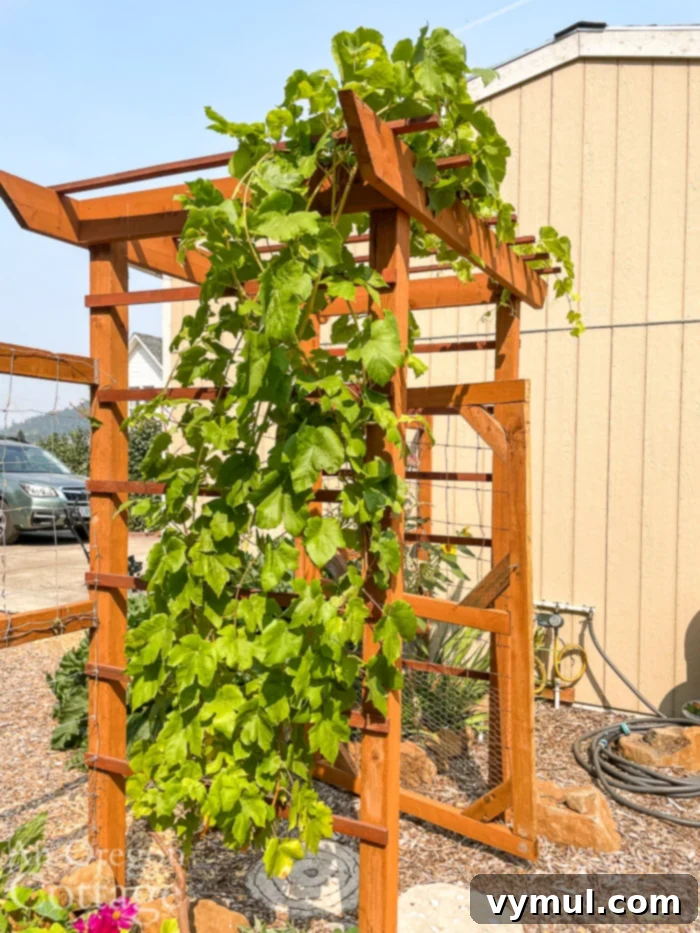
Crucially, regardless of any light summer trimming, you absolutely must perform the hard pruning in the winter when the plant is dormant. At this point, select the two strongest, healthiest canes that grew during the second year and train them horizontally over the arbor. Cut these chosen canes back to approximately 10 buds each (these buds will be responsible for producing fruit next year). Remove all other canes and shoots.
Love this arbor design for your vegetable garden entrance? We’ve created a video demonstrating how to easily and affordably build one for your garden – check it out HERE!
Pruning Year 3 and Beyond: Sustained Production
Each growing season after year two, focus on training the new shoots that emerge from the two canes you left during the previous winter. Guide them along your trellis or over the arbor, ensuring good light exposure and air circulation. Harvest any fruit that develops throughout the summer.
Continue the cane pruning method each winter. Annually, you will select two new strong, healthy shoots or canes that originated close to the trunk. These will be the primary fruiting canes for the upcoming season. Remove the old canes that fruited in the previous year.
PRO TIP: When selecting your two new fruiting canes, choose ones that are at least the thickness of a pencil. Prioritize canes that were exposed to the most sunlight, typically those on the top or most exposed parts of the plant, as these tend to be the most vigorous and productive.
Now that the plant is well-established, you can leave approximately 15 buds on each chosen cane. Cut the canes back to this length and tie them securely to your structure as needed. Additionally, regularly remove any suckers or shoots that grow from the base around the trunk; all the plant’s energy should be directed towards the productive growth on your trellis or arbor.
(For a more detailed breakdown of both cane and spur pruning techniques, consult resources like “Don’t Be Timid When Pruning Grapes” from the OSU Extension, which offers invaluable insights.)
Winter pruning might seem severe, especially given the explosive growth grapevines produce each season. However, this rigorous pruning is precisely what promotes the production of high-quality, flavorful fruit. Beyond this annual pruning and a simple top dressing with compost each spring, there’s very little maintenance required. This makes grapes a remarkably easy and satisfying plant to grow!
Two Excellent Table Grape Varieties to Grow
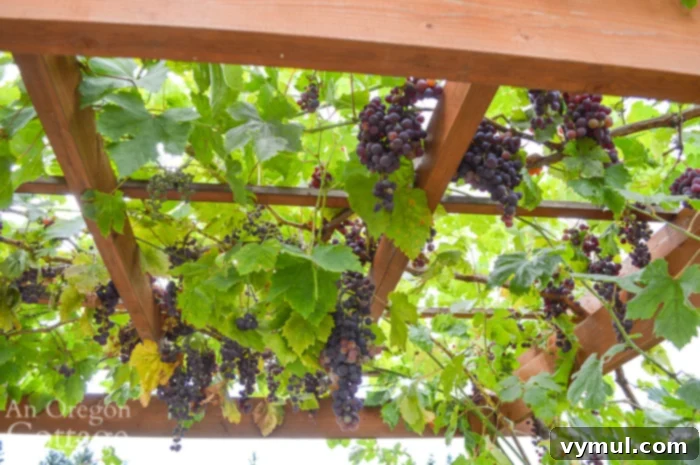
Red Seedless Grape: ‘Flame’
One of the most dependable and popular red table grape varieties is ‘Flame’. Its widespread popularity, making it the second most grown variety in the U.S., stems from its exceptional vigor, delectable sweetness, and impressive shelf life. Having grown it myself, I can unequivocally confirm its robust vigor – the ‘Flame’ vine in our cottage garden managed to cover the entire top of its large arbor by its third year, and remarkably, also extended down the other side! As you can see from the image above, it was absolutely loaded with grapes.
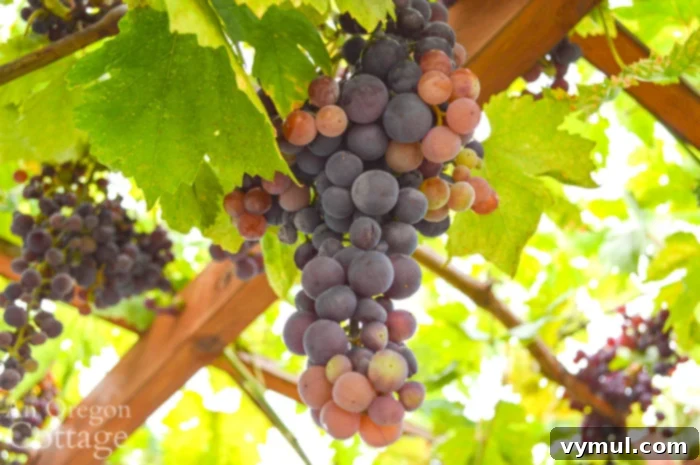
The grapes themselves were consistently healthy, notably large, and incredibly sweet. Our passion for growing grapes truly ignited when we discovered the sheer joy of stepping out into the garden each morning to pick fresh grapes to enjoy throughout the day. This small investment of effort yields an immeasurable return in fresh, delicious fruit.
Green Seedless Grape: ‘Himrod’
For the second large arbor in our cottage garden, we selected the green seedless variety ‘Himrod.’ This is another widely recognized and popular US variety, readily available at nurseries and home improvement stores in the spring. While ‘Himrod’ wasn’t quite as vigorous in its initial growth as the ‘Flame’ grape, I was pleasantly surprised by its production in the third year. Despite my initial lower expectations, it produced abundant clusters along the side of the arbor, particularly where the previous year’s growth had established itself.
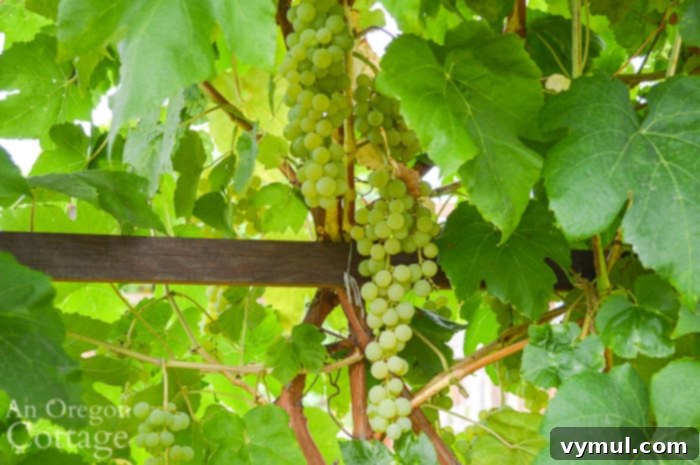
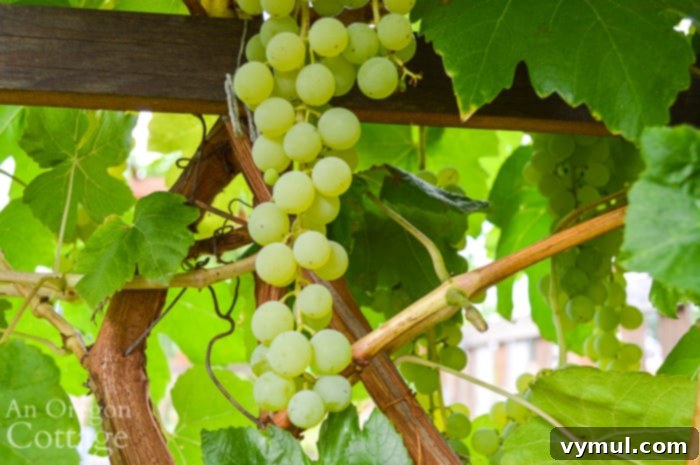
By the end of that summer, we had quite a few clusters, and I noticed that the ‘Himrod’ grapes were much more uniform in size compared to ‘Flame.’
PRO TIP: One minor drawback I discovered when growing both ‘Flame’ and ‘Himrod’ is that they tend to ripen at the same time – typically late August in our region. This meant we were suddenly “swimming” in grapes, racing to consume them before they spoiled, and then had no grapes for the rest of the season. To enjoy a longer fresh eating period, I recommend seeking out two varieties that ripen at different times. Other excellent red varieties known for later ripening include ‘Suffolk Red’ and ‘Seedless Concord,’ which could provide a nice succession of harvests.
Even though ‘Himrod’ produced slightly less fruit in its third year than ‘Flame’ (though its yield significantly increased in subsequent years), it quickly became my personal favorite of the two varieties. This was primarily because ‘Himrod’ grapes offered a sweeter, more nuanced flavor with a wonderfully tender skin. This superior taste profile is why, when I had space to plant only one variety at the farmhouse, I chose to plant another ‘Himrod.’ (Unfortunately, deer also love grapes and grape leaves, so I’m limited to growing them within our fenced garden.)
There’s an undeniable, almost magical feeling that comes with harvesting your own table grapes. I can’t quite pinpoint why – perhaps it’s because they still feel a bit exotic to me, which is silly given that Oregon is now renowned for its vineyards and wines. Nonetheless, the satisfaction of growing and enjoying your own grapes is truly special.
Growing Table Grapes FAQs
Grapevines focus heavily on establishing their root system and vegetative growth (vines and leaves) during the first two years. Depending on the severity of your pruning in the initial years, you should typically start seeing a significant fruit harvest in the third year. This was consistent with our experience; our previous vines were heavily loaded in their third year, had a slightly reduced yield in year four (which is normal), and then produced abundantly again in year five, demonstrating a healthy biennial bearing pattern.
Grapes require a distinct cool winter period to meet their chilling requirements and a warm, extended growing season (ideally 150 to 180 frost-free days) to properly develop and mature their crop. This is why regions with rainy winters and warm summers, such as the coastal areas of the US, are ideal for most commercial grape cultivation. However, there are numerous cold-hardy cultivars available today that enable gardeners in northern states and colder climates to successfully grow grapes. If you’re unsure about suitable varieties for your specific region, it’s highly recommended to consult with a local nursery or agricultural extension office; they can advise you on varieties that thrive in your microclimate.
During the first few years of growth, especially when the vines are establishing, they should receive approximately 1 inch of water weekly, either from rainfall or supplemental watering. Consistent moisture is crucial for root development. As grapevines mature, they become significantly more drought-tolerant and can often thrive with just natural rainfall, unless your area experiences a prolonged period of drought. In such cases, occasional deep watering would be beneficial.
I have personally found that my grapevines flourish without any synthetic fertilizers, relying solely on a generous yearly application of compost mulch to the beds. Compost enriches the soil, improves its structure, and provides a slow release of essential nutrients. If you suspect your soil is particularly depleted, you can opt for a balanced organic fertilizer specifically formulated for food-producing plants. Apply this once early in the growing season, typically in spring, to give your vines an initial boost.
Tell me, do you currently grow grapes in your garden? If so, which varieties are your favorites, and what tips have you found most helpful? Share your experiences in the comments below!

This article has been comprehensively updated and expanded; it was originally published in September of 2013.
Disclosure: Affiliate links in this article will earn commission based on sales, but it doesn’t change your price. Click here to read our full disclaimer and advertising disclosure.