Unveiling Oregon’s Ancient Heart: A Journey Through the John Day Fossil Beds National Monument
Nestled in the remote, high desert landscape of central Oregon, the John Day Fossil Beds National Monument offers a breathtaking glimpse into millions of years of Earth’s history. Far from the lush, green stereotype of the Pacific Northwest, this national treasure captivates visitors with its striking desert-like mesas, vibrant “painted hills,” and the surreal, cerulean depths of the Blue Basin, complete with its mysteriously colored creek. It’s a place where time seems to slow, allowing the imagination to wander back to epochs when ancient mammals roamed and volcanoes shaped the very land beneath our feet. Our family’s recent camping adventure to this northeastern corner of Oregon began with a scenic drive through the charming towns of Bend and Redmond, eventually leading us into the expansive beauty of the John Day Valley. We settled into our campsite for a few days, eager to immerse ourselves in the natural wonders of the John Day Fossil Beds National Monument and its surrounding, equally captivating areas.
This remarkable monument stands as a testament to the dynamic forces that have sculpted our planet, preserving an unparalleled record of prehistoric life and geological change. It’s a journey not just across landscapes, but across geological eras, inviting explorers of all ages to connect with a world that existed long before human memory. From the moment you arrive, the unique beauty of this region unfolds, challenging perceptions and inspiring a deeper appreciation for Oregon’s diverse natural heritage. Whether you’re a seasoned paleontologist, a geology enthusiast, or simply a family looking for an unforgettable outdoor experience, the John Day Fossil Beds promise an adventure unlike any other, revealing the profound stories etched into its ancient rocks and vibrant hillsides.
Exploring the John Day Fossil Beds National Monument: A Window to Prehistory
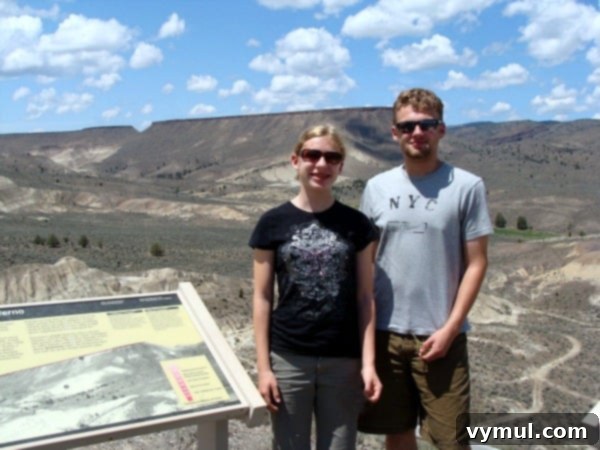
The John Day Fossil Beds National Monument is one of Oregon’s most extraordinary treasures, a place we were excited to share with our children, though it surprised and delighted us equally. This monument is globally renowned for holding one of the most complete and best-preserved fossil records of the Cenozoic Era, particularly from the Age of Mammals. Its vast deposits contain an astonishing array of plant and animal fossils spanning over 40 million years, making it an invaluable site for paleontological research and education. Scientists have uncovered ancient horses, saber-toothed cats, rhinos, camels, and many other prehistoric creatures here, offering crucial insights into the evolution of North American fauna and flora.
The landscape of the John Day Fossil Beds is dramatically different from what many people envision when they think of Oregon. Instead of dense forests and rain, visitors encounter a high-desert environment reminiscent of the American Southwest. However, the presence of the life-giving John Day River imbues the valley with a surprising lushness, creating a verdant ribbon through the otherwise arid terrain. This striking contrast adds to the monument’s unique charm. The flat-topped mesas and dramatic cliffs that dominate the scenery are the remnants of massive volcanic eruptions that occurred millions of years ago. These eruptions layered ash and soil over vast areas, which then solidified into rock and were later carved by erosion. The resulting striations of different colored soils and rock layers create stunning “painted mountains” and formations that look as though an artist meticulously crafted them, right here in our own backyard.
The Three Units of John Day Fossil Beds: Diverse Landscapes and Discoveries
The John Day Fossil Beds National Monument is comprised of three distinct units, each offering a unique geological and paleontological experience: the Sheep Rock Unit, the Painted Hills Unit, and the Clarno Unit. While our visit focused primarily on the Sheep Rock Unit due to time constraints, understanding all three provides a full appreciation of the monument’s immense scope and diversity.
The Sheep Rock Unit: Gateway to Ancient Life
The Sheep Rock Unit is the most centrally located and often serves as the primary entry point for visitors, largely because it hosts the monument’s main visitor facility, the Thomas Condon Paleontology Center. This state-of-the-art center is a must-see, featuring impressive exhibits on the area’s geology and paleontology, including actual fossils found within the monument. Visitors can observe paleontologists at work through a viewing window into the active fossil laboratory, gaining a deeper understanding of the meticulous process involved in uncovering and preserving these ancient relics. The Sheep Rock Unit also boasts several short hiking trails that lead to various fossil beds and scenic overlooks, offering easy access to the monument’s geological wonders.
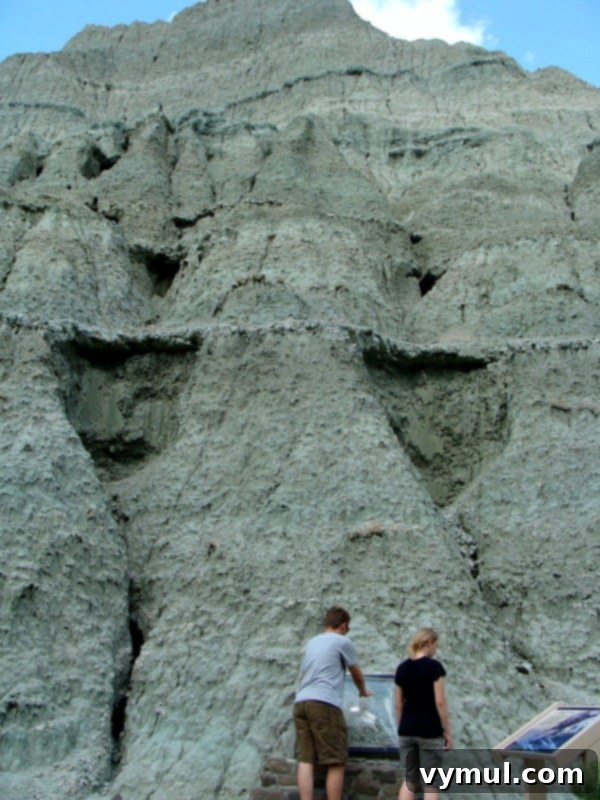
One of the most unforgettable experiences within the Sheep Rock Unit is the hike into the “Blue Basin.” This moderately easy trail, stretching approximately one to one and a half miles round trip, winds through an otherworldly landscape of blue-grey canyons. The path follows a seasonal creek, and during our visit, pockets of standing water shimmered with an intensely bright, almost unreal turquoise hue. The experience of walking along these towering walls, sculpted by millennia of erosion, feels like stepping onto another planet. The sheer scale and unique coloration are truly mesmerizing, offering incredible photographic opportunities at every turn.
Along the trail, interpretive signs provide fascinating details about the geological forces at play and the fossils discovered in the area. Our kids were particularly captivated by a replica of a significant fossil displayed at the base of a canyon wall. It offered a tangible connection to the ancient creatures that once roamed this land. While photographs often struggle to capture the true vibrancy of the Blue Basin, in person, the dominant color shifts from a subtle blue-grey to a more pronounced, vibrant blue, especially under the right light conditions. The atmosphere is one of profound tranquility and geological grandeur, making it a highlight for any visitor to the John Day Fossil Beds.
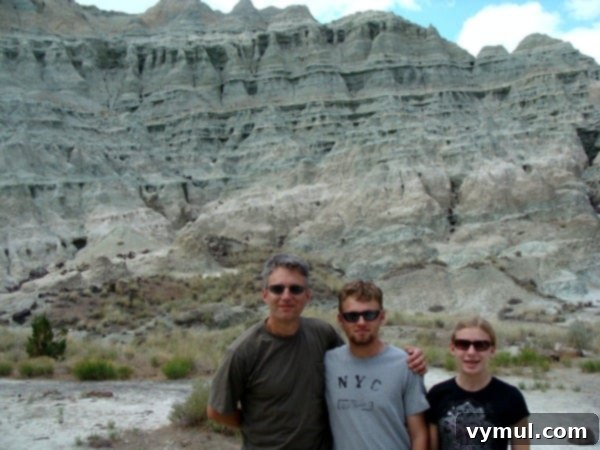
Indeed, the Blue Basin truly lives up to its name, exhibiting a distinct bluish-green tint that sets it apart. The image above captures a moment deep within the basin, at the trail’s terminus, where we were completely encircled by formidable walls resembling castles intricately carved out of the hillside. Here, the numerous layers formed by successive volcanic eruptions and subsequent ash falls are vividly apparent, telling a dramatic geological story. The precise reason for the unique blue coloration of the soil in this particular area remains somewhat of an enigma, a topic of ongoing scientific study, though it’s often attributed to the presence of specific minerals such as celadonite, which formed under ancient volcanic conditions. Regardless of its exact scientific explanation, the phenomenon is utterly amazing and undeniably worth the journey, offering a visual spectacle unlike any other in Oregon.
The Painted Hills Unit: Nature’s Palette
Though we couldn’t visit on this trip, no discussion of John Day Fossil Beds is complete without mentioning the iconic Painted Hills Unit. Located about an hour’s drive from the Sheep Rock Unit, these hills are perhaps the most famous and visually stunning part of the monument. Their vibrant stripes of red, gold, black, and green are formed by ancient soil layers that accumulated over millions of years, varying in color due to different mineral compositions and moisture levels. The colors shift with the light and seasons, making every visit a unique experience. Boardwalk trails and overlooks provide easy access to capture breathtaking photographs of this geological masterpiece.
The Clarno Unit: Ancient Rainforests
The third unit, Clarno, is situated roughly 20 miles west of Fossil, Oregon, and is the oldest of the three. It preserves fossils from the Eocene Epoch, roughly 44 million years ago, when Oregon was a subtropical rainforest. Here, visitors can explore the “nut beds,” where petrified plants, seeds, and even ancient rhinoceros jaws have been found. The Clarno Unit offers a stark contrast to the desert landscapes of the other units, showcasing a completely different ancient ecosystem and providing valuable insights into climatic changes over geological time. Its dramatic volcanic lahars (mudflows) reveal a powerful and turbulent past.
Planning Your Visit to the John Day Fossil Beds National Monument

To make the most of your adventure to the John Day Fossil Beds, planning is key. The best times to visit are spring and fall, when temperatures are milder and the vibrant colors of the landscape are often at their most striking. Summer can be very hot, requiring ample water, sun protection, and early morning or late afternoon hikes. Winter visits are possible, but some facilities or trails may be affected by snow or ice.
Wear sturdy hiking shoes, as many trails involve uneven terrain. Bring plenty of water, especially for longer hikes, as services within the monument are limited. Binoculars are recommended for wildlife viewing and appreciating the distant geological formations. The monument is generally accessible, with paved roads leading to the main units and visitor centers, and many trails are relatively easy, though some sections might be challenging for those with mobility issues. The Thomas Condon Paleontology Center is fully accessible.
The small towns surrounding the monument, such as John Day, Fossil, and Mitchell, offer limited dining and lodging options, so it’s wise to book accommodations in advance, especially during peak seasons. Camping is a popular choice, providing an immersive experience under the vast Oregon night sky. While the monument itself does not have campgrounds, several excellent options are available in the nearby Ochoco National Forest and private facilities in the John Day Valley. We highly recommend dedicating at least two days to explore the various units thoroughly, allowing time for leisurely hikes and absorbing the immense beauty and scientific significance of this extraordinary place.
Our road trip with our vintage trailer has been filled with incredible discoveries, and the John Day Fossil Beds National Monument truly stands out as a jewel. We’re already eagerly anticipating what wonders await us in Baker City and the majestic Wallowa Mountains. Stay tuned for more adventures!