Discover Joy: Your Monthly Guide to Good Things to Do, Buy, Read, and Watch
Welcome to our curated monthly list of excellent recommendations – your go-to source for wonderful things to do, thoughtful purchases, captivating reads, compelling shows, and much more. Each month, we explore and share discoveries that bring a little extra sparkle to everyday life.
Please note: Some links within this article are affiliate links. If you choose to click on them and make a purchase, I may receive a small commission at no additional cost to you. These commissions help support this site and allow me to continue sharing valuable content.
The past month has certainly been a journey, feeling as though it stretched on endlessly for many of us. As we transition into a new month, there’s a collective hope for fresh beginnings, renewed energy, and a much-needed sense of optimism. Even as a self-proclaimed homebody, the recent “cabin fever” has been real, prompting a deeper appreciation for finding small, significant joys.
And that’s precisely what this list is all about – seeking out the inherent good that always exists, often just waiting to be noticed. It’s a delightful exercise for me to reflect on the positive experiences and discoveries of the last few weeks and compile them into a shared resource for you. Whether you’re a creative spirit, a generous giver, a culinary enthusiast, an avid reader, or a dedicated watcher of screens, this list truly offers something for everyone. Dive in and find your next “good thing”!
Monthly Discoveries & Practical Good Things

Easter Zoom Dinner with Friends
While virtual gatherings are far from revolutionary news these days, the concept of spending a major holiday like Easter completely alone felt undeniably strange and melancholic this year. To counteract this feeling, my husband and I decided to transform our isolated celebration into a shared experience with some dear friends. Our solution? A collaborative Easter dinner held over Zoom.
The magic lay in the details: we crafted a unified menu and divided the dishes amongst ourselves. On the Saturday preceding Easter, we orchestrated a socially distanced exchange, dropping off our prepared components at each other’s homes. This simple act made an immense difference, not only because we were enjoying the same meal but also because we got to savor dishes prepared by someone else – a true luxury! My friend’s cheesecake, in particular, was absolutely divine, making me feel quite lucky indeed.
This unique setup turned a potentially somber holiday into a truly memorable Easter. It underscored the power of connection and creativity in challenging times, proving that even apart, we could celebrate together.
Crochet Dishcloths for Sustainable Living
It seems I’m embracing the practical wisdom of previous generations, though perhaps not strictly my own grandmother’s! I must admit, I never understood the appeal of crocheted dishcloths; the ones I’d encountered were often too large, too porous, and seemed to splash water everywhere. They just didn’t click with me.
However, that perspective completely shifted when I discovered this specific pattern for a tight-weave dishcloth on Miss Mustard Seed’s blog. A lightbulb went off! I immediately envisioned these as a perfect, sustainable replacement for the paper towels I used to rely on and even the disposable “Swedish” dishcloths I’d been using for the past few years. While those reusable cellulose cloths are a significant step up from single-use paper towels, they inevitably start to break down after a month or two of regular use and washing. The idea of a durable alternative that could last for years, while still being highly absorbent and convenient, was incredibly appealing.
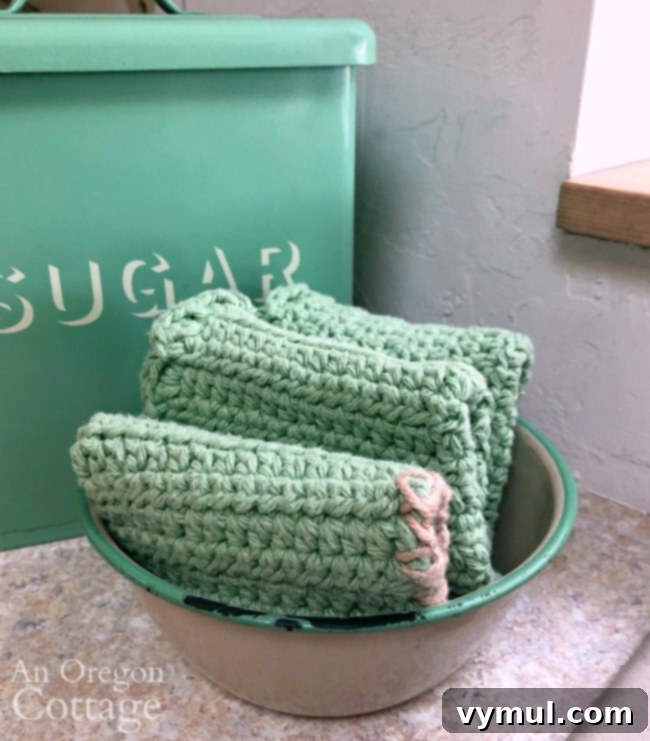
So, I crocheted one using some cotton yarn I had leftover from an old knitting project. After a quick wash, which helped tighten the weave even further, I put it to the test. Both my husband Brian and I were genuinely impressed with its performance. It absorbed well and was easy to handle. This success prompted me to create a full set. Now, a charming enamel bowl by our sink holds a ready supply of these cloths, making them easily accessible whenever needed.
The key, I found, was having enough for an entire week. This allows us to use one fresh cloth per day and toss it into the laundry with the next load, ensuring they stay hygienic and effective. Nobody wants a “grody” dishcloth, right?
If you follow me on Instagram, you might have already seen a photo of these in my stories, accompanied by an enthusiastic “It worked!” We’ve now fully transitioned to these crochet dishcloths, complemented by old t-shirt rags for tackling particularly messy spills (which can be washed or discarded as needed), traditional tea towels for drying dishes, and durable walnut and cellulose scrubber sponges from Grove. We’ve successfully eliminated the need for single-use disposables in our kitchen. My next eco-friendly mission is to find effective alternatives for the myriad of plastic bags that accumulate!
For those inspired to make their own, here are the supplies I recommend:
- Wood crochet hooks: These are incredibly comfortable to hold, making the crafting experience even more enjoyable.
- Dishie cotton yarn: This is my preferred yarn; it’s known for its durability and tends to split less during crocheting, resulting in a smoother fabric.
- Sugar ‘N Cream cotton yarn: Another excellent choice for dishcloths, widely available and reliable for its absorbency and sturdiness.
Brightbox Happy Mail: Spreading Smiles Thoughtfully
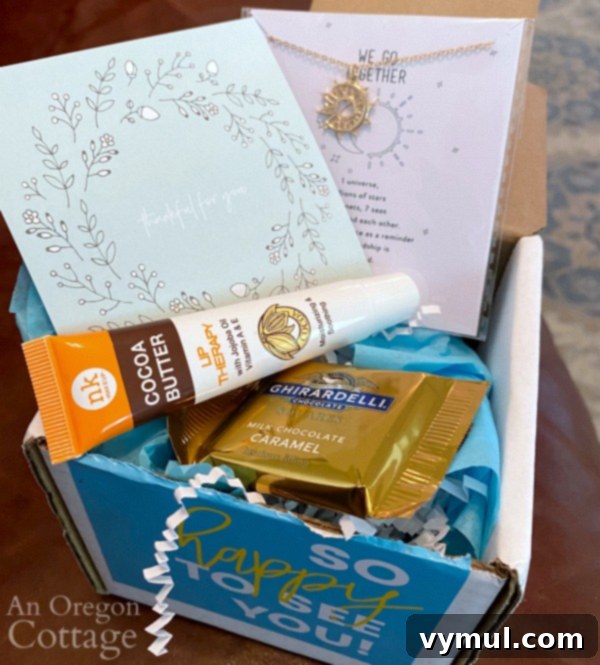
Last month, I stumbled upon a delightful company called Brightbox, and I was so captivated that I immediately sent one to a friend (the photo above is her box she graciously shared with me!). I’m thoroughly impressed by their website, the charming presentation of their boxes, the affordability, and the heartwarming story behind the company. Brightbox feels like a perfectly timed concept, particularly now, when almost everyone could use a dose of “happy mail” to brighten their day.
They offer a fantastic range of options to suit different needs and budgets: carefully curated boxes are available for just $15, custom boxes (allowing you to choose specific items) for $10, and adorable confetti cards for a mere $5. What makes these prices truly remarkable is that all options include shipping, providing exceptional value. It’s a testament to their mission of making thoughtful gestures accessible.
If you’re looking to send a little joy or treat yourself, I highly recommend checking out Brightbox. Use my referral link here to get a free Add-On (up to $3 value) with your first box. I have a strong feeling you’ll adore them as much as I do!
Heavy-Duty Smaller Loaf Pans for Perfect Bakes
For a while, I’ve been troubleshooting a recurring issue with my beloved soft whole wheat sandwich bread – it just wasn’t rising quite as beautifully as it used to. This prompted me to delve into some research regarding loaf pan sizes and how they correlate with the amount of flour in a typical bread recipe. What I discovered was illuminating: my recipe sits right on the cusp between the standard 8.5×4.5-inch and 9×5-inch pans. After our move, with a new kitchen that feels colder, a different oven, and perhaps even slight variations in mixer performance or flour, getting that perfect rise had become a challenge.
Based on my findings, I decided to try the smaller 8.5×4.5-inch size. Crucially, I chose to invest in some quality, heavy-duty pans rather than opting for cheaper alternatives – a decision that has paid off immensely, even though these particular pans are still quite affordable. I am absolutely delighted with these new pans. Their robust construction ensures even heat distribution, and with just a light greasing, the loaves release effortlessly after baking.
While these are still considered a standard loaf size, meaning we haven’t noticed a drastic change in the overall bread dimensions, the significant improvement is that the dough now consistently rises beautifully above the rims, just as it once did. Here’s hoping this wonderful trend continues, leading to many more perfectly baked loaves!
April Reads: A Literary Journey
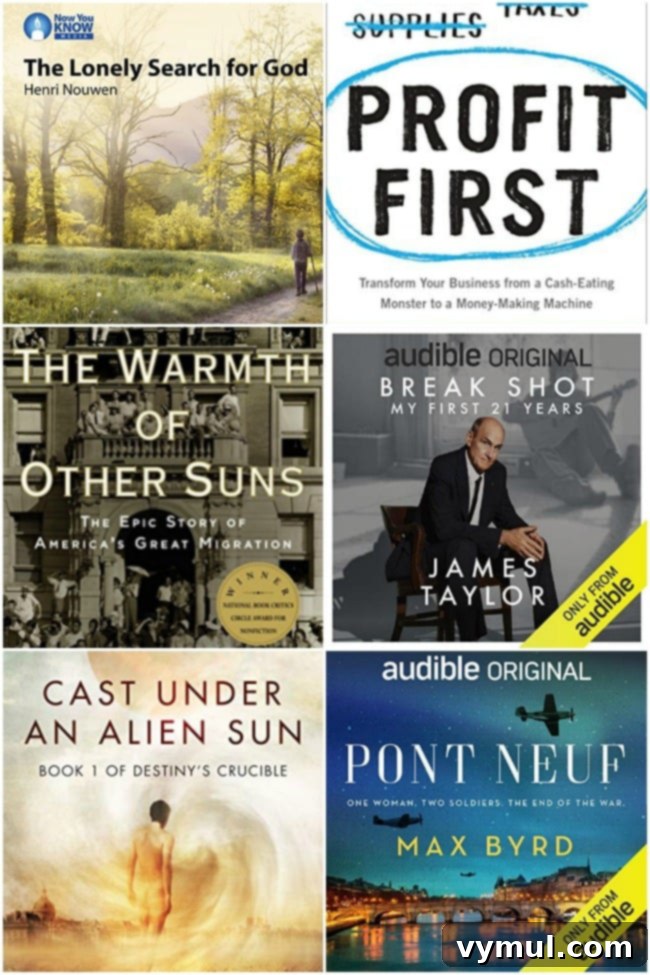
Reflecting on my reading habits, April proved to be a more fruitful month than March, despite encountering a couple of “clinkers” – those books that simply don’t resonate. It’s a natural part of any reading journey, but happily, there were also some truly excellent reads that stood out. My hope is that within these concise reviews, you’ll discover a book that sparks your interest and perhaps finds a place on your own reading list!
The Lonely Search For God by Henri Nouwen
This powerful audiobook is a recording of Henri Nouwen, available on platforms like Audible and library apps such as Hoopla. I’d often seen other Christian bloggers mention Nouwen, but had yet to dive into his work myself. I knew a bit about him: a Catholic priest, a renowned professor for many years, who later dedicated the last years of his life to living and working with disabled individuals in Canada. This background immediately piqued my interest.
In this particular recording, Nouwen exhibits remarkable vulnerability, openly sharing his own struggles with loneliness and articulating his profound understanding of the crucial distinction between loneliness and solitude. In our current era of heightened isolation, his insights feel incredibly timely and relevant. I found myself recording numerous poignant quotes in my Book Notes Journal, including this gem:
The spiritual life must change from one of loneliness to one of solitude. In solitude there is fruitful waiting, patience. In loneliness, grasping and seeking.
Nouwen also explored the concept of maintaining a “secret self” – a sacred part of us that we share with no one but God. This idea was particularly thought-provoking for me, as it was a perspective I hadn’t previously considered. He posits that if we fail to protect this “inner mystery,” we paradoxically lose the capacity to form genuine community:
Our inner mystery attracts us to each other and allows us to establish friendships and develop lasting relationships of love. Intimate relationships between people not only asks for mutual openness, but also for mutual respectful protection of each other’s mystery. It’s a false form of honesty that suggests nothing can remain hidden and everything should be said, expressed, or communicated.
As an introvert, these affirmations resonated deeply, reassuring me that there’s nothing inherently “wrong” with me for not needing to share every single detail of my inner world. It also elegantly explains why oversharing can feel so uncomfortable. Overall, this book offers truly profound and valuable perspectives for reflection on self, connection, and spiritual life.
Profit First by Michael Michalowicz
This book came highly recommended by numerous online business owners, so I decided to listen to it, curious about its core principles and whether they might apply to my own small online venture. However, I ultimately concluded it wasn’t quite the right fit for me. The method Michalowicz outlines essentially inverts the traditional accounting formula. Instead of “sales – expenses = profit,” his “Profit First” system advocates for taking your profit first, and then managing your expenses with what remains. It’s built on the idea that resources contract to fit demand – if you allocate less for expenses, you’ll find ways to operate within that smaller budget, preventing overspending.
While the concept is sound and clearly effective for many, given the modest scale of my operation and lack of employees, I felt that integrating this system would introduce unnecessary complexity into my already simple accounting. Nevertheless, it was valuable to understand the methodology and see why it garners such praise in the business community.
The Warmth of Other Suns: The Epic Story of America’s Great Migration by Isabel Wilkerson
As an ardent history buff, this extensive exploration of the Great Migration — the mass movement of six million African Americans from the rural Jim Crow South to the urban North, Midwest, and West from 1916 to 1970 — was absolutely enthralling. Isabel Wilkerson delves into meticulous detail, dissecting the complex motivations behind this monumental demographic shift, explaining why some felt compelled to leave and others chose to stay.
To bring this vast historical narrative to a deeply personal level, Wilkerson masterfully weaves together the life stories of three individuals and their families who undertook this journey at different points in time. This narrative choice truly humanizes the statistics and provides poignant insights into the personal sacrifices and triumphs. Intriguingly, one of these individuals is the author’s own mother, which underscores her personal connection to the subject.
Several aspects of this book will undoubtedly stay with me: the horrifying accounts of the systemic cruelty faced by Black southerners during the Jim Crow era, a stark reminder of humanity’s capacity for terrible injustice; the sheer absurdity of the era’s discriminatory laws (such as Black passengers being forced to move to separate cars or sections when trains crossed from a Northern state into a Jim Crow Southern state); and Wilkerson’s compelling findings that countered popular misconceptions by demonstrating that Southern migrants were not the primary cause of social problems in Northern Black neighborhoods, as was often suggested.
Gaining this in-depth knowledge about such a critical, yet often misunderstood, period of American history has been incredibly enriching, fostering both empathy and a deeper understanding of our nation’s past.
Break Shot: My First 21 Years by James Taylor
While I’m not a colossal James Taylor fan – his peak was slightly before my time – I’ve always appreciated his timeless popular songs. So, when this autobiography was offered as a free Audible selection, I eagerly grabbed it. What often draws me to autobiographies is the historical context they provide – a window into another era and place. It’s also consistently fascinating to learn about the often serendipitous paths famous individuals take to achieve success.
One of the most captivating revelations in James Taylor’s story of breakthrough was the sheer randomness of his first big break. It came through a friend of a friend who happened to be scouting talent for Apple Records, The Beatles’ newly formed label, in the late 1960s. Taylor became the first artist to release a record on their label – his debut album – and while his tenure with Apple was brief, lasting only a year, it provided the crucial springboard his career needed.
Beyond his musical journey, I was unaware of his profound struggles with mental health, a challenge that affected his entire family. Hearing about the origins and personal significance behind some of his earliest and most beloved songs has also given them an entirely new dimension, making me listen to them with fresh ears and a deeper appreciation.
Cast Under an Alien Sun by Olan Thorensen
This was the most recent audiobook Brian and I shared, and I must confess, it took us an unusually long time to get through it because it was, regrettably, quite boring. We kept hoping it would improve, especially since the opening premise was rather promising, but alas, it never truly picked up. Instead, the narrative was bogged down by endless, lengthy meetings, excessive dialogue, and the introduction of numerous characters who, for the duration of this particular book, seemed to have no significant role in the plot. We later learned there are six books in the series, which perhaps explains the extensive world-building at the expense of plot progression in the first installment.
The story begins with a man on a routine flight, heading to a conference to speak about his tech expertise (the specifics of which I can’t quite recall), when his plane is struck by something. Believing he’s died, he awakes to find himself saved by aliens who heal him and transport him to a planet inhabited by other humans. He cannot return to Earth (again, the reason eludes me). This new planet happens to be culturally equivalent to our own 1700s, forcing him to adapt to this vastly different society while trying to subtly introduce his 21st-century knowledge without causing panic.
See? The premise genuinely sounds intriguing, doesn’t it? The core issue, however, is the severe lack of a compelling plot. It felt as though the author dedicated this entire first book almost exclusively to world-building. The unfortunate consequence is that we now have no interest in continuing the series, which is a shame. It would have been far more satisfying to have some form of plot arc that reached a conclusion within this single book, much like one of our all-time favorites, Red Rising, brilliantly achieved.
Pont Neuf by Max Byrd
Another Audible original that was available for free, which turned out to be a good thing, as this story also failed to captivate me. Set in the waning months of World War II, the narrative revolves around a female war correspondent and two American soldiers. There were moments that were quite engaging, typically the detailed and vivid descriptions of the war itself, with the Battle of the Bulge sequences being particularly well-rendered.
However, the ending proved to be a significant letdown, offering absolutely no sense of closure. In fact, the final portion of the book felt so rushed and disjointed that I struggled to even grasp what was happening in the epilogue. A poorly executed ending can, for me, completely diminish the enjoyment of an otherwise decent book.
Watching Now: TV Series & Movies
TV Series:
- Tennison, Prime Suspect 1973 (PBS): Brian and I thoroughly enjoyed this prequel series. It’s akin to “Endeavour,” offering a glimpse into the early career of a beloved character from a popular detective franchise – in this case, a young Jane Tennison just starting out in the police force. We were genuinely saddened to learn that it consists of only one season and will not be returning, leaving us wanting more of its excellent storytelling and character development.
- World On Fire (PBS Masterpiece): This is a compelling, ongoing Masterpiece series that we’re currently following. Set during the tense prelude to World War II, it masterfully tracks the lives of a diverse group of individuals across various parts of Europe. Like all Masterpiece productions, it’s exceptionally well-made, featuring strong performances and an immersive historical setting. I find myself more engrossed than Brian, but we both appreciate its quality.
- Baptiste (PBS): The other current series keeping us engaged. Interestingly, Brian is enjoying this one more than I am. It can be a bit gory at times, but what truly distinguishes it is the lead character. Unlike the often-formulaic protagonists found in American television, Baptiste feels remarkably authentic and complex, making for a refreshing and intriguing watch.
- Lost in Space, Season 2 (Netflix): This show is simply a fun, escapist adventure. It beautifully explores themes of family bonds, the intricacies of friendships, and the challenges posed by eccentric characters and a fascinating robot companion. While this second season leans a little more into the sentimental dynamic between the robot and the young protagonist than the first, it remains a thoroughly enjoyable, clean, and engaging series for all ages.
- Deadwater Fell (Acorn TV): We subscribed to a free trial of Acorn TV specifically to watch this intense series starring David Tennant. The premise is gripping: a doctor in a small village (I couldn’t quite pinpoint if it was English or Irish) loses his entire family in a devastating fire, and the central mystery revolves around who set it. The acting is superb, and each episode cleverly unfolds the story from a different character’s perspective, ending with a compelling cliffhanger that compelled us to binge the next episode.
- What To Do When Someone Dies (Acorn TV): While browsing Acorn TV for other content, we stumbled upon this intriguingly titled short series. (As an aside: has anyone else noticed that many of these “premium” streaming channels you pay for seem to offer very little original content, often directing you to other paid services? It can be quite frustrating!) Surprisingly, I actually preferred this series to the David Tennant show. It delved much deeper into psychological themes, and we quickly became invested in the main character’s journey as she unraveled the truth behind her husband’s death. It also handled the sensitive topic of grieving with remarkable gentleness and delivered a truly satisfying conclusion.
Movies:
Last month, our movie viewing was limited to just two titles: The Signal (2014) and Event Horizon (1997). Both were discovered on a list of highly-rated sci-fi movies to watch. However, after viewing them, Brian and I both agreed they didn’t quite hit the mark for us, so they won’t be making it onto our “Good Things List” this time around, unfortunately!
That concludes another edition of our Monthly Good Things List!
If you’re keen to explore more of my favorite recommendations and discoveries, you can browse all previous Good Things Lists here. I’d absolutely love to hear your thoughts – whether you’ve tried any of these recommendations or have some wonderful suggestions of your own to share. Please leave a comment below with your insights!
Disclosure: Affiliate links in this article may earn a commission based on sales, but this will not alter your purchase price. Click here to read my full disclaimer and advertising disclosure for more information.