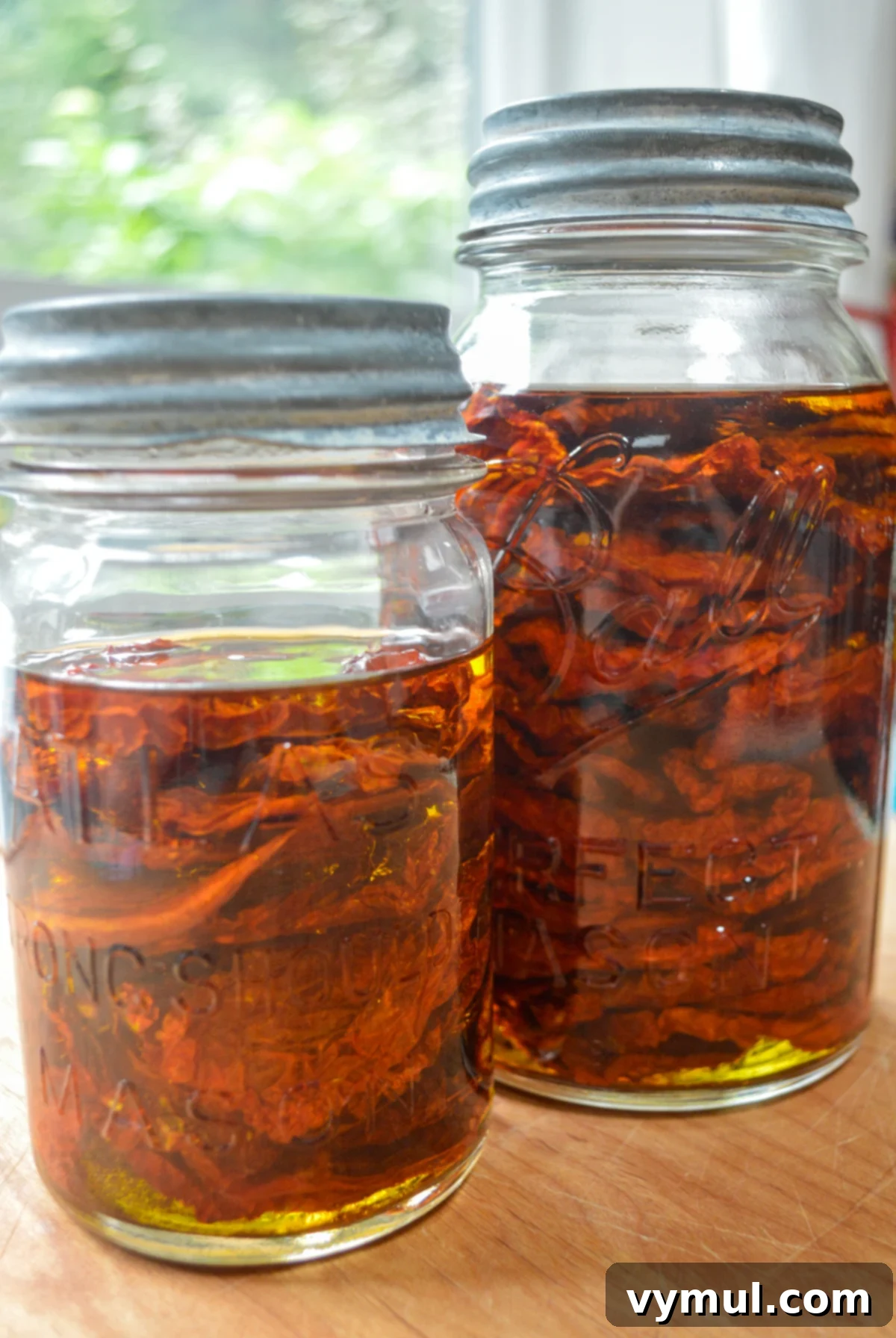
The Complete Guide to Safely Drying Tomatoes and Storing Them in Olive Oil at Room Temperature
Welcome to a comprehensive guide on a time-honored tradition: safely drying tomatoes and storing them in olive oil at room temperature, without the need for canning. This method is an excellent way to preserve the vibrant flavor of fresh tomatoes, transforming them into versatile ingredients for countless recipes. Say goodbye to store-bought dried tomatoes and embrace the superior taste and cost-efficiency of homemade!
✩ What readers are saying…
“Thank you for dedicating yourself to sharing such amazing recipes, anecdotes and information. I am so glad you discovered the ‘facts of the matter’ on preserving these delights this way and from the first time I found this recipe years ago, to revisiting it today and finding more information than there had been previously I cannot thank you enough! ” -Wyn
Some links in this article are affiliate links and if you click on them I will receive a small commission at no cost to you.
IMPORTANT NOTE: This tutorial outlines a method for preserving completely dried tomatoes in olive oil at room temperature. It is CRUCIAL to understand that this is NOT a method for canning tomatoes in oil. Canning tomatoes with oil is generally not recommended for home kitchens due to significant safety risks. Removing all air from partially dried tomatoes or fresh ingredients covered in oil can create an anaerobic (oxygen-free) environment where botulism spores can thrive, especially if the acidity is not carefully controlled. Our method ensures safety by using only fully dehydrated tomatoes and pure olive oil. We specifically advise against adding any fresh garlic or herbs, as these can introduce moisture and lower acidity, increasing botulism risk.
This tutorial details the precise method I’ve successfully used for years to dry tomatoes and store them on the pantry shelf, submerged in olive oil. This technique yields beautifully preserved tomatoes that are incredibly flavorful and remarkably convenient for a wide range of culinary applications.
Storing dried tomatoes in oil makes them infinitely easier to use compared to simply dried and packaged versions. The oil rehydrates them slightly, making them soft, pliable, and ready to be chopped and added directly to your favorite Italian pasta dishes, salads, dips, and more – no rehydration in water necessary! Beyond the convenience, this method offers substantial cost savings compared to purchasing pre-packaged sun-dried tomatoes, making it a truly rewarding home preservation project.
Is This Method for Storing Dried Tomatoes in Oil Safe? Delving into the Research and Expert Advice
Food safety is my utmost priority, and I firmly believe in methods backed by sound research, not just anecdotal evidence. My journey with this preservation technique began in the 1990s, learning from the highly respected local food preservationist and writer, Jan Roberts-Dominguez, through her articles in the Oregonian newspaper. Jan was meticulous about adhering to USDA guidelines, and her tested recipes became staples in my kitchen, even teaching me the fundamentals of canning.
When I discovered her method for drying tomatoes and preserving them in oil, I adopted it wholeheartedly and never looked back. It quickly became a favorite for its ease, delicious results, and significant economic benefits.
I firmly believe that this particular, time-honored preserving method has successfully stood the test of time due to two critical factors:
- Tomatoes are inherently acidic, a natural deterrent to many spoilage organisms. Crucially, I never introduce any fresh garlic or herbs, which could reduce acidity or introduce moisture.
- The tomatoes are dried to a precise point: they remain pliable, but absolutely no liquid can be squeezed from them when tested. This complete dehydration eliminates the water activity necessary for microbial growth.
As an additional layer of precaution, I also incorporate Ms. Dominguez’s smart recommendation to dip the fully dried tomatoes in red wine vinegar. This step further enhances their shelf life by increasing their surface acidity, acting as an extra safety measure.
Addressing the Safety Concerns and Misinformation
In 2010, I encountered a newsletter from the National Center For Home Food Preservation (NCHFP) stating they no longer recommended storing dried tomatoes in olive oil. This news was unsettling, to say the least, especially considering the success I’d had with the method for years. The NCHFP’s stated reasons were:
“Preserving tomatoes in oil is currently not recommended. Oil may protect botulism organisms trapped in a water droplet. Furthermore, oil may have a deleterious effect on lid gaskets and at least one manufacturer of home canning lids recommends against it.”
My initial reaction was frustration, largely because:
- The method I employ involves *fully dried* tomatoes, which by definition, do not contain “water droplets.” The risk they described was relevant for *partially* dried or fresh produce.
- The oil in this method does not typically come into prolonged contact with the lid gaskets, as the jars are simply sealed and stored, not heat-processed like in canning.
More importantly, my extensive research into this new recommendation at the time yielded no other reputable sites or scientific studies to corroborate the NCHFP’s broad claim. It seemed to be a general caution rather than a specific condemnation of preserving *fully dried* tomatoes in oil.
To clarify, I reached out directly to Ms. Dominguez. She had not heard of this specific warning but echoed my sentiments: if the tomatoes are genuinely dry and packed without any fresh herbs or garlic, there should be no safety issue. The vinegar dip she recommended further tips the acidity level in favor of safety, making the environment even less hospitable to undesirable bacteria.
September 3, 2011 Safety Update: Shedding Light on the Botulism Scare
Further investigation led me to information from the book, How to Store Your Home-Grown Produce: Canning, Pickling, Jamming, and So Much More by John and Val Harrison, which corroborated my own conclusions:
For years we stored in oil by simply placing the produce in a sterilized jar and filling the jar with oil, agitating to get any air bubbles out before sealing…when we published this on our website we were deluged with emails warning that we could get botulism from this…
When we researched this…we discovered that it was first mentioned on a Canadian website in reference to an outbreak of botulism from a restaurant…this was picked up and repeated…until it became a fact as far as casual searchers were concerned.
(We) decided to consult a food scientist directly. He explained that there was a theoretical risk that small droplets of water adhering to the vegetable would provide a growing medium for botulism. He couldn’t quantify the risk, not being a statistician, but comparisons with being struck by a meteor…were mentioned. He wouldn’t go on record as saying it was safe, although he said he would have no concerns personally about using the method.
This insight highlights how a single, perhaps miscontextualized, incident can lead to widespread misinformation. The “theoretical risk” applies primarily to items that are not fully dried or are combined with other ingredients that introduce moisture and change acidity levels.
September 5, 2017 Safety Update: Oregon State Extension Service Gives the Green Light!
The most reassuring validation came in 2017 when The Oregon State Extension Service officially listed this method as a safe way to store tomatoes! Their guidelines provide clear, concise instructions:
Because of their acidity, unseasoned (i.e., no vegetables or herbs) fully dried tomatoes may be safely stored in oil at room temperature. (Refrigeration may delay rancidity, however). The tomatoes will soften more if quickly dipped in bottled lemon or lime juice before being placed in the oil. The tomatoes can be flavored with dried herbs and garlic. NOTE: Dried tomatoes-in-oil mixtures with [fresh] garlic and/or herbs MUST be refrigerated and used within 4 days or frozen for long-term storage.
This up-to-date information unequivocally supports the safety of storing fully dried, unseasoned tomatoes in oil at room temperature, provided the critical conditions (complete dryness, no fresh additives) are met. Their recommendation for a lemon or lime juice dip further validates the principle of increasing acidity, much like my red wine vinegar dip. This comprehensive endorsement from a reputable extension service provides immense confidence in this home preservation technique.
In summary, the consensus among food preservation experts confirms that storing fully dried, unseasoned tomatoes in olive oil at room temperature is a safe and reliable method, provided the tomatoes are completely dehydrated and no fresh, low-acid ingredients like garlic or herbs are added. This method allows you to enjoy the unparalleled taste and versatility of homemade dried tomatoes without the complexities or risks associated with home canning.
How to Dry and Store Tomatoes In Olive Oil Video Tutorial
For those who learn best visually, we’ve created a helpful video demonstrating the entire process. This video is particularly useful for understanding how to accurately gauge when your tomatoes are sufficiently dry – a critical step for safety and quality – along with other essential details of the preparation and storage process.
Step-by-Step Tutorial for Drying Tomatoes & Storing in Olive Oil
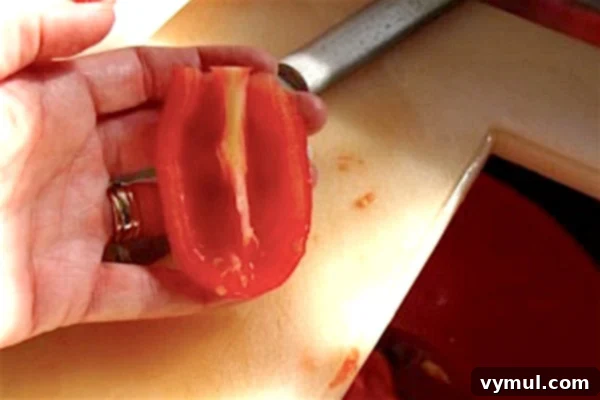
1. Prepare Your Tomatoes: Wash, Core, and Halve.
Begin by thoroughly washing your tomatoes. Next, use a small paring knife to cut out the top core of each tomato. Then, slice each tomato in half lengthwise. For the best results with dried tomatoes, I highly recommend using paste or plum tomatoes (such as Roma or San Marzano varieties). Their meaty texture and lower water content make them ideal for drying, resulting in a richer flavor and better finished product compared to juicier slicing tomatoes.
After halving, remove as many seeds and as much watery pulp as possible. A simple trick is to run your thumb down the inside of each half. While it might sound laborious, this step goes surprisingly quickly once you get into a rhythm. TIP: An over-the-sink cutting board with a convenient cut-out can streamline this process, allowing you to easily scrape the discarded pulp directly into a bowl placed below the board.
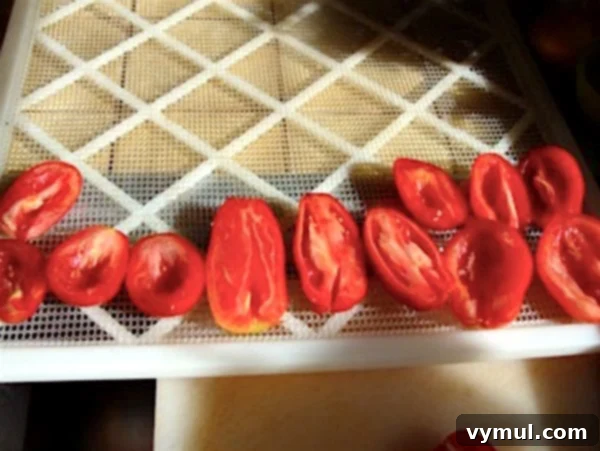
2. Arrange Tomato Halves on Dehydrator Trays.
Place the tomato halves on your dehydrator trays with the cut side facing up. This orientation is crucial because it allows moisture to escape efficiently and prevents the cut surface from sticking to the trays, which can make them difficult to remove and turn later. Don’t be afraid to pack them in relatively tightly, as tomatoes shrink significantly during the drying process, leaving plenty of space.
3. Begin the Drying Process (Dehydrator or Oven Method).
Using a Dehydrator: Set your dehydrator to the manufacturer’s recommended temperature, typically around 135 degrees Fahrenheit. (I personally use and highly recommend a 5-tray Excalibur Food Dehydrator for its reliability and capacity.) Allow them to dry for approximately four hours before performing the first rotation: turn each tomato half over and rearrange the trays (moving top trays to the bottom and vice versa). At this initial stage, most tomatoes won’t be fully dry, though a few exceptionally small ones might be. Continue drying for another 1-2 hours before checking again. From this point onward, you’ll likely find some tomatoes are adequately dry. Remove these fully dried pieces and set them aside in a large bowl or bag, then continue drying the remaining tomatoes until they reach the desired consistency.
Alternative Oven-Drying Method: If you don’t have a dehydrator, you can use your oven. Arrange the tomato halves on baking sheets and cook them in a 170-degree Fahrenheit oven for about 3 hours. It’s crucial to leave the oven door ajar by about 3 inches to allow moisture to escape. After 3 hours, turn the tomatoes over so the cut side faces down, and gently press them flat with a spatula. Continue baking, turning and gently pressing the tomatoes every few hours, until they are thoroughly dried. This can take an additional 9 hours or more, depending on your oven and the moisture content of the tomatoes. Check frequently, as smaller or less moist tomatoes will dry faster. The goal is a leathery, pliable texture that bends without being crisp, and crucially, shows no moisture when pressed firmly with your fingers.
What Does a Fully Dried Tomato Look and Feel Like?
Achieving the correct dryness is the most critical step for safe storage in oil. For a clearer visual demonstration, please refer to the video tutorial provided earlier in this article, which walks you through this process in detail.
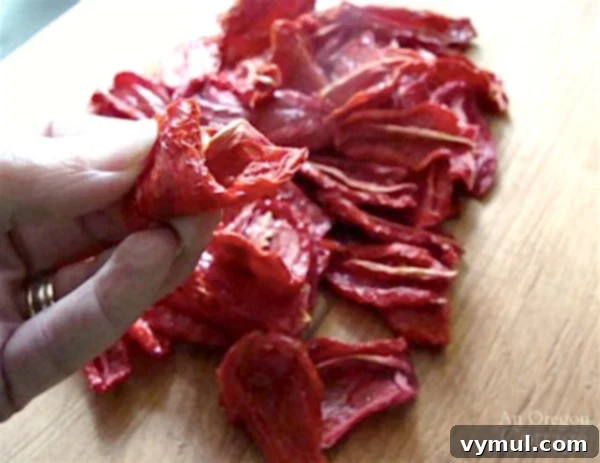
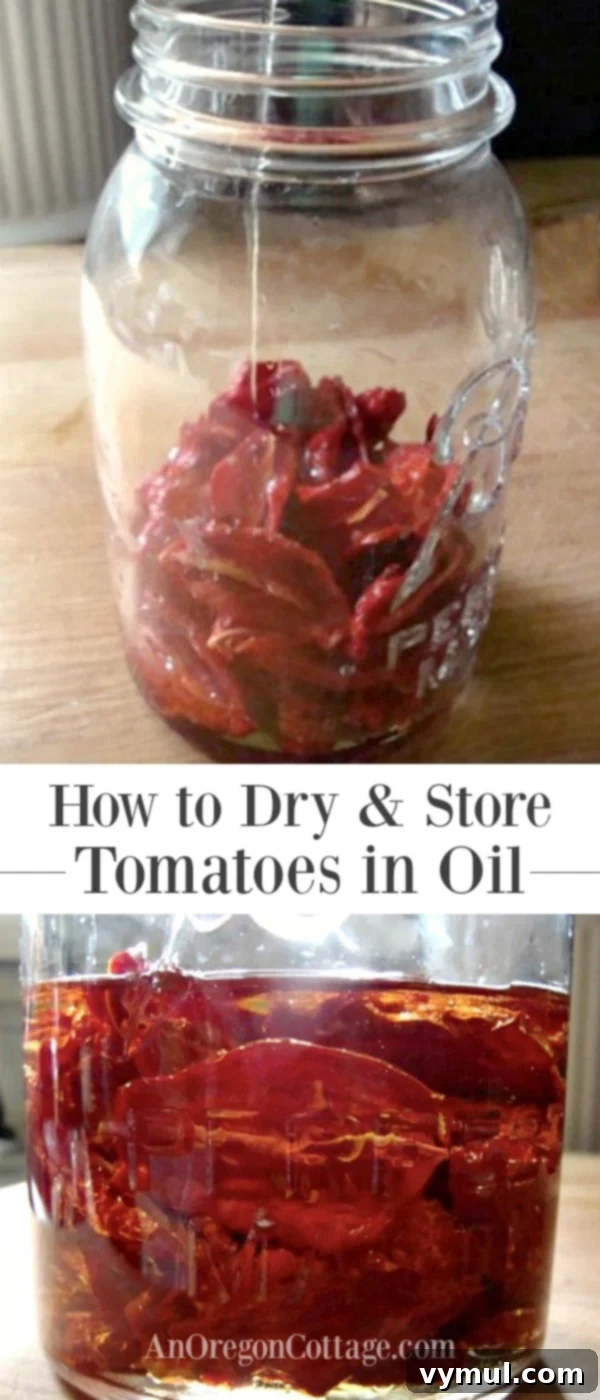
Your fully dried tomato halves should have a distinctive leathery, pliable texture. When you press them with your fingers, there should be absolutely no moisture evident. They should be flexible enough to bend, much like the example shown in the image above, without cracking or feeling brittle. It’s perfectly fine if a few edges become a little crisp, but avoid letting all of them reach this state, as no amount of oil will re-soften them once they’re overly brittle.
(HELPFUL TIP: If you accidentally over-dry some tomatoes and they become too crisp, don’t discard them! You can whir them up in a food processor or blender to create a fine tomato powder. This powder is a fantastic pantry staple, perfect for making instant tomato paste by simply adding a bit of water, or for boosting the flavor of soups, sauces, and spice rubs.)
As you continue drying batches of tomatoes, you can begin the process of preparing the fully dried halves for storage in jars, starting with the important vinegar rinse.
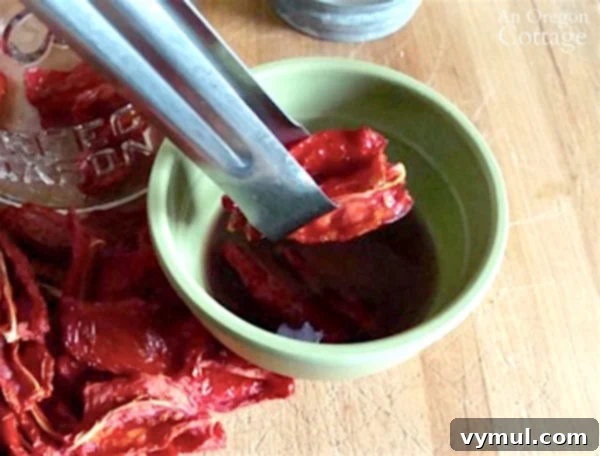
4. The Vinegar Dip: An Added Layer of Safety.
Pour red wine vinegar into a small bowl. Using tongs, carefully dip each fully dried tomato half into the vinegar. Allow any excess vinegar to drip off for about a minute before transferring the tomato to a clean, sterilized quart jar. This quick vinegar bath is an extra precautionary step that helps to increase the surface acidity of the tomatoes, making them even more stable for room temperature storage.
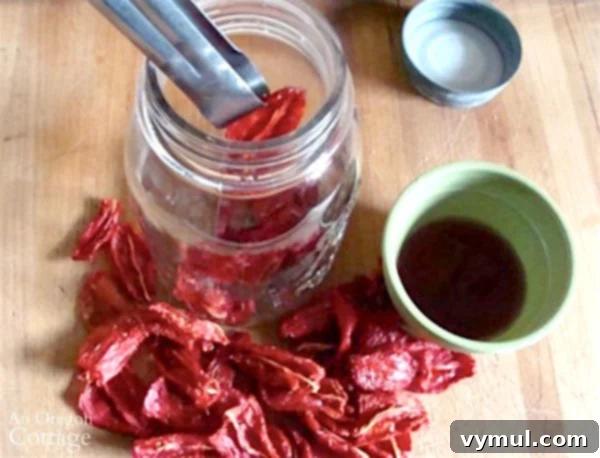
5. Filling the Jar with Dried Tomatoes.
Continue dipping the dried tomatoes in vinegar, letting them drip briefly, and then placing them into the jar. Gently press down on the tomatoes as you fill the jar to remove any large air pockets and fit as many as possible. Fill the jar to its shoulders, leaving a small headspace for the oil.
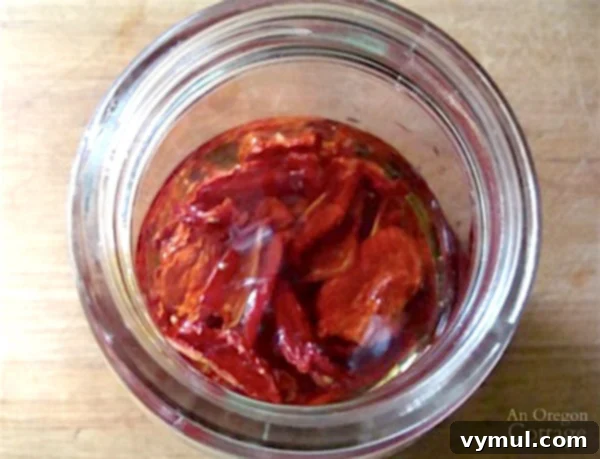
6. Covering with Olive Oil: The Final Seal.
Once the jar is filled with dried tomatoes, carefully pour good quality olive oil over them until they are completely submerged and covered. You’ll likely need a significant amount of oil, but rest assured, none of it will go to waste! As you use up your preserved tomatoes, the flavor-infused oil can be repurposed for salad dressings, sautéing, or adding a rich, savory depth to other dishes. (TIP: You can often find excellent prices on olive oil here on Amazon.)
KEY for storage and safety:
Always ensure the tomatoes are completely covered in olive oil, even after you begin to use them. This is paramount for safe room temperature storage.
7. Continue the Process for Additional Batches.
If you have more tomatoes to dry, simply repeat steps 1 through 6. As subsequent batches of tomatoes dry, continue to “dip and drip” each one in the vinegar and place them into your jar, layering them with previously stored tomatoes. Remember to cover the newly added tomatoes with more olive oil, ensuring everything remains fully submerged.
8. Storage and Shelf Life.
Once your jar is completely full and the tomatoes are fully covered with oil, screw on a lid tightly. Store the jar in a cool, dark place, such as a pantry or cupboard. As you begin to use the tomatoes from the jar, always check that the remaining tomatoes are still fully submerged in oil. If necessary, top up the jar with more olive oil to maintain coverage before returning it to the shelf. This practice is essential for preserving quality and ensuring safety.
How Long Can Dried Tomatoes in Oil Be Stored on the Shelf?
For optimal flavor and appearance, your homemade dried tomatoes stored in olive oil are best consumed within one year. Beyond approximately six months, you may notice them beginning to darken and lose some of their vibrant red color. However, they will still remain safe to eat and retain their delicious flavor for up to a year, even if their aesthetic appeal diminishes slightly over time.
Creative Ways to Enjoy Your Homemade Dried Tomatoes
Once you have a jar of these exquisite sun-dried tomatoes, a world of culinary possibilities opens up. Their intense, savory flavor and tender texture make them a fantastic addition to both simple and sophisticated dishes. Here are just a few ideas to get you started, alongside some of my favorite recipes:
- Toss them into pasta salads or warm pasta dishes for a burst of Mediterranean flavor.
- Chop them finely and mix into omelets, scrambled eggs, or frittatas.
- Blend them into hummus or other dips for an extra layer of umami.
- Garnish pizzas, flatbreads, or bruschetta.
- Add them to homemade bread, focaccia, or savory muffins.
- Stir into rice, quinoa, or couscous for a flavorful side dish.
- They are excellent in sandwiches and wraps.
- Don’t forget the infused oil! Use it in vinaigrettes, to sauté vegetables, or for dipping crusty bread.
Here are some specific recipes that showcase these delicious preserved tomatoes:
- 5 Minute Goat Cheese Appetizer with Dried Tomatoes & Roasted Red Peppers
- Slow Cooker Chicken with Artichokes, Dried Tomatoes & Olives
- 20 Minute Mediterranean Chicken Pesto Pasta Recipe
- White Bean Dried Tomato Dip Recipe
Print Recipe
Pin Recipe
How to Dry & Store Tomatoes In Olive Oil (at room temperature safely)
Equipment
-
Food Dryer (or use optional oven method)
Ingredients
- 3-5 pounds paste/plum tomatoes (preferably, though you can slice and dry bigger tomatoes)
- 1/4 cup (or more) red wine vinegar (you can also use white wine vinegar or apple cider vinegar)
- 2 cups olive oil, or enough needed to cover tomatoes
Instructions
-
Wash tomatoes, cut the top core off and cut them in half. Remove as many seeds and as much watery pulp as possible.
-
Line the tomato halves on a dehydrator tray, cut side up, packing them relatively close as they will shrink.
-
Dry in a dehydrator at the manufacturer’s recommended 135 degrees F (or refer to the oven method in the notes below). Check after about four hours, then turn the tomatoes over and rotate the trays. Continue drying for another 1-2 hours before checking again. Remove fully dried tomatoes and continue drying the rest until all are leathery and pliable with no moisture when pressed.
-
Fill a small bowl with red wine vinegar. Using tongs, dip the fully dried tomato halves into the vinegar and let drip for a minute before placing them into a clean, sterilized quart jar. Press down on the tomatoes to remove air and fit more into the jar, filling it to the shoulders.
-
Once a jar is full to the shoulders, pour olive oil over the tomatoes until they are FULLY covered. For safety, the tomatoes should always be completely covered with oil, even when you start using them. The infused oil can be used for dressings and cooking.
-
Continue drying tomatoes, dipping in vinegar, and covering with oil until all your dried tomatoes are processed and stored.
-
Store jars in a cool, dark place for up to a year. They are best within 6 months, as they may darken with time, but remain safe and flavorful for longer.
Notes
Cook tomato halves on baking sheets in a 170-degree oven for about 3 hours, leaving the oven door open about 3 inches for moisture to escape. Then turn the tomatoes over, cut side down, and press flat with a spatula. Continue baking, turning the tomatoes every few hours and gently pressing down, until the tomatoes are fully dried, up to 9 hours more. Check often, as some tomatoes will finish quicker depending on size and moisture. Aim for a leathery feel that will bend but is not crisp, and shows no moisture when pressed firmly with your fingers.
NOTE: The nutrition facts provided are an automatic calculation and do not accurately account for the fact that you drain the tomatoes before eating them, so the fat and calorie values may not be precise for the consumed portion.
Nutrition
This comprehensive tutorial has been updated with the latest research and information, originally published in 2010.
Disclosure: Affiliate links within this post may generate a small commission based on sales, but this does not affect your purchase price. Click here to read my full disclaimer and advertising disclosure for more information.