Effortless One-Day Sourdough Artisan Bread: The Ultimate Beginner-Friendly Recipe
Have you been searching for a reliable sourdough recipe that delivers a perfectly crusty, golden loaf without the usual fuss and complexity? This easy sourdough artisan bread recipe is meticulously crafted for simplicity, making it ideal for both novice and experienced bakers seeking a straightforward approach. Using everyday measurements, minimal steps, and your trusty stand mixer (or a bit of hand-kneading), you can create a beautiful sourdough dough that’s ready to bake in just one day. Baked in an enameled cast iron pot (with flexible alternatives available), the result is consistently a loaf boasting a beautifully blistered, robust crust and a soft, delightfully chewy interior. Say goodbye to daunting multi-day processes and hello to homemade sourdough perfection!
✩ What readers are saying…
“I wish I could say how great this recipe is in words!… Could this be true? Could I have found the perfect sourdough recipe for me and my family? After all these years and all these attempts, suddenly, in my lap, the sourdough recipe that really IS “The Easiest Best Sourdough Recipe on Earth”? Really? Well, I’m here to tell you, “YES!” Emphatically, “YES!” This is it! So good! So easy! So perfect! Please try this recipe! You will be so happy you did.” -David
Some links in this article are affiliate links and if you click on them I will receive a small commission at no cost to you.
My Journey to the Easiest Sourdough Artisan Bread
Ever since I first cultivated my own sourdough starter and began exploring the world of sourdough bread, my goal has been simple: to consistently bake a truly exceptional loaf of artisan sourdough that rivals the best bakeries, much like my favorite easy yeast artisan bread. My vision was a bread with an incredibly crispy crust, a wonderful texture, and an inviting open crumb (those desirable holes inside), all achieved through a remarkably straightforward process.
I yearned for a same-day sourdough bread recipe that didn’t demand extensive scientific knowledge or complex techniques. Ideally, it would mirror the simplicity of my super easy artisan bread, which bakes beautifully in an enameled cast iron pot. For me, “easy” means a practical, everyday sourdough bread that relies on familiar cup measurements, minimal steps, and doesn’t get bogged down in intricate calculations – akin to how our great-grandmothers might have baked.
While some bakers thrive on the intricate details of sourdough science, I found it often led to overwhelming complexity. For those who wish to delve deeper into the nuanced world of sourdough, I recommend resources like Northwest Sourdough, which offers thorough guidance without being overly intimidating. However, my personal quest was for accessibility and delicious results.
After a couple of years of searching and experimenting, I finally discovered a technique that promised the artisan sourdough loaf I craved. When I stumbled upon this fantastic recipe, I immediately saw its potential. I knew I could adapt it to be even more user-friendly, perfectly suited for my favorite enameled cast iron pot, and capable of consistently producing excellent loaves. And it did! This recipe truly stands out as the easiest sourdough bread recipe anyone can make, from absolute beginners taking their first steps into sourdough to seasoned bakers looking for a no-fuss option.
The beauty of this method lies in its flexibility. It can be prepared relatively quickly (in sourdough terms, meaning within a single day) or adapted for a bulk fermentation overnight in the refrigerator, fitting seamlessly into your schedule. While I personally find baking easier with a stand mixer, this recipe is entirely achievable by hand. You’ll just need to put in a little more elbow grease to develop the dough properly, but the results are just as rewarding.
Artisan Sourdough Bread Recipe Video Tutorial
Essential Ingredients for Your Perfect Sourdough Loaf
Crafting this classic sourdough bread requires only 3-4 fundamental ingredients. Understanding each component is key to achieving the desired results. Here are some detailed notes and answers to common questions about the ingredients:
- Flour: The choice of flour significantly impacts the final texture and appearance of your bread. You can successfully make this recipe using all-purpose flour, white whole wheat flour, spelt flour, or traditional whole wheat flours. Keep in mind that spelt and whole wheat flours will typically result in a denser crumb with fewer large holes, though still delicious. For a taller rise and more open crumb, consider using bread flour, either white or whole wheat. Bread flour contains a higher protein content, which is crucial for developing strong gluten networks—essential for trapping gases produced by the yeast and giving your bread structure. It’s important to note that pastry flours, with their lower protein content, are excellent for delicate baked goods like cookies and muffins but are not suitable for yeast or sourdough breads.
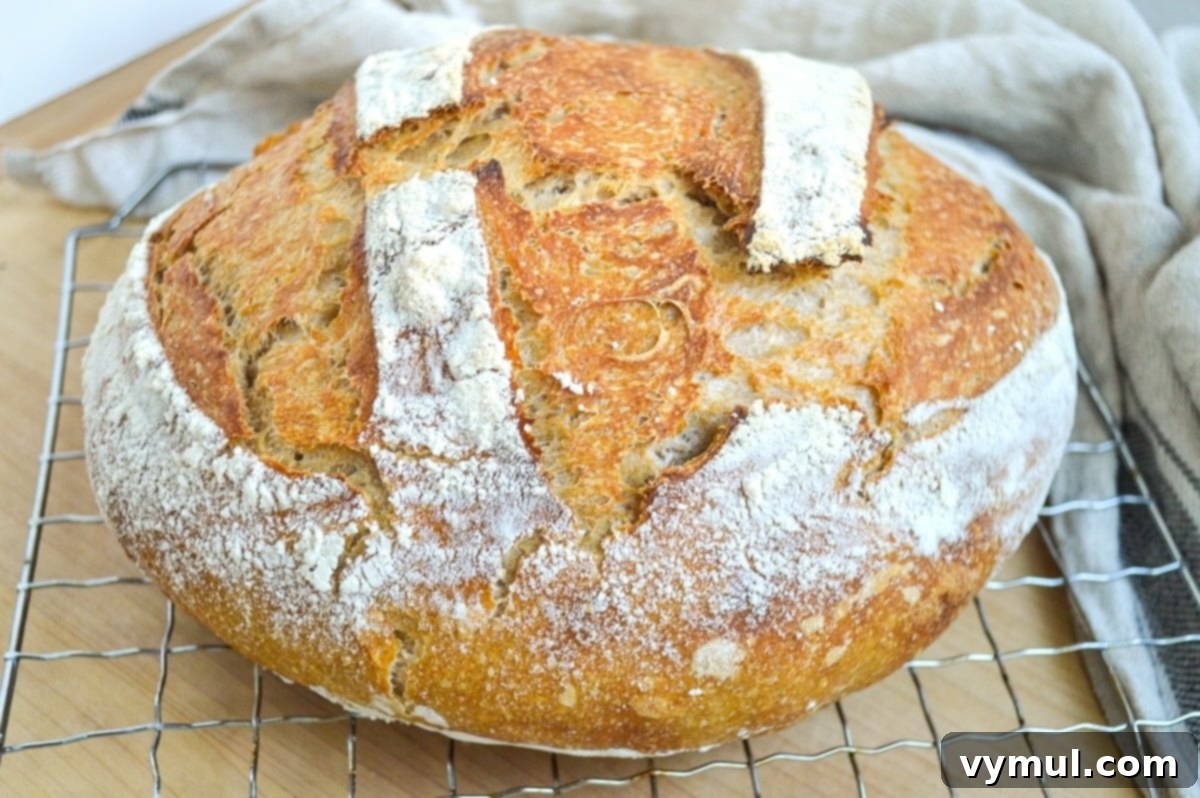
For the loaves pictured here, I’ve primarily used all white whole wheat flour with my regular whole wheat starter, which gives the bread a slightly darker hue than loaves made exclusively with white flour. Below, you’ll also see an example made with regular whole wheat flour. I consistently use a whole wheat starter and often combine different flours I have on hand to achieve unique flavors and textures.
- Sourdough Starter: The heart of your sourdough bread! I developed my starter using these simple steps with whole wheat flour. For this recipe, your starter must be robust and active. A strong starter should be very bubbly and visibly double in volume within 6 hours (or less) after being fed. I generally recommend feeding your starter the night before you plan to bake to ensure it’s at its peak activity level. See the “Important Note” section below for more details on starter strength.
- Salt: Alongside water, salt is the third absolutely indispensable ingredient. Omitting it will result in a remarkably bland bread. Salt not only enhances flavor but also plays a vital role in controlling the rate of fermentation and strengthening the gluten structure. After your first bake, feel free to adjust the salt quantity to perfectly suit your taste preferences.
- Honey (Optional): While optional, I consistently incorporate honey into my sourdough. It provides immediate sugars for the wild yeasts to feed on, giving them an initial boost. More importantly, honey contributes to a beautiful, golden-brown crust, adding a subtle sweetness and depth of flavor that complements the tanginess of the sourdough.
Step-by-Step Guide to Baking Easy Sourdough Artisan Bread
Follow these simple steps to create your own incredible sourdough loaf. Each stage is designed for maximum ease and delicious results.
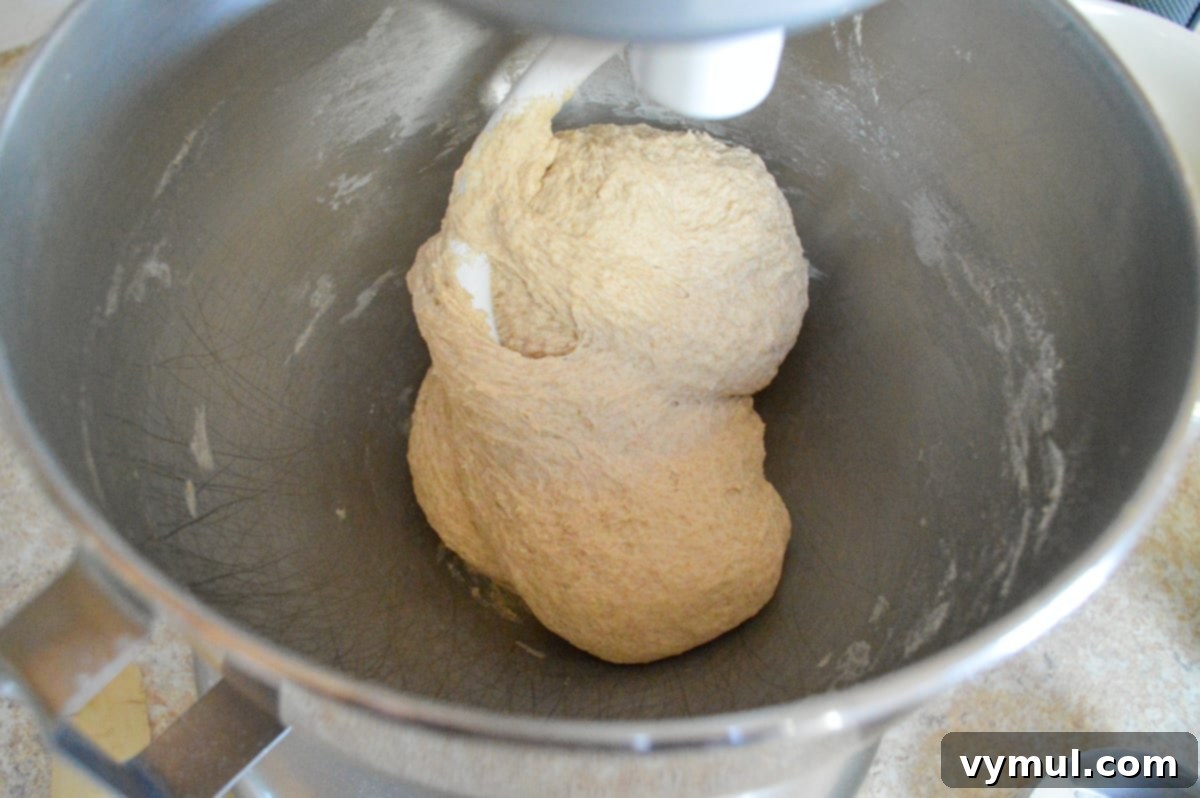
Step 1: Initial Mix and Rest. Begin by combining all your ingredients—flour, warm water, active sourdough starter, optional honey, and salt—in a large mixing bowl or the bowl of your stand mixer. Mix just until the ingredients are fully incorporated and no dry flour remains. This initial hydration period, sometimes called “autolyse,” allows the flour to absorb the water, kickstarting gluten development. Let the dough rest for 15 minutes. After resting, if using a stand mixer with a dough hook, knead for 5 minutes. If kneading by hand, work the dough for 8 to 10 minutes until it begins to develop elasticity.
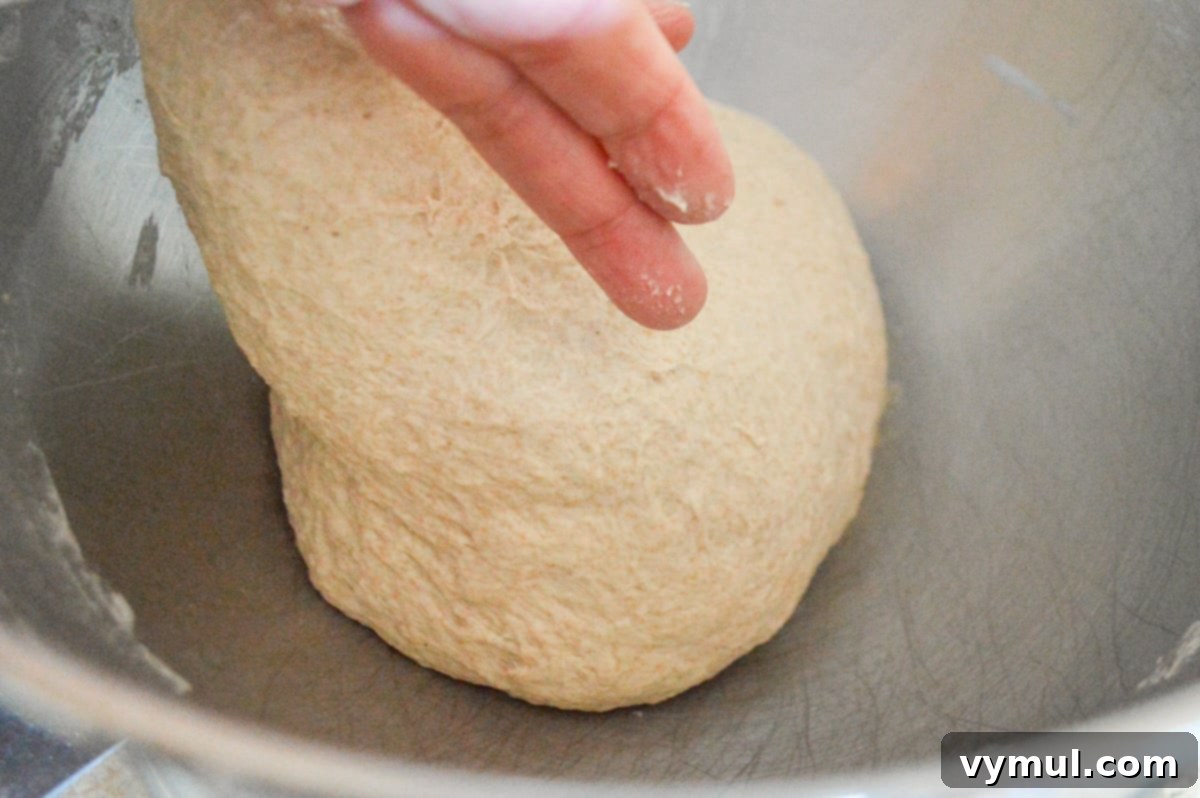
Step 2: Adjusting Dough Consistency. As you knead, gradually add more flour, a small amount at a time, only if necessary. The goal is to achieve a dough that still clings slightly to the very bottom of the bowl but cleanly pulls away from the upper sides. The final consistency should be tacky to the touch, meaning it’s sticky enough to hold together but won’t heavily adhere to your fingers, leaving only a slight residue as shown in the photo. This specific consistency is crucial for an airy crumb and good crust development.
TIP: Incorporating Flavorful Add-ins. If you wish to customize your bread with dried or fresh herbs, chopped olives, cheese, dried fruit, or nuts, this is the perfect time! Add your chosen mix-ins during this kneading phase, after you’ve achieved the desired dough consistency as described in Step 2. Mix them in gently until evenly distributed before proceeding to the next step.
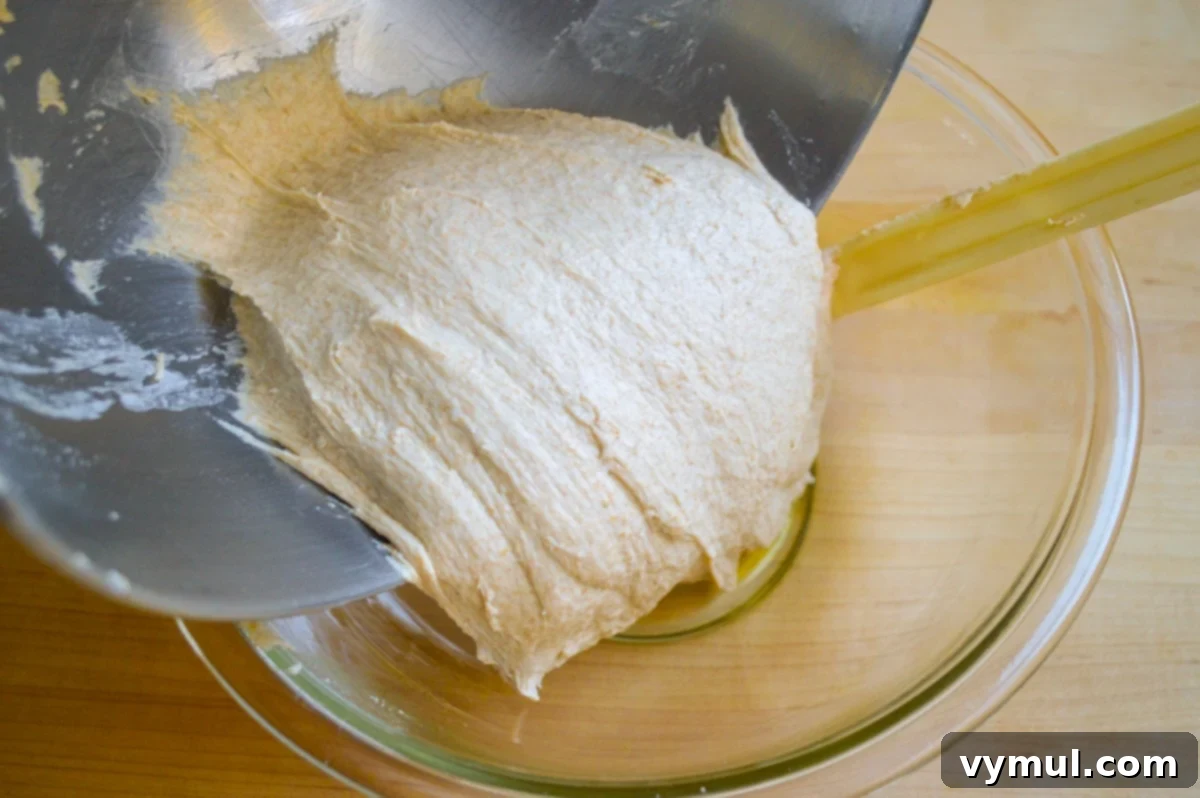
Step 3: Preparing for the First Rise. Once kneading is complete, transfer the dough to a large bowl that has been lightly coated with oil. You’ll likely need to scrape the dough out, as it will naturally be sticky and cling to the mixer bowl. Ensure the dough is comfortably settled in the oiled bowl, ready for its bulk fermentation.
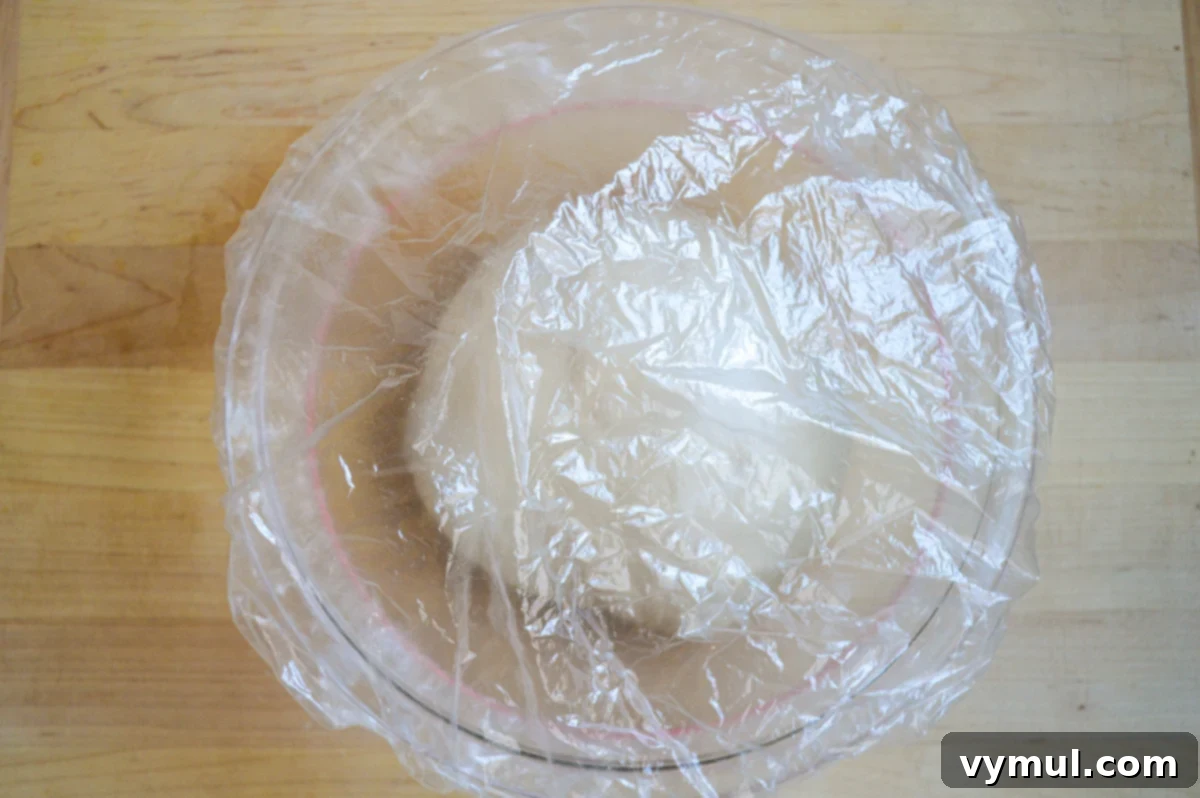
Step 4: First Rise (Bulk Fermentation). Cover the bowl securely with plastic wrap or a damp kitchen towel. Let the dough rest and rise at room temperature for 3 hours. During this period, the wild yeasts in your starter will begin their work, fermenting the sugars and producing gases that create the characteristic air pockets in sourdough. The dough will visibly increase in volume and become more aerated.
TIP: Optimal Dough Covering. For consistent results, I highly recommend using plastic “shower cap” style bowl covers. They are washable, reusable for years, and most importantly, create an airtight seal that keeps the dough perfectly moist throughout its longer rise. Recently, in an effort to reduce plastic use, I’ve also found that beeswax bowl covers are an excellent eco-friendly alternative, effectively keeping the dough hydrated during its fermentation.
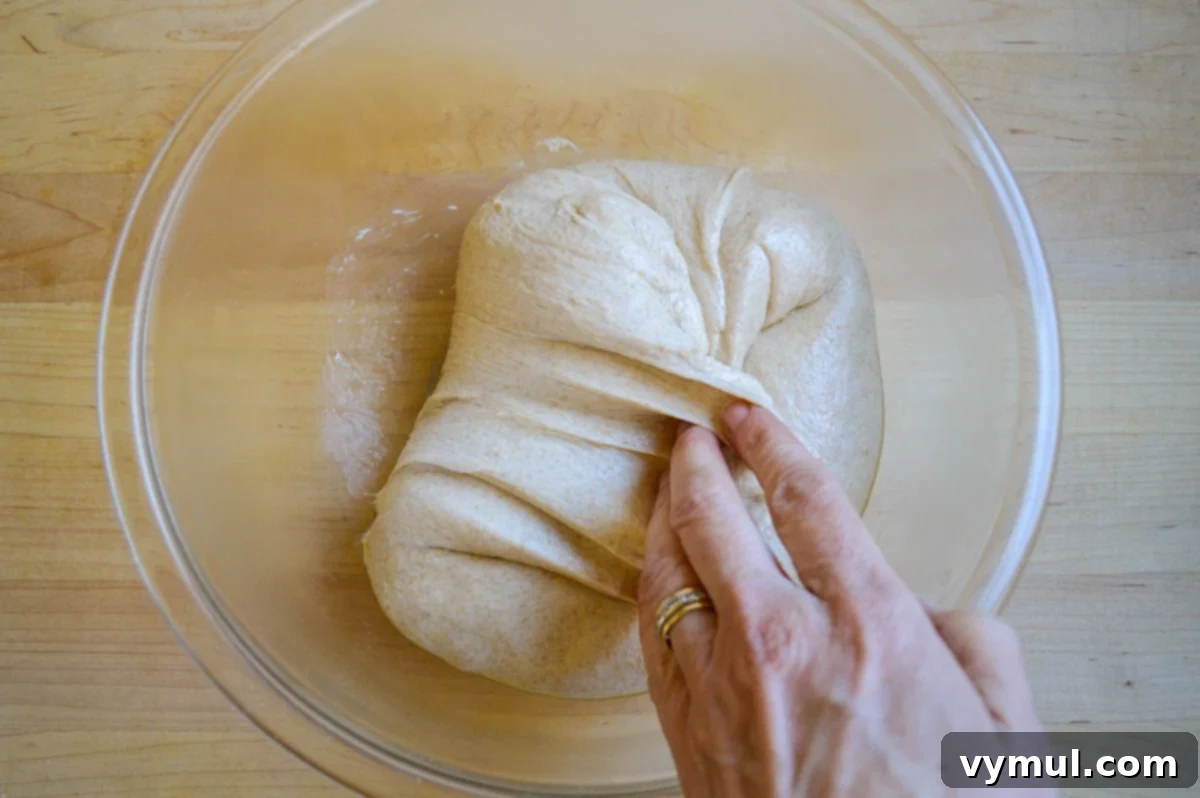
Step 5: The Gentle Stretch and Fold. During the 3-hour initial rise, perform one or two “stretch and fold” sessions. This technique involves gently pulling an edge of the dough up and folding it towards the center, then rotating the bowl and repeating with other edges. This process helps to strengthen the gluten structure, redistribute the yeast and nutrients, and build elasticity without requiring aggressive kneading. It’s a crucial step for achieving that desirable open crumb.
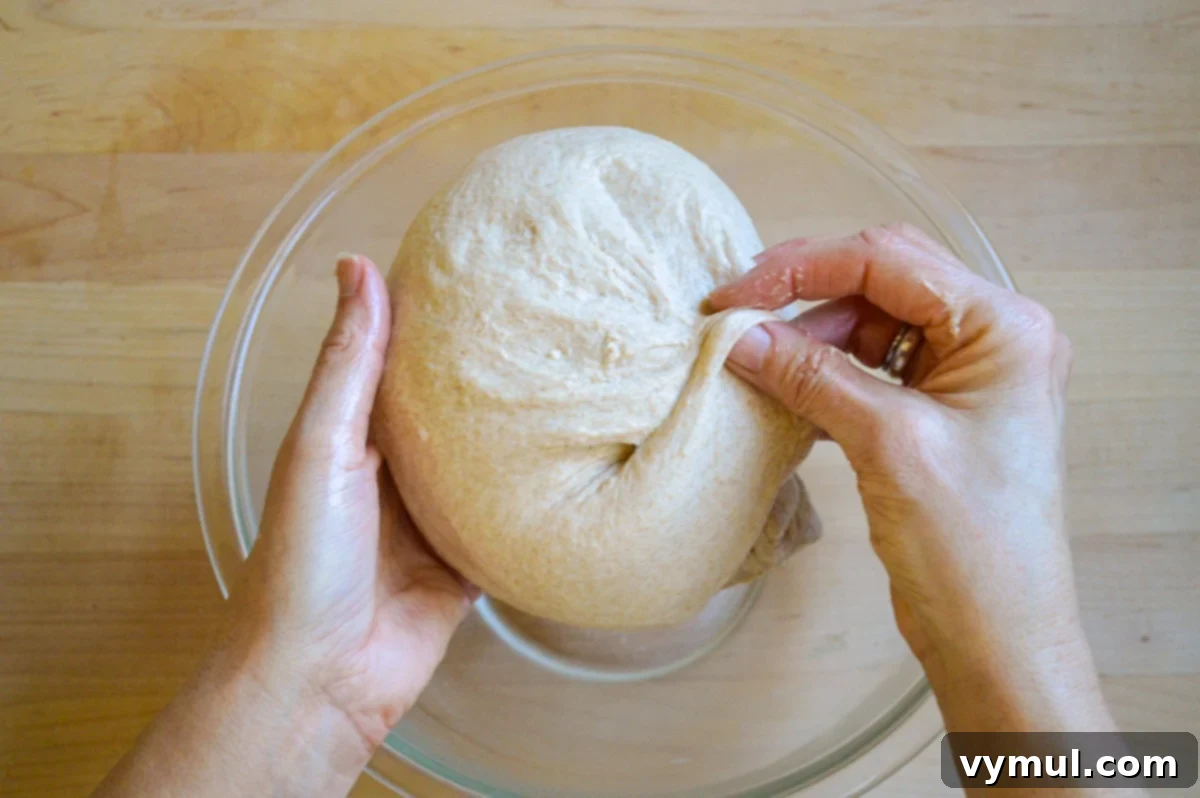
Step 6: Second Rise and Final Shaping Prep. After the initial 3-hour rise and stretch and folds, carefully remove the dough from the bowl. Perform another gentle turn and fold, ensuring you create some surface tension. Place the dough back into the bowl, this time with the seam-side facing up. Cover it again and allow it to rise for another 2 hours. This second rise allows the dough to continue developing flavor and structure before its final shaping.
TIP: Efficient Dough Handling. I typically perform the stretch and folds directly over the bowl. The slight oil residue from the dough on my hands is usually sufficient. If your hands feel too sticky, simply add a tiny bit more oil. For a visual demonstration and further guidance on this technique, refer to the recipe video.
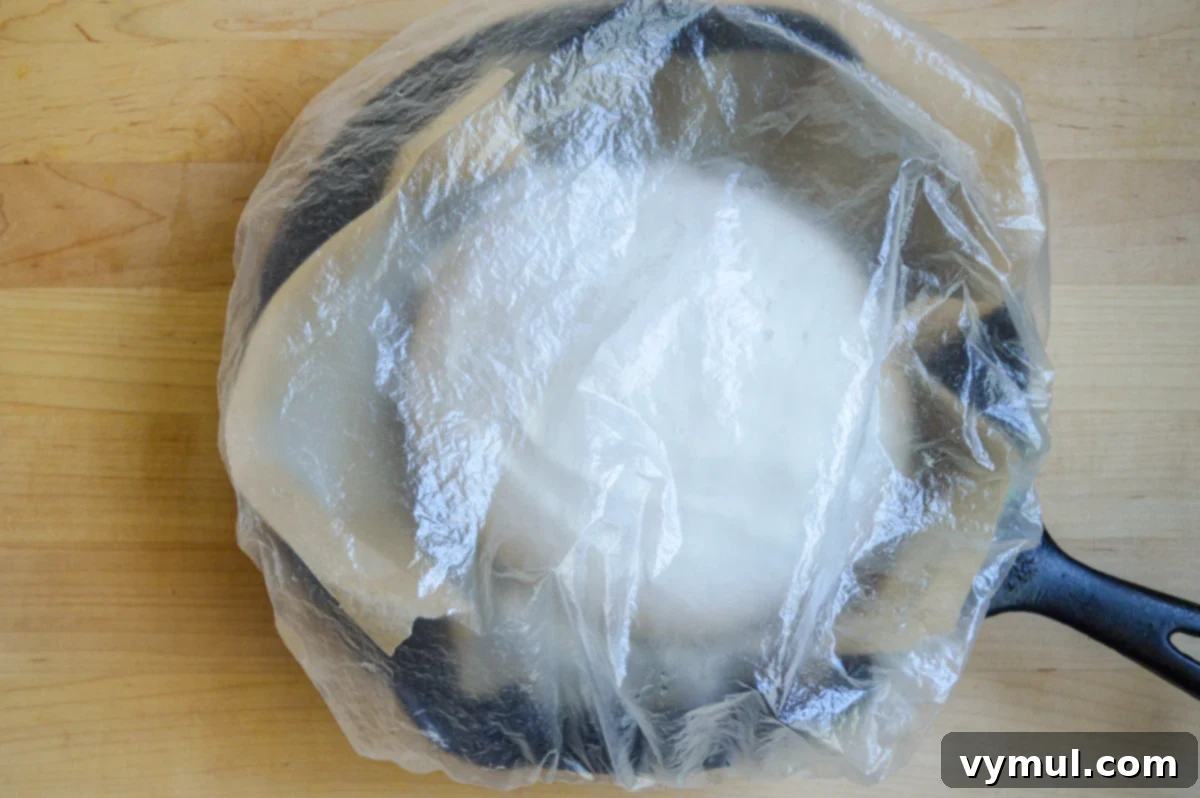
Step 7: Final Shaping and Proofing. After the second rise, gently turn the dough out onto a piece of parchment paper placed on a cookie sheet or a small skillet (see tip below for skillet use). Sprinkle the dough generously with flour. With well-floured hands, gently shape the dough into your desired boule (round) or oval right over the parchment. The dough will be moist, so liberal flouring is key to prevent sticking. Ensure there’s a good coating of flour on the top surface, as this will make scoring the loaf easier later. Replace the cover for this final proofing stage.
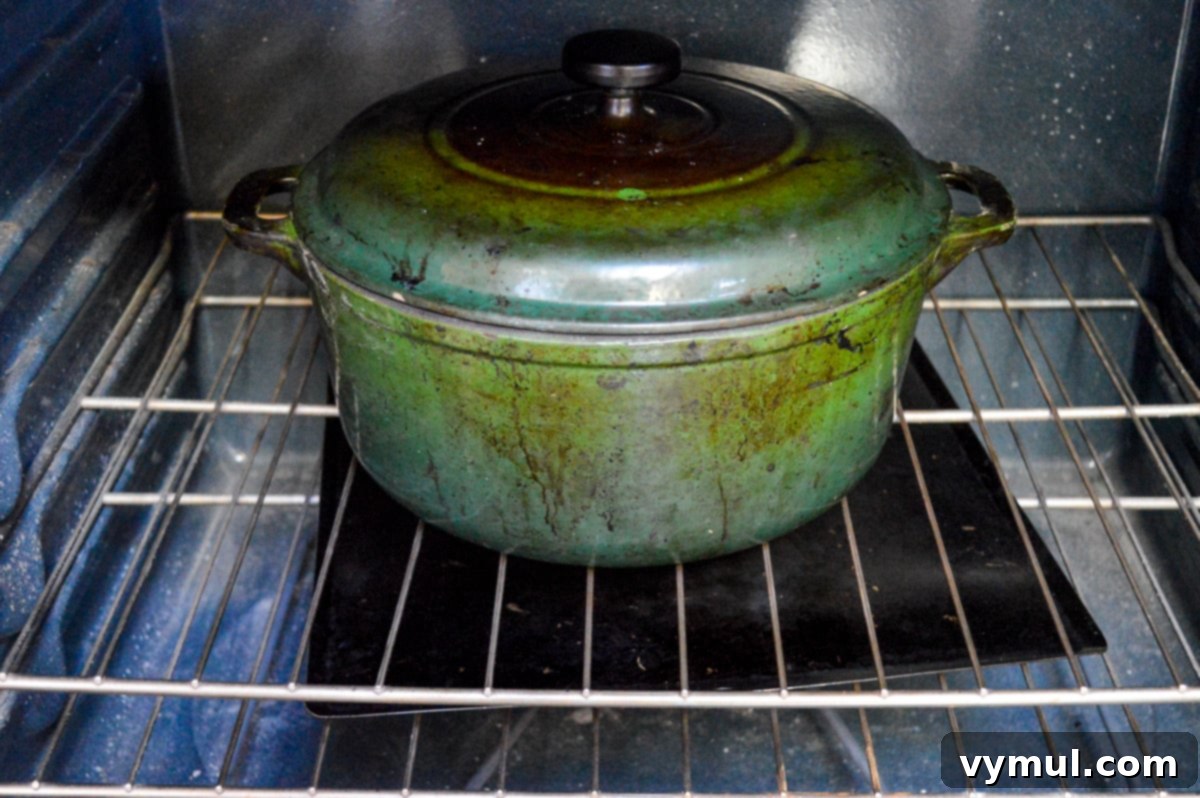
Step 8: Preheating for Optimal Bake. While your shaped dough undergoes its final proof at room temperature, prepare your baking vessel. Place an empty 4-6 quart enameled cast iron (or regular cast iron) Dutch oven into a cold oven. Set the oven temperature to 450°F (230°C) and set a timer for 40 minutes. This ensures the Dutch oven is thoroughly heated, which is crucial for creating the perfect crust. Alternatively, you can use a baking stone. (Refer to the FAQs below for detailed instructions on baking without a Dutch oven.)
TIP 1: Enhancing Dough Shape and Tension. After placing the dough on the parchment, I often flour my fingers and use them to gently push the edges of the loaf underneath. This technique helps to create a more compact shape and increases the surface tension, both of which contribute to a better rise and a more aesthetically pleasing loaf. Watch the video for a clearer demonstration.
TIP 2: Skillet vs. Banneton for Proofing. Shaping the dough directly into a small oven-safe skillet can prevent the edges from spreading as much as they might on a flat cookie sheet, helping to maintain a higher profile. If you own a bread proofing basket (banneton), this is an excellent alternative for the final rise, imparting a lovely floured pattern to your loaf.
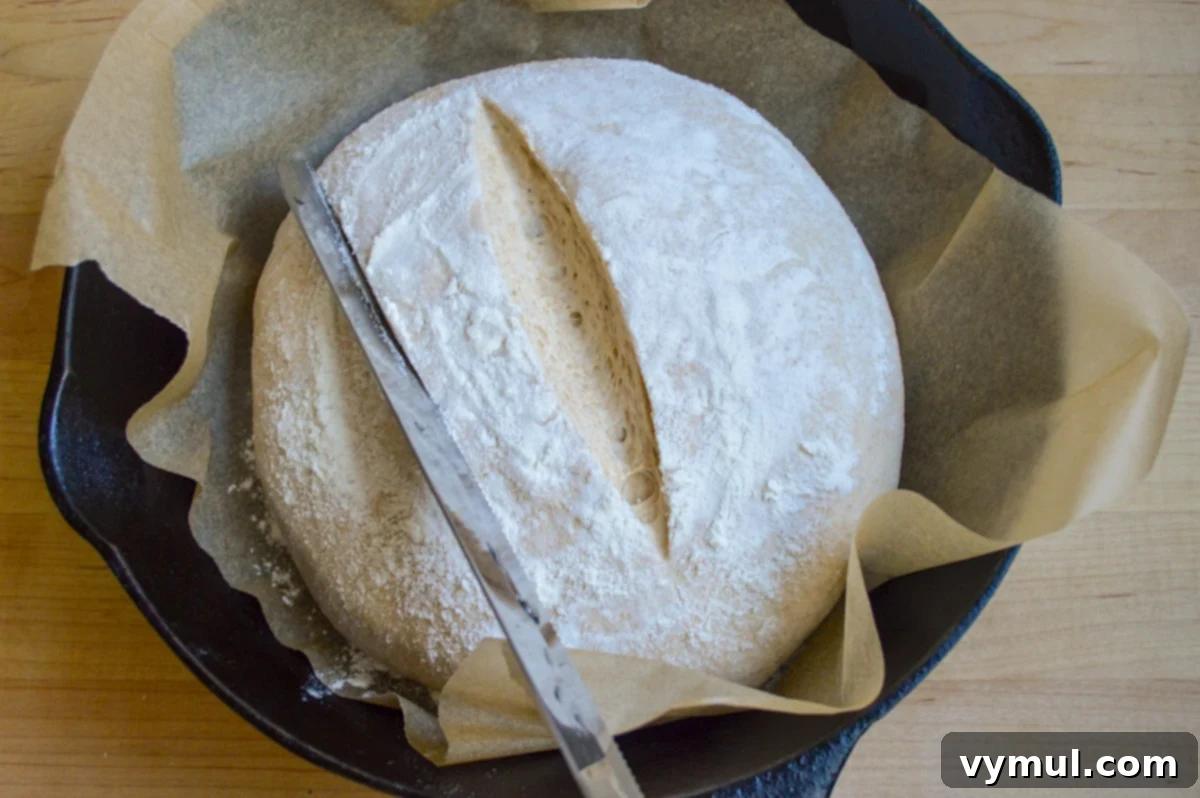
Step 9: Scoring Your Loaf. Once the 40-minute preheating timer goes off, carefully remove the dough’s cover. Using a sharp serrated knife or a bread lame (a specialized scoring tool), make 2-3 slashes on the top surface of the loaf. These cuts allow the bread to expand predictably in the oven, creating beautiful “ears” and preventing uncontrolled cracks. You can create a simple cross, a few parallel lines, or more intricate patterns to personalize your bread.
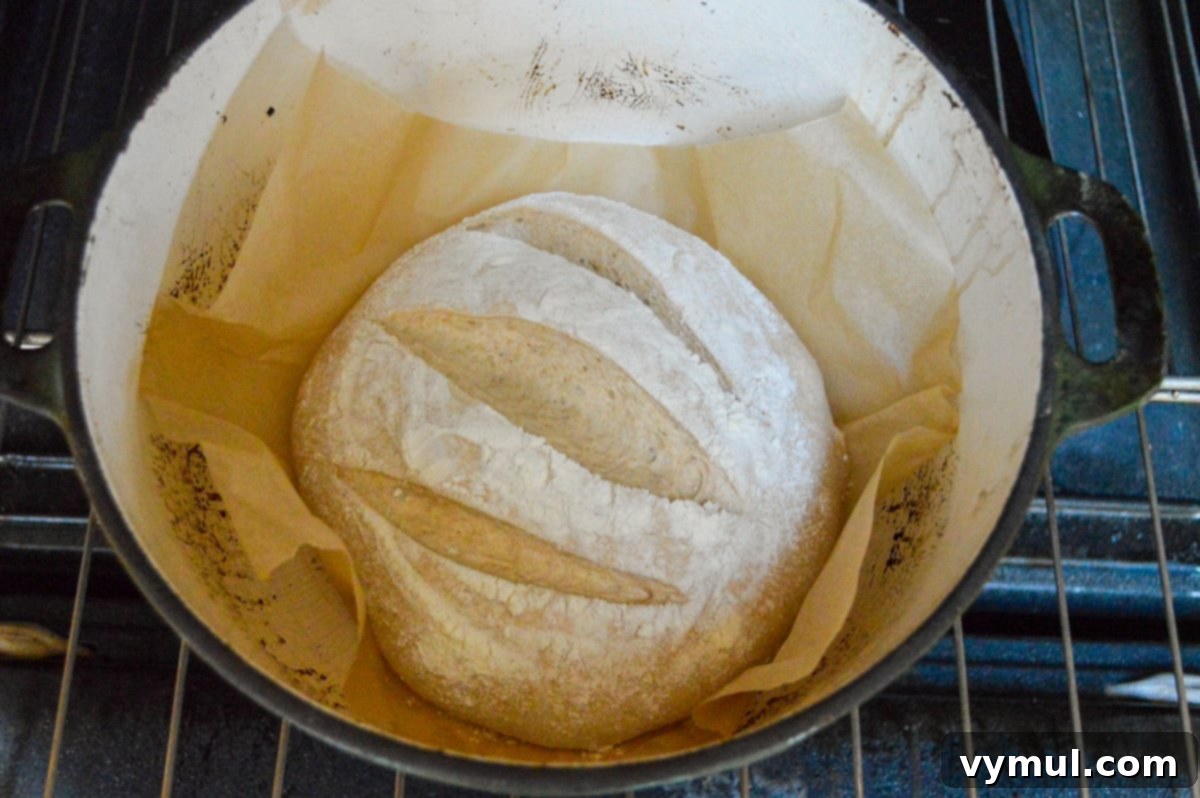
Step 10: Baking with Initial Steam. Carefully transfer the scored loaf, still on its parchment paper, into the preheated Dutch oven (or onto your baking stone). The parchment paper acts as a sling, making it easy to gently lower the dough without burning yourself. The bread will bake directly on the parchment within the pot. The high heat and trapped steam from the covered Dutch oven are critical for achieving that signature blistered, crispy sourdough crust.
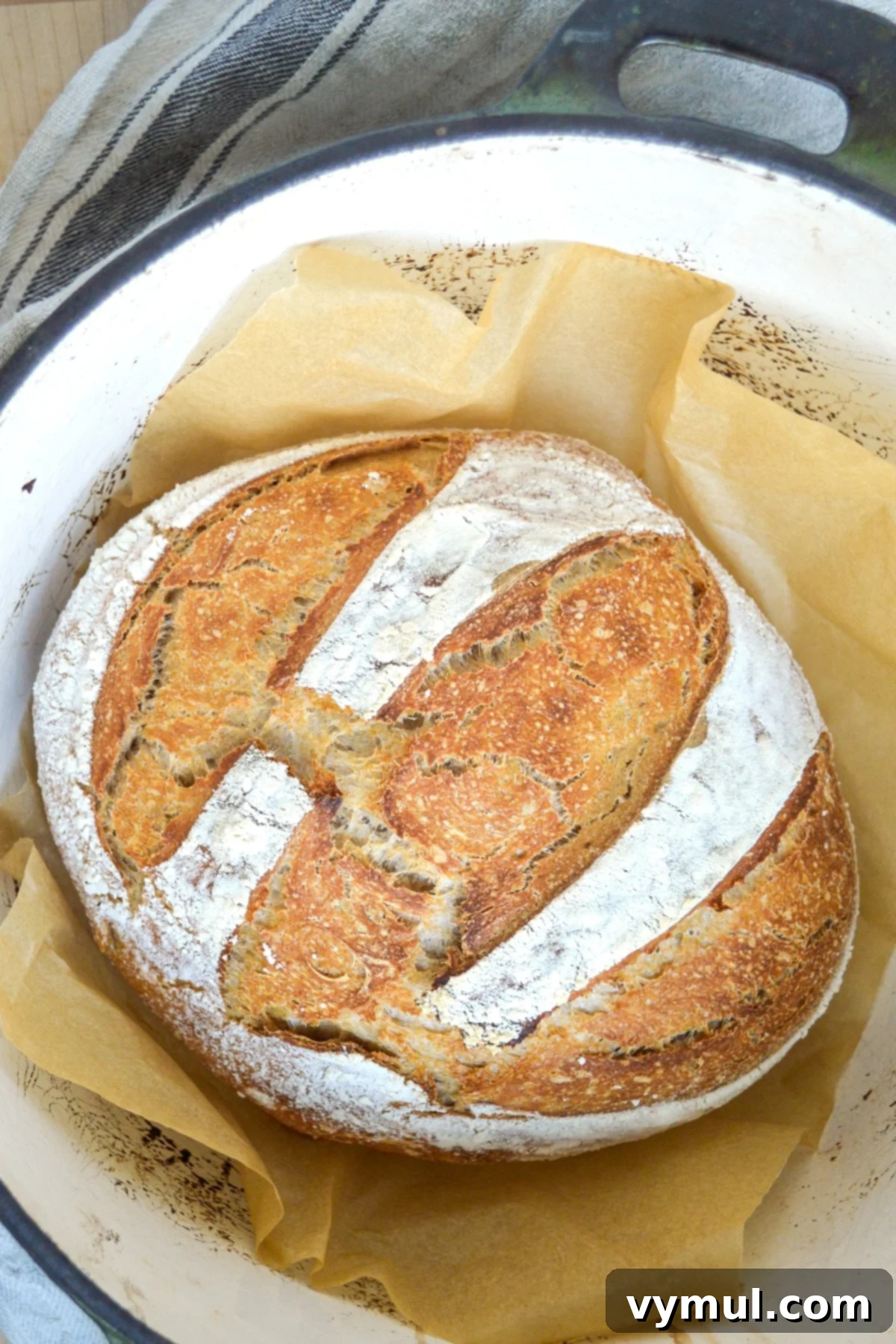
Step 11: The Perfect Crust and Internal Bake. Replace the hot lid on the Dutch oven and bake for 12-15 minutes. This initial covered bake steams the bread, allowing for maximum oven spring and crust development. After this period, remove the lid and continue baking for another 13-15 minutes, or until the loaf achieves a beautiful golden-brown color and its internal temperature reaches 190-200°F (88-93°C) when checked with an instant-read thermometer. The uncovered baking allows the crust to crisp up and develop its characteristic blisters. Look at that crust! That’s true bread-beauty right there—blistered, cracked, and bubbly. You can see why I consider this easy sourdough bread recipe the absolute best!
Exploring Flour Varieties: White vs. Whole Wheat Sourdough
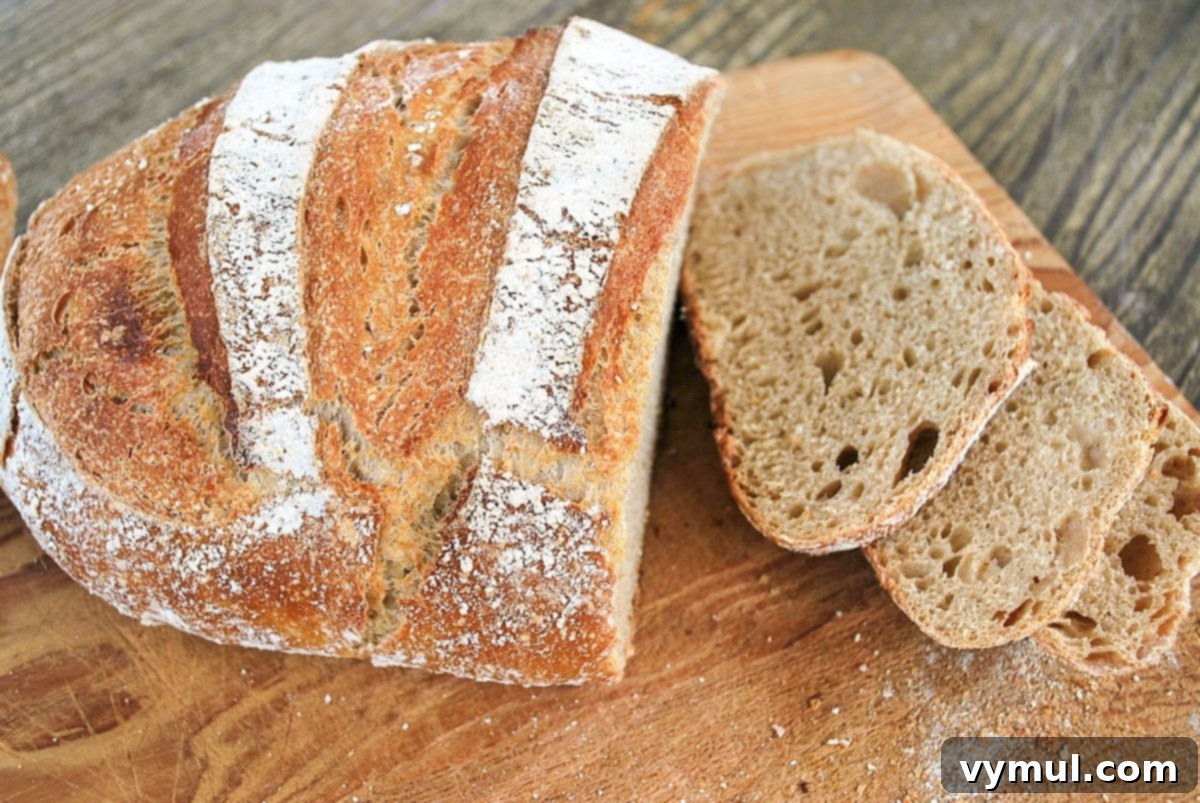
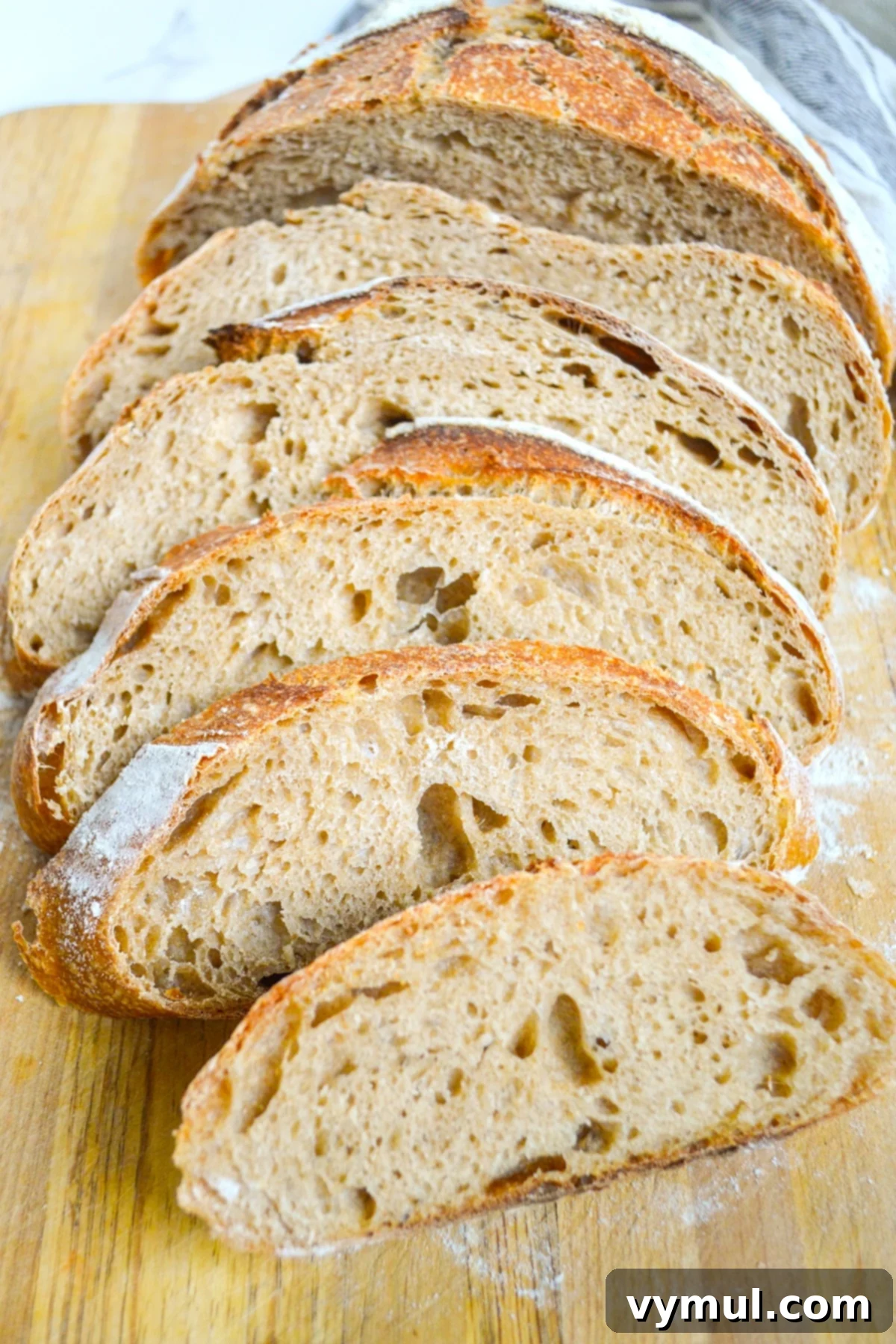
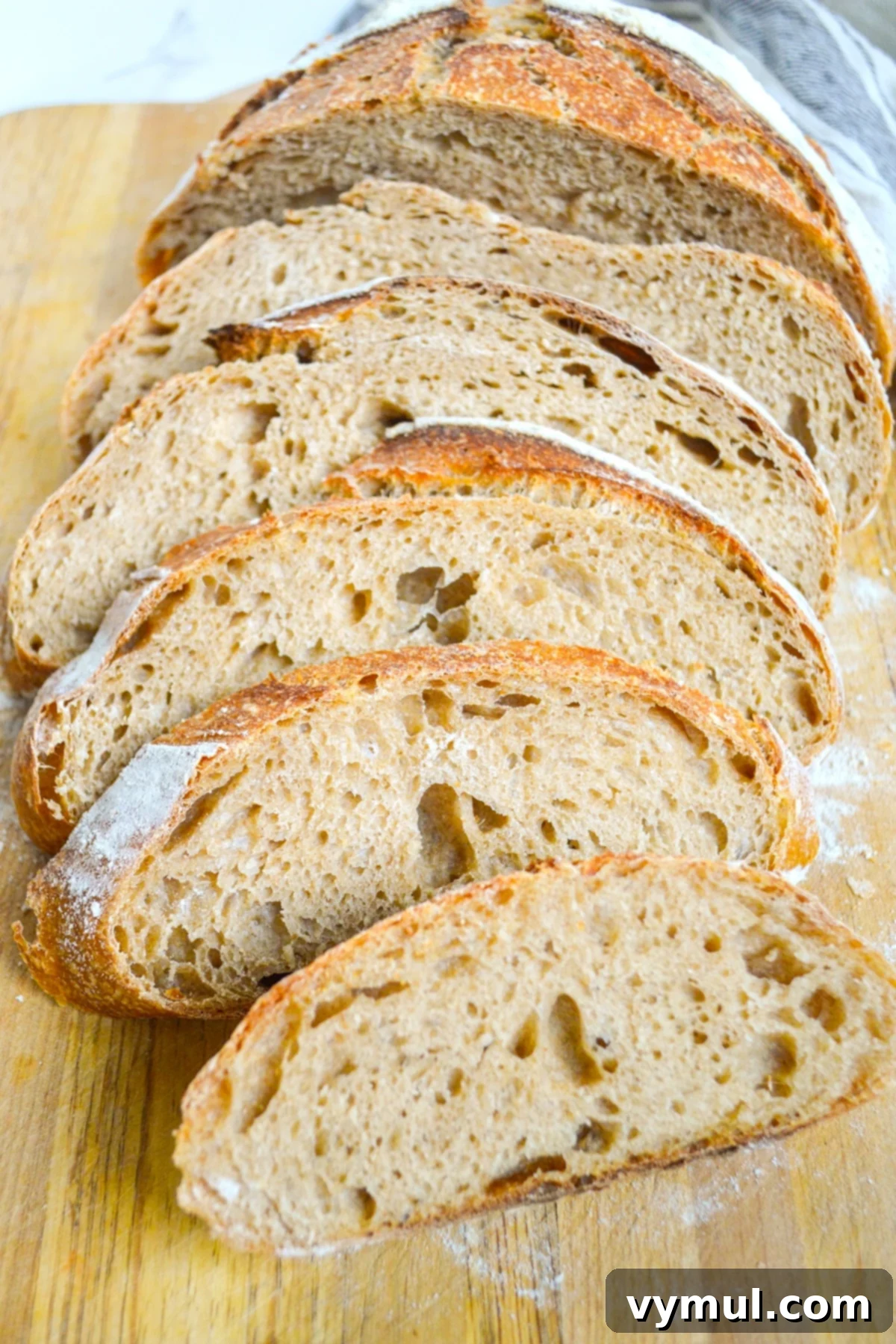
While the previous images showcase loaves made with white whole wheat flour, the sliced loaf pictured above was crafted using 100% whole wheat bread flour. This particular flour choice results in a crust that, while still fantastic, might not achieve the exact same level of delicate blistering as a loaf made with white or white whole wheat flour. However, it unequivocally passes the taste and texture test.
The interior crumb of a whole wheat bread flour loaf tends to be a bit denser, yet it remains wonderfully full of holes, retaining a delightful chewiness, and offering that signature subtle sourness. It’s perfection in its own right! (A quick note: if you use all regular whole wheat flour, the crumb will be noticeably denser with only tiny holes, but in my opinion, it’s still incredibly satisfying and flavorful.) This recipe’s versatility in accommodating various flours means you can experiment and find your personal favorite. Since maintaining a sourdough starter is most beneficial when used weekly or bi-weekly, I now find myself baking this effortless sourdough recipe more frequently than my beloved easy yeast artisan bread. Both are absolute winners in my kitchen!
The Critical Role of a Strong Sourdough Starter for Successful Baking
I’ve received numerous comments about this recipe, often along the lines of, “great flavor, but it was so flat,” or “I let it rise all day and it didn’t double.” These experiences highlight a fundamental truth on the sourdough journey:
You cannot expect a new sourdough starter to effectively raise bread. It requires sufficient time to grow, mature, and strengthen its yeast and bacteria cultures to achieve the necessary leavening power.
While intensive feeding might accelerate the process, it typically takes several weeks, or even up to a month, for a starter to become consistently robust enough to reliably raise a loaf of bread. Patience is truly a virtue in sourdough baking.
How can you confidently determine if your sourdough starter is strong enough for baking?
Here’s the simplest and most reliable test I use:
If your fed sourdough starter consistently doubles in volume in 6 hours or less, it possesses the strength required to effectively raise bread.
To accurately measure its rise, consider using a piece of tape on the outside of your starter jar or a dedicated rising bucket – anything that clearly allows you to observe its doubling. Once your starter confidently meets this benchmark, you can proceed with this recipe, assured of a successful rise! Many bakers also mention the “float test” (where a small piece of starter is dropped into water to see if it floats). While sometimes useful, I find that when working specifically with whole grain starters, the doubling test provides a much more accurate and consistent guideline for strength.
Utilizing Your Sourdough Discard: Delicious Recipes for Weaker Starter
It’s common to accumulate sourdough discard while waiting for your starter to reach optimal strength or during regular feedings. Don’t let it go to waste! There are countless delicious recipes that don’t rely on the wild yeast for a full, dramatic rise, making them perfect for using your discard. Here are some of my favorite baked goods:
- Crispy Whole Wheat Sourdough Crackers
- Fluffy Sourdough English Muffins
- Delightful Sourdough Waffles
- Savory Sourdough Cheese Batter Bread (This is an excellent option when your starter is almost ready for full bread baking; the batter still produces a lovely bread texture without needing as significant a rise.)
For an even wider array of unique and delicious ways to make the most of your sourdough discard, be sure to explore this incredible list of 35 sourdough discard recipes!
Essential Equipment for Your Sourdough Baking Success
Having the right tools can make all the difference in your sourdough baking journey. These are the items I recommend for consistently great results with this recipe:
- This excellent quality, affordably pricedenameled cast iron Dutch oven is very similar to the one I use and is perfect for achieving that signature crust. Here’s another fantastic, slightly more budget-friendly option that performs beautifully.
- I’ve relied on Kitchenaid mixers for years to effortlessly knead all my bread doughs. This is the current model, a robust workhorse for any home baker.
- This convenientrising bucket offers ample space and clear markings, making it easy to observe your starter doubling in volume. Personally, I prefer to use my glass 2-quart measuring cup with a lid for feeding and tracking my starter.
- This is my absolute favorite brand ofwhite whole wheat flour, crafted from hard white wheat, offering a lighter texture than traditional whole wheat.
- And for my daily starter feedings, I consistently use this reliable brand forhard red wheat flour (often referred to as ‘regular’ whole wheat).
Perfect Timing: Your One-Day Sourdough Baking Schedule
Initially, figuring out the timing for sourdough bread can be a bit challenging, as it requires a longer rise compared to traditional yeast breads. To help you master the process, here’s a typical timeline to ensure you can enjoy a freshly baked artisan loaf for dinner on the same day:
To ensure your sourdough artisan bread is perfectly ready for an evening dinner:
- The Night Before: Feed your sourdough starter. This gives it ample time to become robust and active overnight, reaching its peak leavening power by morning.
- Early Morning: Begin the sourdough artisan bread recipe the very next morning. This provides sufficient time for the dough’s essential bulk fermentation and proofing stages.
- Early Afternoon: Allow the dough to complete its final rise. You can then bake and cool the loaf, ensuring it’s at the perfect temperature to be sliced and served with your dinner.
What if you forgot to feed your starter the night before? Don’t panic, it happens to even the most seasoned bakers! If you find yourself in this situation, simply feed your starter first thing in the morning. Let it sit for a couple of hours until it’s visibly bubbly and active, then proceed with the recipe as usual. While a slightly rushed starter might result in a loaf that cools for a shorter period and has a marginally denser crumb, the difference is often negligible, and a warm, fresh loaf is always a delight!
Frequently Asked Sourdough Questions (FAQs)
Absolutely! Cold proofing (retarding) the dough in the refrigerator overnight is an excellent technique. It allows for a slower, longer fermentation, which develops a more complex flavor in your sourdough. For the second rise, simply place the shaped dough in the refrigerator. The next day, let the dough come back to room temperature for about an hour before you begin to preheat your pot and oven, then proceed with slashing and baking.
While a Dutch oven provides the best results for a truly crusty artisan loaf due to its ability to trap steam, you can still achieve a wonderful bread without one. Here’s how:
– After shaping the loaf on parchment paper (either on your counter or in a small skillet), place a baking stone, a cast iron skillet, or a heavy-duty cookie sheet into a cold oven and preheat to 450°F (230°C).
–Creating Steam: To emulate the steam trapped by a Dutch oven (which is vital for a crispy crust and excellent oven spring), you have a few options:
- Place a shallow pan of water on the bottom rack of your oven while it preheats with your baking surface.
- Alternatively, just before placing the dough in the hot oven, spray the loaf generously with water.
Experiment to see which method you prefer. You can also try covering the dough with a deep, oven-safe lid that fits over it, or tenting aluminum foil over the loaf to trap steam during the initial bake.
–Baking: Once the oven is preheated, carefully slash your dough. Use the parchment paper corners to gently transfer the dough onto your hot baking stone or chosen surface. Bake for 15 minutes. Then, turn the dough halfway (if not covered with a lid or foil) and continue baking for another 15 to 20-25 minutes, or until it’s beautifully golden brown and cooked through.
Any desired add-ins can be kneaded directly into the dough during Step 2 of the instructions. This is after the initial 15-minute rest and while the dough is being kneaded in the stand mixer or by hand. This timing ensures the ingredients are evenly distributed throughout the loaf.
Hear From Happy Bakers: More Reader Raves
“Wanted to tell you your sourdough recipe was the best and easiest! It tasted great and I felt like I accomplished my dream of finally making sourdough!” -Stephanie
“Here’s another thank you for the simple recipe. I have been struggling to find one that wasn’t so overwhelming; I don’t want to understand every minute detail of science….I just wanna bake some bread! This is the only recipe that I’ve had success with.” -Brittney
“Since I am new to sourdough, I was skeptical that this would work on my first try. It turned out fantastic.” -Helen
“Thank you for this awesome video! A friend gave me a jar of starter over a month ago and I was hesitant and unsure of how to proceed after watching other videos online. I made my first loaf ever last night and it was incredible. I really appreciate your video, it’s like you’re in my kitchen helping me along the way. All of your tips were super helpful and I now love making bread!” -Tracy
I genuinely hope you fall in love with this easy sourdough artisan bread recipe as much as my family and I have. If you bake it, please consider leaving a recipe rating and sharing your experience – your feedback helps fellow bakers!

Print Recipe
Pin Recipe
SaveSaved!
Easy Sourdough Artisan Bread Recipe
Equipment
-
stand mixer or suitable for hand kneading
-
4-6 quart enameled or regular cast iron pot or a baking stone/cookie sheet with a steam bath
-
Parchment Paper
Ingredients
- 3 to 3½ cups (360-400 g) flour white whole wheat, whole wheat, unbleached all-purpose, or a combination
- 1 ¼ cups (300 g) warm water*
- ¾ cup (150 g) active sourdough starter 75%-100% hydration (I find 80-90% optimal)
- 1 tablespoon (21 g) honey**
- 1 ½ teaspoons (9 g) salt adjust to your preference
Instructions
-
Combine all ingredients (flour, water, active starter, optional honey, and salt) in the bowl of a stand mixer or a large mixing bowl. Mix just until everything is thoroughly combined and no dry patches of flour remain. Let the dough rest for 15 minutes to allow for initial hydration.
-
Using a dough hook on a stand mixer, knead the dough for 5 minutes until it becomes more elastic. If kneading by hand, work the dough for 8 to 10 minutes. (TIP: You may need to add a little more flour, a tablespoon at a time, during kneading to achieve the correct consistency. The dough should still cling slightly to the bottom of the bowl but clear the upper sides. It should feel tacky, but not stick heavily to your finger.)
-
Transfer the kneaded dough to a medium-sized bowl that has been lightly coated with oil. Ensure the dough is scraped cleanly from your mixing bowl. Cover the bowl securely with plastic wrap or a damp kitchen towel and let the dough rise at room temperature for 3 hours. During this first rise (bulk fermentation), perform one or two gentle stretch and folds, as described in Step 5 of the main article.
-
After the 3-hour rise, gently remove the dough from the bowl. Perform another turn and fold with lightly oiled hands, shaping the dough into a taut ball. Place it back into the bowl, seam-side up. Cover again and allow it to rise for another 2 hours. TIP: I usually do this directly over the bowl, and the residual oil from the dough is often enough to prevent sticking. Add more oil to your hands if needed.
-
Once the second rise is complete, prepare for final shaping. Place a square of parchment paper on a cookie sheet or inside a small skillet (see tip below). Generously sprinkle the dough with flour. Gently shape the dough into a ball (boule) or oval directly over the parchment with floured hands, as the dough will be moist. To enhance the shape and surface tension, I often flour my fingers and tuck the edges of the loaf underneath. Ensure the top surface has a good coating of flour, which will assist with scoring later.
-
To Bake with a Dutch Oven: While your shaped dough is resting for its final proof, place an empty enameled cast iron (or regular cast iron) Dutch oven into a cold oven. Preheat the oven to 450°F (230°C) and set a timer for 40 minutes. This ensures the pot is thoroughly preheated for optimal crust development.
-
When the 40-minute timer sounds, carefully slash the top of the loaf with a serrated knife or bread lame (making 2-3 cuts) in your desired pattern. Using the parchment paper as a sling, gently transfer the scored loaf into the preheated Dutch oven. The bread will bake while remaining on the parchment.
-
Replace the hot lid on the Dutch oven and bake for 12-15 minutes. This initial covered period creates essential steam for a fantastic crust. After 12-15 minutes, remove the lid and continue baking for another 13-15 minutes, or until the loaf achieves a deep golden brown color and an internal temperature of 190-200°F (88-93°C).
-
To Bake without a Dutch Oven: If you don’t have a Dutch oven, prepare by placing a baking stone, cast iron skillet, or sturdy cookie sheet into a cold oven and preheating it to 450°F (230°C).
Creating Steam: To achieve a crisp crust, you’ll need to create steam. Place a shallow pan of water on the bottom rack of your oven while it preheats, or spray the dough generously with water just before placing it into the hot oven. Alternatively, cover the dough with a deep, oven-safe lid or tent aluminum foil over it during the initial bake to trap moisture.
Baking: Slash the dough as desired, then use the parchment paper corners to transfer it to your hot baking surface. Bake for 15 minutes, turning the dough halfway if necessary. Continue baking for an additional 15 to 25 minutes, until the bread is golden brown and cooked through.
-
Once baked, carefully remove the bread from the oven and transfer it to a wire rack to cool completely. It’s crucial to let it cool for at least 30 minutes (ideally longer) before slicing to allow the internal structure to set.
Notes
**Honey is an optional ingredient that aids in crust browning and provides a slight energy boost for the wild yeast, contributing to a better rise and flavor.
Slicing Tip: For beautifully clean slices of crusty artisan bread, especially when warm, consider using a high-quality serrated knife. For ultimate ease, an electric knife works like a charm and cuts through even warm loaves without squishing the delicate crumb.
Variations: Feel free to experiment with flavor! Chopped fresh herbs, dried fruits, nuts, or olives can be kneaded into the dough during Step 2 to create unique and delicious variations of this artisan bread.
Nutrition
Expand Your Sourdough Horizons: More Delicious Recipes
Once you master this easy sourdough artisan bread, a world of sourdough possibilities opens up! Explore exciting recipes such as no-knead sourdough focaccia, a delightful sourdough lemon loaf, irresistibly soft sourdough bagels, and much more. You can find a comprehensive collection of diverse sourdough creations on the dedicated sourdough recipes page here.
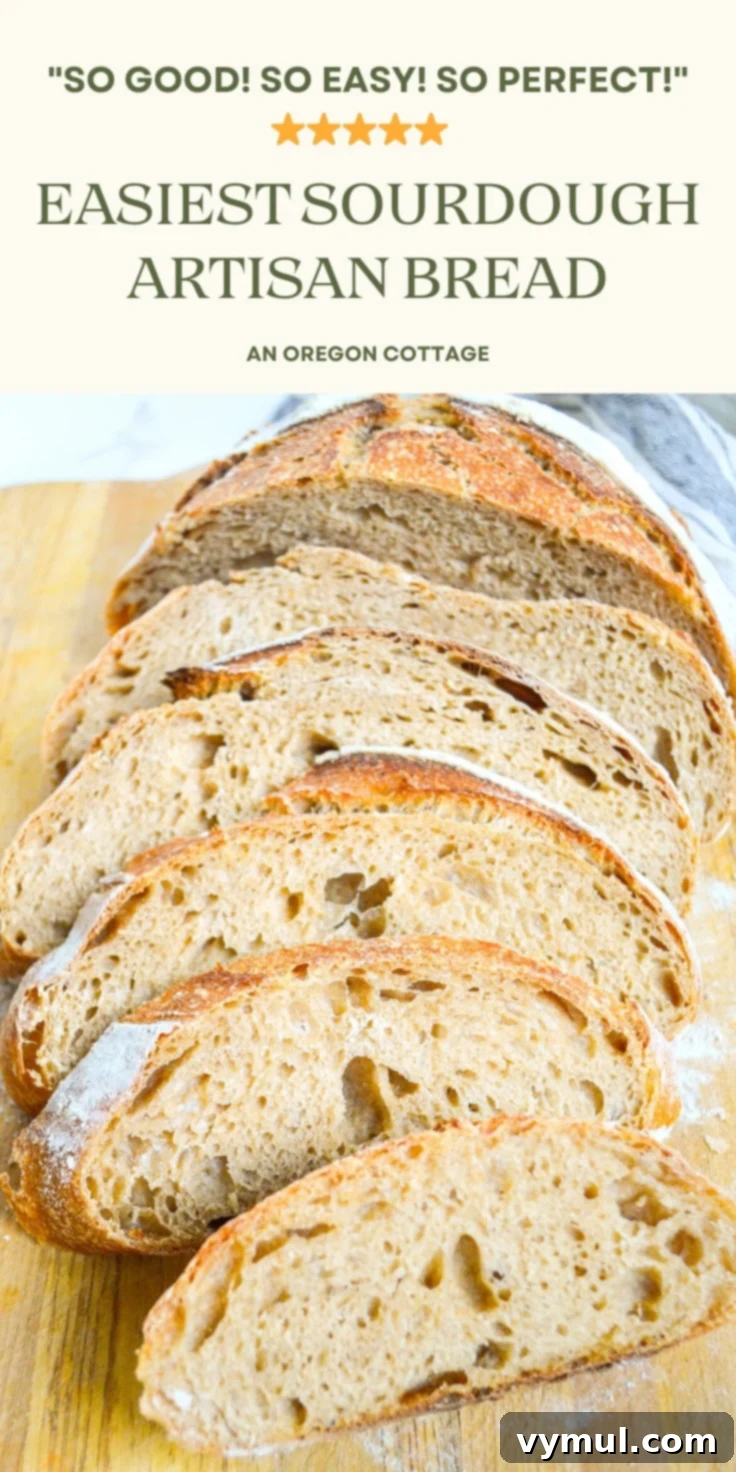
This recipe was originally published in 2012 and has been continually updated with the latest tips and techniques, most recently in 2025, to ensure the best possible baking experience for you.
Disclosure: Affiliate links within this article may generate a commission based on sales, but this does not alter your purchase price. Click here to review our full disclaimer and advertising disclosure policy.