DIY Painted Barn Quilts: Transform Your Home with Rustic Charm
Barn quilts offer a unique blend of traditional artistry and modern farmhouse appeal, making them a captivating decor choice for both expansive outdoor spaces and cozy interiors. Imagine transforming a large, empty wall in your home with a vibrant, handcrafted piece of art that tells a story and adds character. This comprehensive tutorial will guide you through the process of painting a beautiful barn quilt on beadboard or plywood, creating a bespoke piece of decor that’s perfect for your own home or as a truly special handmade gift.
2018 Update: We love seeing how these projects evolve! Mary, whose original barn quilt inspired this guide, has since repainted her creation to complement a fresh room makeover. Scroll to the bottom to see her stunning new version and get inspired by the versatility of this DIY project!
We’re thrilled to feature a special guest post from Mary of Front Porch Ideas and More. When Mary shared her colorful and surprisingly easy barn quilt, crafted from recycled beadboard for her foyer, we knew we had to share it with you. It’s an incredibly clever and unique way to fill a significant wall space and makes for an unforgettable, personalized gift.
Barn quilts, often seen adorning the sides of rustic barns across the countryside, are quickly growing in popularity. These large, painted wooden squares featuring traditional quilt block patterns add an undeniable pop of color and charm to any rural landscape. In some states, dedicated “quilt trails” invite visitors to embark on scenic drives, using maps to discover and appreciate these beautifully decorated barns. But why limit their beauty to the outdoors?
Photo Source
Inspired by the beauty of these outdoor masterpieces, we wondered: why not bring the charm of a painted barn quilt inside? The good news is, you don’t need any sewing skills to create a magnificent piece of quilt art for your home. With just a piece of plywood or beadboard and a selection of paints, you can craft a stunning and unique decorative item or a heartfelt gift. This project is a fantastic alternative to traditional quilting, offering a much quicker and equally rewarding creative experience.
Project Overview: Painting Your Barn Quilt
This project is designed to be accessible for crafters of all skill levels. Here’s a quick look at what’s involved:
- Work Time: Approximately 2 hours (active painting and drawing)
- Drying Time: 1 day (allows for paint layers and sealant to fully cure)
- Total Time: Roughly 1 day and 2 hours (including drying periods)
- Makes: 1 custom barn quilt
- Author: Jami Boys, with inspiration from Mary
- Estimated Cost: Around $17 (can vary based on materials already on hand)
Materials and Tools You’ll Need
Gathering your supplies is the first step towards creating your stunning barn quilt. Most of these items are readily available at hardware or craft stores, and you might even have some leftover paint around the house!
Materials:
- Plywood or Beadboard: One piece, typically cut to 4′ x 4′. A square shape is recommended for ease of pattern transfer, but you can adjust the size to fit your specific space. Beadboard offers a unique texture that adds dimension to the finished piece.
- Several Colors of Paint: You’ll be surprised how little paint is actually needed. Leftover house paint works wonderfully, and acrylic craft paints are also a great option. Choose colors that complement your existing decor or the recipient’s style.
- Outdoor Sealant (Optional): If you plan to display your barn quilt outdoors, a high-quality outdoor sealant is essential to protect it from the elements and ensure its longevity.
Tools:
- Pencil: For lightly sketching your chosen quilt pattern onto the board.
- Ruler: A long ruler or straight edge is crucial for accurate measurements and drawing straight lines.
- Painter’s Tape: High-quality painter’s tape with clean edges will help create crisp lines between your painted sections.
- Paintbrushes: A selection of brush sizes will be helpful for larger areas and detailed work.
- Hanging Apparatus: Choose a sturdy hanging system appropriate for the weight and size of your finished artwork. Options include D-rings, picture wire, or a French cleat.
Step-by-Step Instructions for Painting Your Barn Quilt
1. Choose Your Quilt Pattern
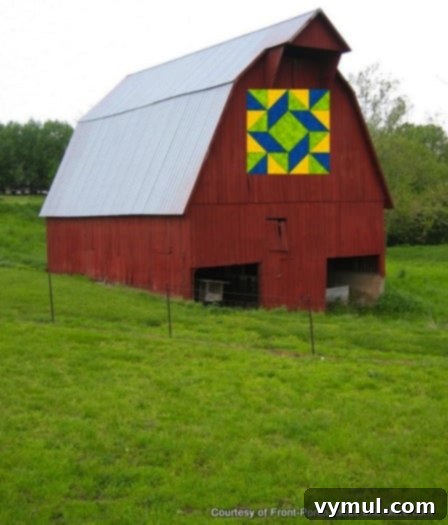
The beauty of a barn quilt lies in its geometric simplicity. For your first project, we highly recommend selecting a straightforward pattern without intricate curves. Classic quilt blocks like a basic “four-patch,” “nine-patch,” “star,” or simple geometric designs are ideal for beginners. My original wall art was inspired by a barn quilt I found on this Pinterest board. Although the inspiring image here might have been photoshopped onto a barn, its design still offers great inspiration! I chose colors that perfectly coordinated with my home’s existing decor: two shades of blue, a buttery gold, and a cheerful green. When selecting your pattern, consider the overall aesthetic you want to achieve and how the colors will interact.
2. Apply Your Base Coat
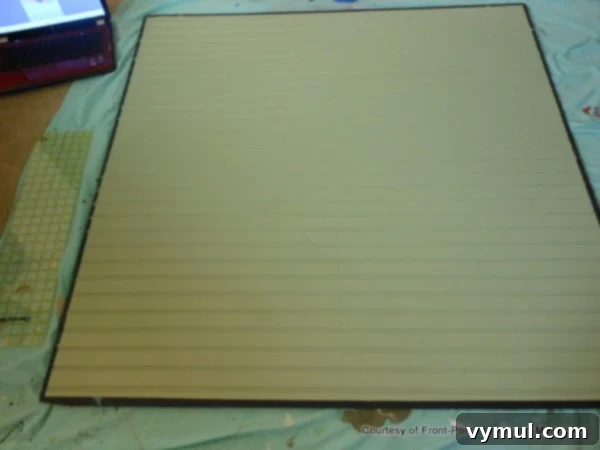
Begin by painting the entire board with a predominant color. If your chosen pattern doesn’t have a single dominant color, simply select one of your chosen hues to serve as the base. This step serves two important purposes: first, it provides an easy way to cover the entire board evenly, as subsequent painting will be focused on smaller, taped-off sections. Second, this initial coat acts as a primer, creating a smooth, consistent surface that will help your other colors adhere better and appear more vibrant. For my project, I applied a light green base coat and accented the edges with navy blue to add a subtle framing effect.
3. Draw Your Quilt Pattern
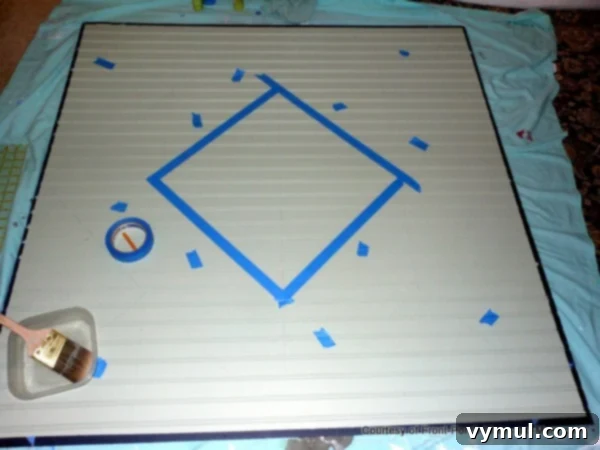
Once your base coat is completely dry, it’s time to transfer your quilt pattern onto the board. For my 4′ x 4′ beadboard, I divided the surface into 16 equal squares (4 across and 4 down) using a ruler and a light pencil. Think of your board as a giant grid, and lightly sketch in the lines of your chosen quilt pattern within this grid. Precision is key here, so take your time measuring. If you’ve opted for a simple pattern, this step should be quite straightforward. Don’t worry if your pencil lines aren’t perfectly visible in the photos – they just need to be clear enough for you to follow!
4. Mark Your Colors
To prevent any painting mishaps, it’s highly recommended to mark each section of your drawn pattern with its corresponding color. You can either write the color name directly within each section or, for a cleaner approach, dab a small touch of the intended paint color inside the lines. Another effective method is to use small pieces of painter’s tape, labeled with an initial for each color (e.g., “B” for blue, “G” for green). This visual reminder will save you from accidentally painting a section the wrong hue.
5. Begin Painting Your Quilt
Now for the fun part! Choose your first color and carefully mask off all the sections that will be painted with that particular shade using painter’s tape. Press the tape edges down firmly to minimize bleeding. Once taped, apply your paint. A helpful technique is to paint one color at a time across all its designated sections. This saves you from constantly washing your brush when moving between different colors. Remember to allow ample drying time between each color application to prevent smudging or mixing. For my project, I started with the medium blue sections, then moved to dark blue, followed by navy blue, and finally the gold. It’s much like a paint-by-number kit!
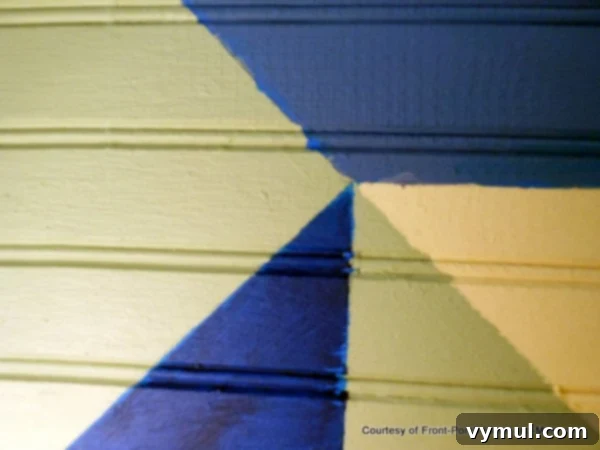
Don’t fret if you experience a little paint bleed, especially with textured surfaces like beadboard where paint might seep into the grooves. For crisper lines, you can try painting near the tape edges with a dry brush or even applying a thin layer of your base coat over the tape edges before adding your color to “seal” the tape. However, don’t strive for absolute perfection; a handmade look adds charm. Any minor bleeds can be touched up after the tape is removed and the paint is completely dry. My own wall art is far from perfect up close, but it still looks fantastic as an overall piece.
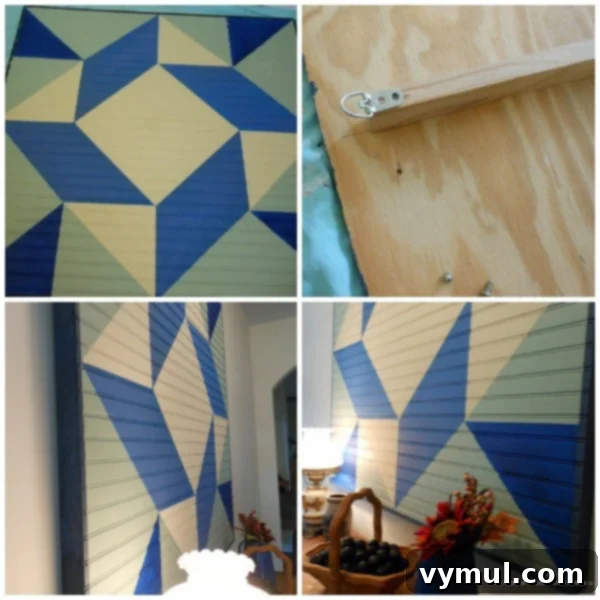
6. Edge and Hang Your Barn Quilt (Optional)
Once all your painting is complete and any small imperfections have been touched up, you might consider adding an optional finished edge. My husband constructed a simple “frame” for the beadboard using 3/4-inch by 1 1/2-inch slats, cut to the height and width of the board. These were secured with a nail gun, designed to make the artwork stand out about an inch from the wall, adding a professional and polished touch. We only framed the top, right, and left sides, as the bottom edge wouldn’t be visible. The blue “edging” you see in the photo is simply paint applied directly to the beadboard, matched to the color of the wooden frame for a seamless look.
Hanging Your Barn Quilt:
For hanging, we opted for loop-type picture hangers, spaced 16 inches apart, ensuring the heavy piece was securely hung from wall studs. Regardless of your chosen method (D-rings, wire, or a French cleat), always make sure it is rated to support the full weight of your barn quilt for safety. You can also display your artwork by simply resting it flat against a wall or atop a fireplace mantel for a more casual look.
Note for Outdoor Use: If you intend for your barn quilt to adorn an outdoor space or a real barn, apply a robust outdoor sealant designed for weather protection. Additionally, you may want to use nails or screws for extra security, especially in windy conditions, to prevent it from being dislodged.
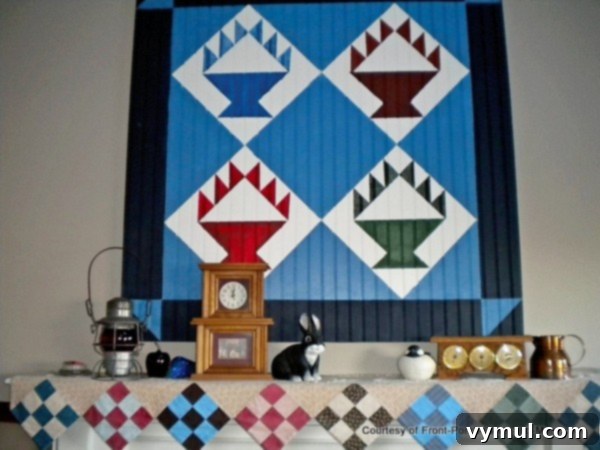
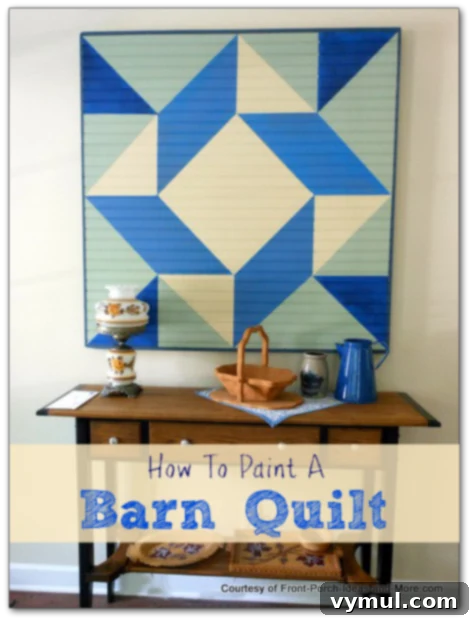
This was my original decorative barn quilt, featuring a classic basket pattern. The beauty of a DIY barn quilt is its adaptability. When we moved and wanted a change, I simply painted over this design to create a new one. This project offers incredible flexibility: if your decor changes or you simply desire a fresh look for your indoor barn quilt (or even one for your porch!), it’s incredibly easy to repaint and refresh your existing piece.
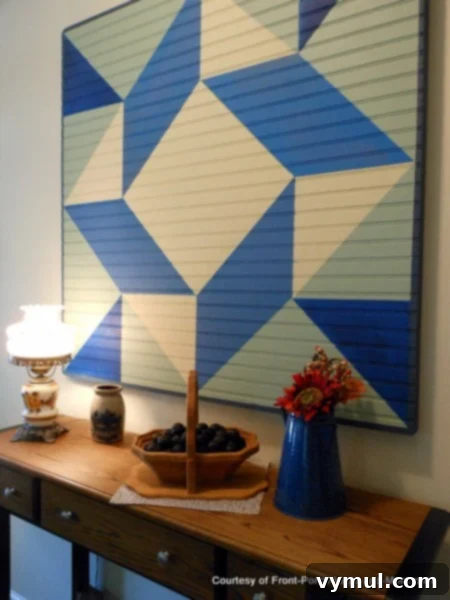
Our barn quilt consistently garners compliments and is a fantastic, eye-catching solution for filling a large, otherwise empty wall. It truly anchors the room and adds a personalized touch that store-bought decor simply can’t match.
Unleash Your Creativity: Try It for Yourself or as a Gift
We hope this tutorial inspires you to paint your very own barn quilt for your home. Whether it’s destined for a welcoming foyer, a cozy living room, or a charming front porch, this project is significantly quicker and often more satisfying than traditional fabric quilting. And the best part? You absolutely don’t need to be a professional artist. It truly is as simple and enjoyable as a paint-by-number project!
Imagine the possibilities: a striking trio of painted quilts on a wall, perhaps three smaller 1′ x 1′ squares displayed side-by-side. Or consider creating seasonal barn quilts to switch out throughout the year, adding festive cheer to your space. Have fun experimenting with patterns, colors, and arrangements!
A huge thank you to Jami for providing this wonderful platform to share my painted quilt project with all of you! It was truly an honor to be featured on An Oregon Cottage!
And thank you, Mary, for sharing such clear and inspiring instructions. I’m sure many readers, myself included, have some scrap beadboard just waiting to be transformed!
2018 Update: A Fresh Look for a New Room!
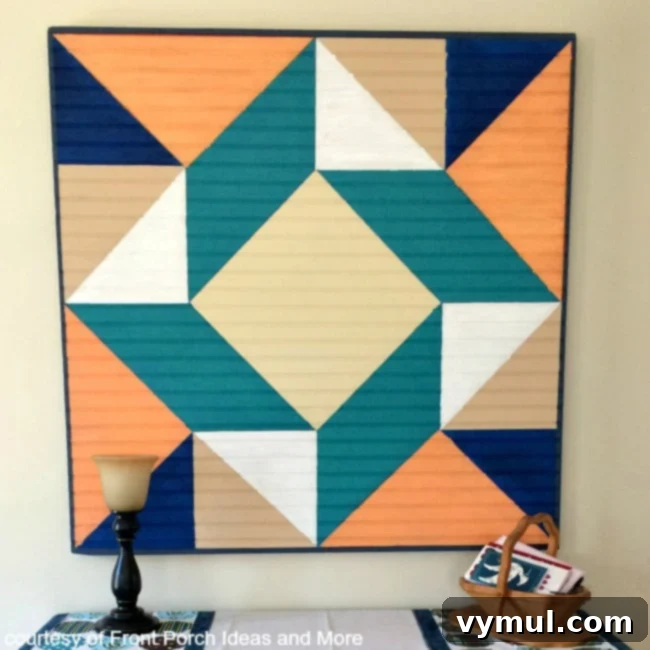
As promised, here’s Mary’s updated barn quilt! After redecorating her living room with new curtains, pillows, and rugs, she beautifully repainted her barn quilt to perfectly match her refreshed color scheme. This serves as a fantastic example and a great source of inspiration, showcasing how a simple change in paint colors can completely transform the look and feel of your artwork. This adaptability is one of the greatest benefits of creating something yourself – you have the freedom to change it whenever your style or decor evolves!
We’d absolutely love to see your barn quilt creations! Share your finished projects with us on Facebook or tag #anoregoncottage on Instagram to inspire our community.
For more fantastic porch decorating and building ideas, be sure to visit Mary and her husband Dave over at Front Porch Ideas and More. And if you’re looking for more inspiration for easy DIY gifts, check out our dedicated section or explore our Handmade Gifts Pinterest board!