Restoring a Century-Old Farmhouse: Main Bathroom Remodel Journey & Design Vision
Our comprehensive, to-the-studs bathroom remodel in a 100-year-old farmhouse is finally nearing completion! Join us as we explore the vintage-inspired decor plan and significant progress made in transforming our main bathroom.

We are thrilled to announce that our farmhouse fixer main bathroom remodel is just *this* close to being finished! This extensive project is a significant milestone in our journey to restore and revitalize our beloved 100-year-old farmhouse.
For those new to our adventure, my husband and I acquired this charming 100-year-old farmhouse, situated on three sprawling acres, back in January of 2018. Since then, our mission has been to systematically transform it into a sturdy, safe, and truly livable home. Our ability to reside in a manufactured home on the property during this process has been invaluable, allowing us to tackle a substantial portion of the renovation work ourselves, while carefully coordinating the aspects that required professional expertise.
The scale of this renovation has been immense, addressing foundational issues and outdated systems. Some of the major projects we’ve undertaken include:
- New Foundation & Plans for Addition: The original foundation was precariously balanced on rocks and boulders – a testament to its age but certainly not up to modern safety standards (you can see the initial state in our exterior before tour here). This monumental task consumed almost the entirety of our first year. Obtaining the building permit was the first hurdle, followed by the surprisingly challenging search for a qualified contractor in our area. Once a team was secured, the actual construction and finishing of the new stone foundation spanned four months. Similarly, finding an architect to draft and approve our addition plans also required considerable time and patience – a common experience for anyone undertaking major remodels.
- Siding, Dry Rot Repair, and New Window Moldings: After meticulously removing the old vinyl siding that had been added in a previous “remuddle,” we spent the remainder of the first year addressing pervasive dry rot and installing new, historically appropriate window moldings. This significantly improved the home’s structural integrity and curb appeal.
- Bedroom Bump-Out: Early in our second year, we undertook an 8-foot bump-out expansion to the back bedroom. This crucial addition was designed to finally accommodate a queen-sized bed, transforming it into a functional and comfortable main floor master bedroom, a modern necessity for our farmhouse living.
- Comprehensive Electrical and Plumbing Overhaul: Despite assurances that the electrical and plumbing had been updated, we quickly discovered a shoddy and unsafe system. Consequently, almost everything had to be replaced. We wisely enlisted a professional plumber for the bathroom and laundry areas, as fixtures were being relocated, and an electrician to move our main electrical box (which was awkwardly located on the exterior wall we were removing for the bump-out). Beyond these specialized tasks, Brian, with his incredible dedication, has personally handled all other electrical and plumbing repairs, ensuring everything is now up to code under our permit. The state of some of the original wiring and pipes we uncovered was truly shocking – it’s a wonder the house didn’t experience a catastrophic event! This extensive work spanned the rest of year two and continued into year three.
- Wall Removal and Load-Bearing Beam Installation: A significant structural alteration involved removing a wall between the kitchen and an enclosed porch. This created a more open and functional living space, necessitating the installation of a new load-bearing beam to support the structure above.
- Staircase Reconstruction: The original staircase was unsafe and not up to current building codes. We tore out the old structure and are currently awaiting our hired contractor to rebuild it to modern safety and code standards. This represents one of our last major structural tasks before we can proceed with installing new flooring and finishing the interior walls throughout the home.
As you can probably gather, this farmhouse has truly required a complete transformation, from its very foundations upwards. We’ve encountered numerous “remuddles” – ill-conceived renovations from previous owners that detracted from the home’s original character. Our efforts have focused on rectifying these, such as removing modern textured wallboard and meticulously rebuilding a wall in the main living area that was part of the original floor plan, bringing the house back to its authentic glory.
For a comprehensive look at our entire farmhouse renovation journey, including captivating before tours and detailed recaps of our progress, you can see all the farmhouse articles here.
With so much foundational and structural work now behind us, we are immensely excited to finally be on what feels like the home stretch to moving in! Our immediate goal has always been to make the main floor completely livable, allowing us to move into the farmhouse and then leisurely continue working on other areas – like the entire second floor, which awaits our attention – at our own pace.
The very first room we’re dedicating ourselves to finishing is the main bathroom, a project that has been ongoing for quite some time. If you’re a faithful follower of our Simple Homemade Life podcast, you’ve undoubtedly heard about our tiling trials and tribulations. You might also recall my surprise when I discovered that tiling a floor with larger format tiles was significantly easier and faster than the smaller, more intricate tiles I had tackled in previous projects. This unexpected revelation was a welcome boost to our DIY efforts.
However, I’ve yet to fully share my comprehensive vision for this crucial bathroom space. So, today, I want to take you on a detailed tour of our main bathroom remodel, highlighting the progress we’ve made and, more excitingly, revealing the decor plans I’ve meticulously crafted for it.
Farmhouse Main Bathroom Remodel Progress: A Transformation Story
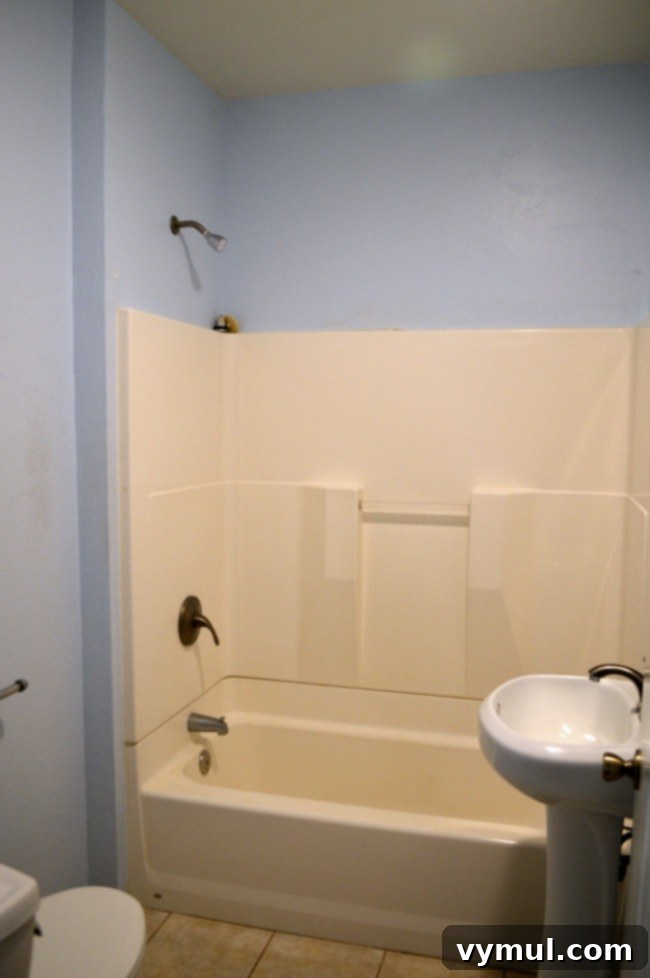
Let’s rewind to the beginning. This image shows what the main bathroom looked like the day we purchased the farmhouse. It was undeniably small, cramped, and lacked any real farmhouse charm or character. More critically, it was barely functional. The most perplexing discovery was the complete absence of an electrical outlet in the entire room – a truly baffling oversight that left us wondering how previous renters managed their daily routines, especially hair care!
As we began the demolition phase, carefully stripping away layers of past renovations, we uncovered a fascinating piece of history: all the original walls were constructed from beautiful shiplap or solid wood, often featuring wide planks of 10 and 12-inch old-growth timber. This discovery filled us with excitement and a renewed commitment to preserving the home’s authentic character.
Another thrilling find was evidence of an original window on what would become the tub wall. It had always been my intention to add a window in that very spot to bring in natural light, so finding that we would essentially be restoring a window to its original location felt like a wonderful alignment of past and present.
The Core Bathroom Remodel Progress
A pivotal step in our farmhouse bathroom renovation involved expanding the space. As part of our broader master bedroom addition, we strategically moved the wall separating the bathroom and the adjacent bedroom by two feet. This seemingly small adjustment yielded much-needed space, transforming the once cramped bathroom into a more generous and functional area. The wall we moved is visible to the right in the “before” photo above, illustrating the significant spatial gain.
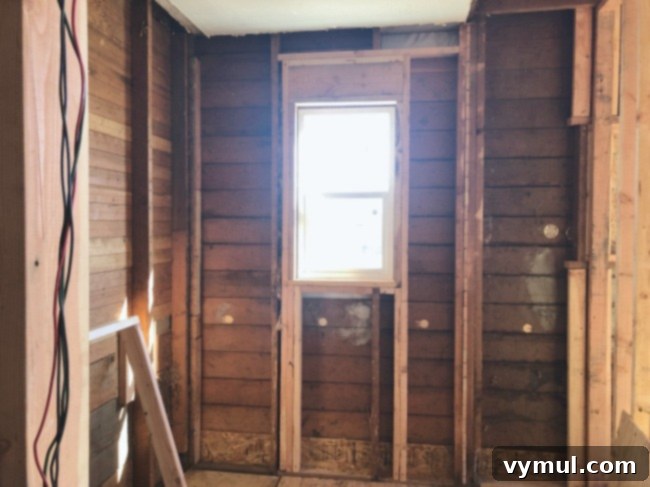
Our commitment to historical preservation meant that everything in the bathroom was taken down to the studs, and we diligently salvaged every piece of original wood we possibly could. During this extensive demo, we made another intriguing discovery: this area had originally served as a pantry, complete with a window and a door leading to the kitchen on the left-hand wall. Furthermore, beneath layers of white paneling on the ceiling, we found beautiful, original wood, which we were also able to save and restore.
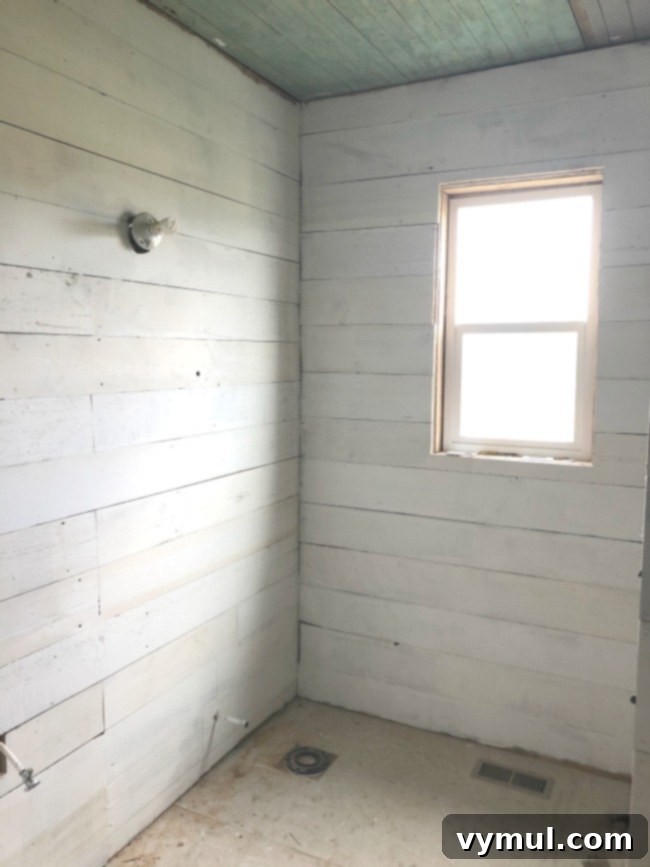
Following the structural work, the renovation progressed through essential stages: installing new plumbing and electrical systems, adding modern insulation for energy efficiency, and meticulously restoring the beautiful wood walls with salvaged original shiplap. It was incredibly satisfying to bring these historic elements back to life. You can also clearly see the original wood ceiling we managed to save, which will all be painted a crisp white, providing a bright and clean backdrop for our vintage farmhouse design.
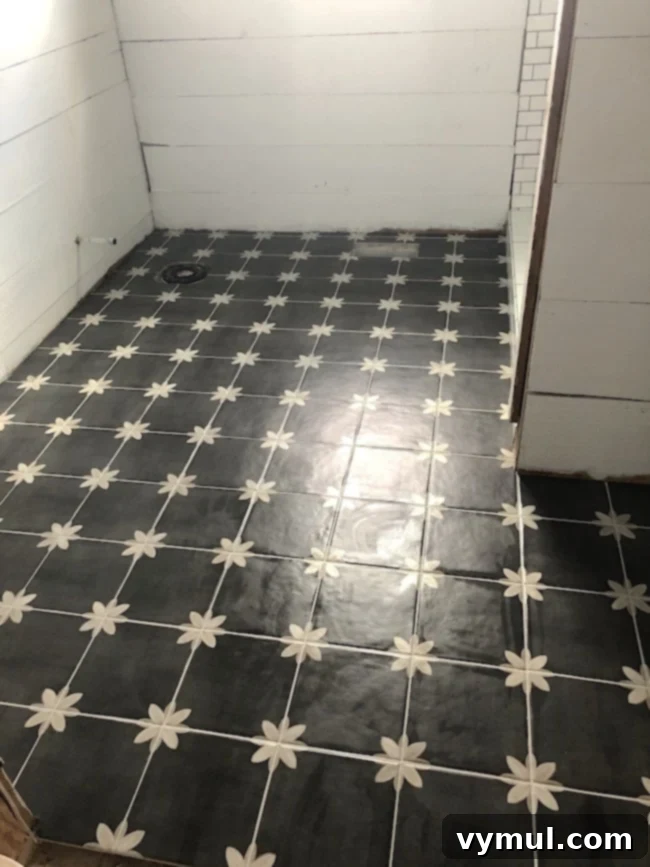
Next came the tiling of the floor and shower. After having previously tiled two other bathrooms in our former home, we were initially determined to hire out this part of the project. The memories of the meticulous, sometimes frustrating work were still fresh.
However, two significant factors compelled us to reconsider. Firstly, we faced considerable difficulty finding any contractors willing to even provide a bid; skilled tradespeople are incredibly busy and hard to secure in our rural area. Secondly, the bids we *did* manage to obtain were astronomically high, making it a financial impossibility. The thought of spending thousands on a relatively small space was simply not feasible for our budget.
Yikes! Faced with these challenges, we made the decision to DIY both the floor and shower tiling. This proved to be a surprising lesson in efficiency and savings.
I happily discovered that laying larger tiles in this small bathroom area was *significantly* easier and faster than our previous experience with smaller, more intricate mosaic tiles. With Brian expertly handling the cuts and me laying the tiles, the floor was completed in just half a day. Another couple of hours for grouting, and the beautiful floor was finished. The effort was absolutely worth it! Want to know how much we saved on the floor alone? The lowest bid we received for our 60-square-foot floor was a staggering $1600. So, yes, it was incredibly well worth the DIY effort.
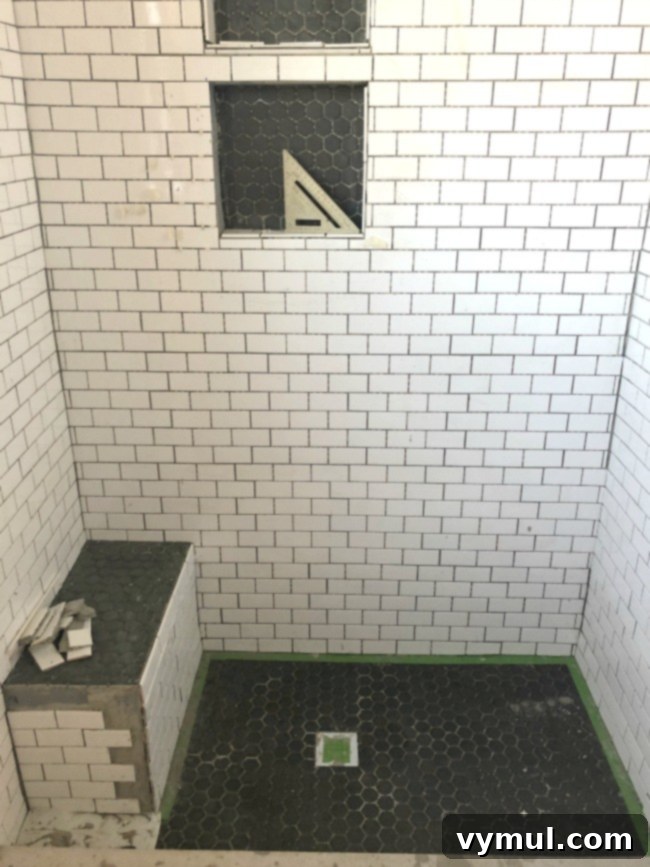
The shower tiling, however, presented a different set of challenges. We initially received an exorbitant quote, followed by a second bid that was roughly half the price. We initially declined both, but a week later, realizing the value of the lower offer, we attempted to re-contact the bidder, but unfortunately, he never returned our calls. With no other viable options, we embarked on the shower tiling ourselves, relying heavily on the wisdom of YouTube tutorials for guidance (which proved invaluable for a novice project of this scale!).
Now, having completed the entire shower ourselves – with significant help from a friend – including all the intricate waterproofing, precise sloping of the floor, constructing the built-in bench, and creating the functional niche, and painstakingly sourcing all the necessary accessory tiles (edges, thresholds, corners, etc.), we can confidently say we would have hired it out in a minute for that lower quoted amount. It was an exceptionally *hard* and complex undertaking.
Many of our stumbling blocks stemmed from being novices, particularly in our initial choice of a tile that lacked a full suite of matching accessory pieces. This oversight led to countless hours of problem-solving and custom cutting, ultimately extending the completion time to several months. Despite the immense difficulty and the steep learning curve, the shower is now complete, and I absolutely adore the final result!
Farmhouse Main Bathroom Decor Plan: Blending Vintage Charm with Modern Functionality
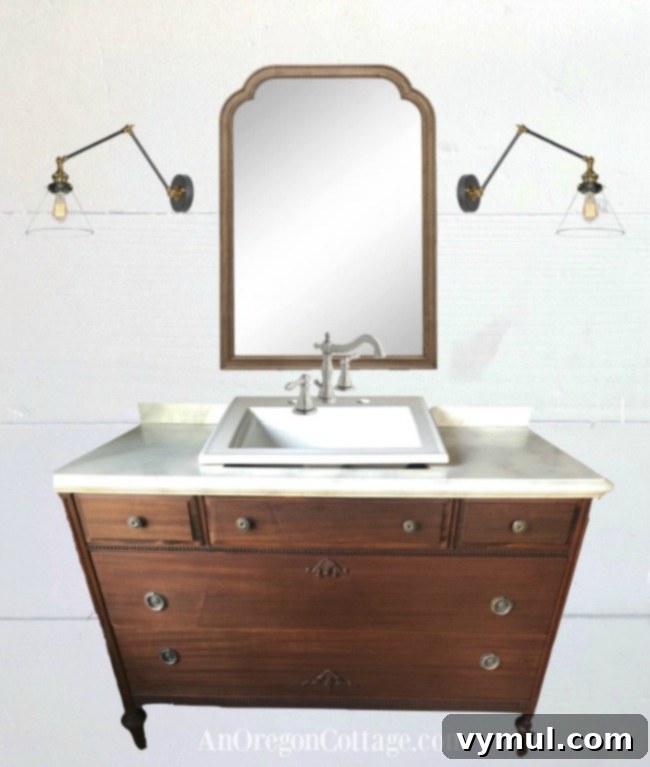
The Charming Vanity Area
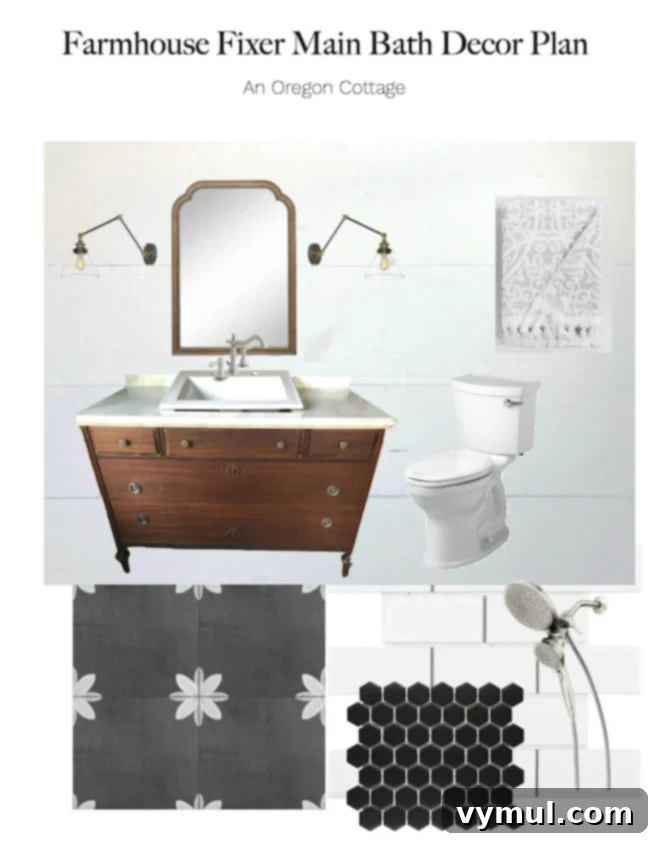
Beyond the classic subway tile shower, one of the elements I’m most excited about in our new main farmhouse bathroom is our custom dresser-turned-vanity. After successfully converting a dresser into a vanity in our previous master bathroom, I knew this was a design choice I wanted to replicate if the right piece presented itself. It took several months of diligent searching on Facebook Marketplace to find a dresser with the ideal proportions and drawer configuration, but eventually, I found one that was almost perfect.
My reasoning for embracing dressers as vanities is twofold:
- Unique Aesthetic Appeal: They undeniably add a distinctive, custom, and visually rich element to any bathroom. Unlike mass-produced vanities, a repurposed dresser injects character and a sense of history that perfectly complements a vintage farmhouse style.
- Remarkable Cost Savings: From a practical perspective, dressers are hundreds of dollars cheaper than purchasing a new, comparable bathroom vanity. Our chosen dresser, for instance, cost a mere $125 and is constructed from solid wood, offering superior quality and durability compared to many modern vanity options at a fraction of the price.
The “almost perfect” aspect of this particular dresser was its top, which had some peeling veneer and two nickel-sized holes in the back where a mirror had once been attached. These imperfections made it an ideal candidate for a painted finish. I decided to tackle a faux marble finish, and after a few rounds of trial and error (the beauty of paint is its forgiving nature!), it turned out beautifully. With six protective coats of water-based polyurethane, the surface is now smooth, durable, and ready for daily use. I will be sharing a detailed tutorial on how I achieved this faux marble look as soon as the vanity is installed and I can capture some stunning “after” photos.
- Sink: We opted for the Kohler Memoirs Stately 17″ Drop In Bathroom Sink. This sink was chosen not only for its elegant, vintage-inspired design but also for its practical overhang, which will provide added protection for the newly painted vanity top.
- Faucet: The Glacier Bay Lyndhurst 8-inch Widespread 2-Handle High-Arc Bathroom Faucet in Brushed Nickel was our choice. I consciously moved away from oil-rubbed bronze, favoring brushed nickel for its more classic, timeless aesthetic that evokes a sense of having been part of the home for decades. Additionally, brushed finishes are excellent at concealing fingerprints, and the high-arc shape beautifully mirrors the design we plan for our kitchen faucet.
- Mirror: The Threshold 30″ x 42″ French Country Wall Mirror was a pre-emptive purchase made over a year ago, inspired by a feature on Young House Love. I absolutely adore its classic lines and charm. While it frequently sells out and its continued production is uncertain, I’m providing the link in case it becomes available again.
- Vanity Sconces: We selected the LNC 9.1-in H On/Off Switch Black Swing Arm Modern Glass Shade sconces. These offer the flexibility of either hard-wire or plug-in installation, a convenient feature. I was drawn to their adjustable design and the way their black finish will elegantly tie into the black floor tiles and the brown-gold tones of the mirror. Although the modern clear glass shades are not my preferred aesthetic, as I prefer a softer, diffused light for applying makeup, I plan to source similar replacement shades in a milky white finish to achieve the desired ambiance.
The Invigorating Shower Space
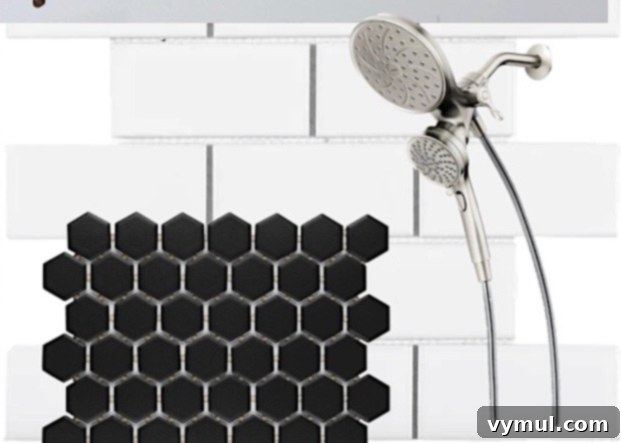
- Subway Tile: For the shower walls, we chose the Satori Hudson Brilliant White Glossy 12-in x 12-in Glossy Porcelain Brick Wall Tile. Our initial reasoning for selecting sheets of subway tile was the assumption that they would be simpler to install (and eliminate the need for complex mathematical calculations!) compared to individual, larger tiles. While the laying process might have felt a bit quicker, the intricate setting and subsequent grouting proved to be quite time-consuming, leading us to now believe that larger, single tiles might actually have been a more efficient choice in hindsight.
A crucial note for future DIYers: I am linking to the style and brand of tile we *should* have used, which offers a full range of matching accessory pieces. This is not the specific Daltile exclusive to Home Depot that we initially purchased. We eventually found our way to Lowe’s excellent tile department and recognized the critical mistake of not having compatible trim pieces. Lesson learned!
- Shower Floor, Bench, Niche Tile: This was my dream tile for years: the Restore Matte Black Hexagon 10 in. x 12 in. x 6.35 mm Glazed Ceramic Mosaic Tile. While it was undeniably a “bear” to work with due to its small, individual pieces and the need for meticulous alignment, I absolutely, unequivocally love, love, love the sophisticated and timeless look it brings to the shower floor, bench, and niche.
- Shower Head: Our choice for the shower head was the Attract with Magnetix Dual Shower Head and Adjustable Handheld in Brushed Nickel. This selection represents a perfect compromise between Brian’s preferences and mine. I was keen on having a shower head with an adjustable handheld component on a slider bar for maximum convenience, while Brian was understandably reluctant to drill any more holes into the painstakingly tiled shower walls. This magnetic dual head system offered the best of both worlds, providing the functionality I desired without compromising the integrity of his hard work.
The Distinctive Floor Tile

Having lived with white tile floors in our previous home, I was determined to avoid that experience again in a bathroom. While white can look clean, it quickly shows every speck of dirt and hair, making constant cleaning a necessity. My initial preference for this farmhouse bathroom would have been classic wood flooring, but for various practical reasons related to moisture and wear in a main bathroom, it simply wasn’t the right choice for us.
My next desire was to cover the entire floor with the same elegant black hexagon tiles used in the shower. However, these tiles are quite expensive, and, as we learned in the shower, they are also incredibly labor-intensive to lay in such a large quantity. The cost and effort would have been prohibitive for the main floor.
Therefore, I embarked on a search for a matte black tile that offered a fun, interesting element without the extreme cost or installation difficulty. I believe what I found strikes a beautiful balance between aesthetics and practicality, and it was certainly a breeze to lay compared to the hexagon tiles.
- Tile: We chose the Della Torre Fiona Black and White 8-in x 8-in Glazed Porcelain Encaustic Floor and Wall Tile. Its graphic pattern adds a vintage touch that complements the farmhouse style while providing the durability and easy maintenance we desired.
Thoughtful Accessories
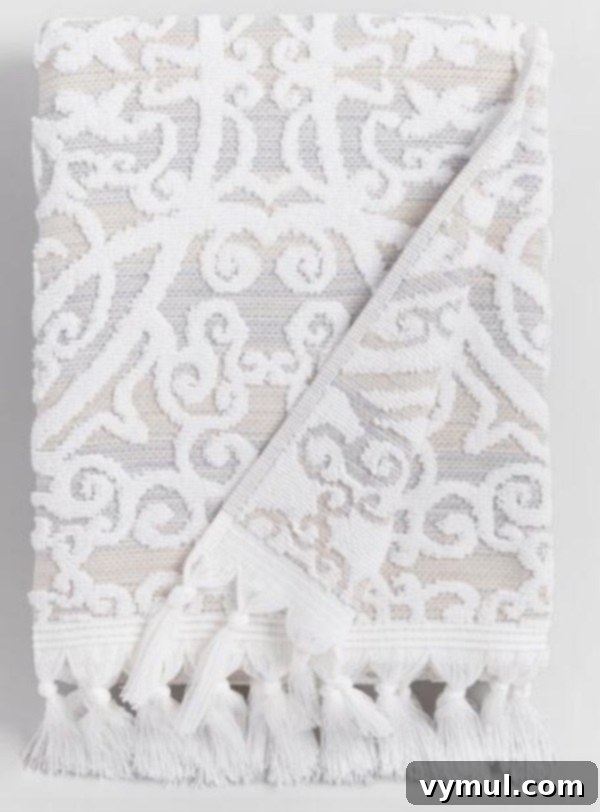
- Towels: For a touch of understated elegance, we’re using the Taupe Medallion Scarlett Sculpted Bath Towel. I’ve been enjoying these delightful towels from World Market for about a year now. I particularly appreciate the smart balance of white with just enough subtle color to prevent them from looking dirty after only a single use, a practical consideration in any busy bathroom.

- Shower Accessories: To maintain a cohesive and organized look within the shower, we’ve invested in Dark Green Plastic Pump Bottles. These will elegantly hold our shampoo, conditioner, and body oil, eliminating visual clutter from mismatched product bottles. I’ll soon be sourcing waterproof labels to give them a polished, custom feel. I absolutely adore the unusual and rich color of these bottles, which will perfectly coordinate with a special piece I haven’t revealed yet: a vintage china hutch that I’m repurposing into a linen cabinet. We painstakingly painted it a luscious dark green, and I have a strong feeling it’s going to look absolutely stunning in the space – so stay tuned for more details and photos on that exciting transformation!
The only remaining items on my decor checklist are the perfect set of towel hooks to complete the practical and aesthetic needs of the bathroom.
We are genuinely hopeful that this charming farmhouse main bathroom will be fully finished and ready for its grand reveal within the next few weeks. Rest assured, when that time comes, we will share a comprehensive full reveal and video tour – an event I am utterly ecstatic about!
Intrigued by the extensive renovation of our century-old farmhouse? Explore the dedicated page here with all the articles detailing our journey since purchasing it.
Perhaps you’d like to witness the remarkable transformation of an early 1980s ranch house into a charming cottage, complete with a sprawling front porch, elegant French doors, and delightful vintage touches? See the full house tour here, with convenient links to all the various remodel projects.