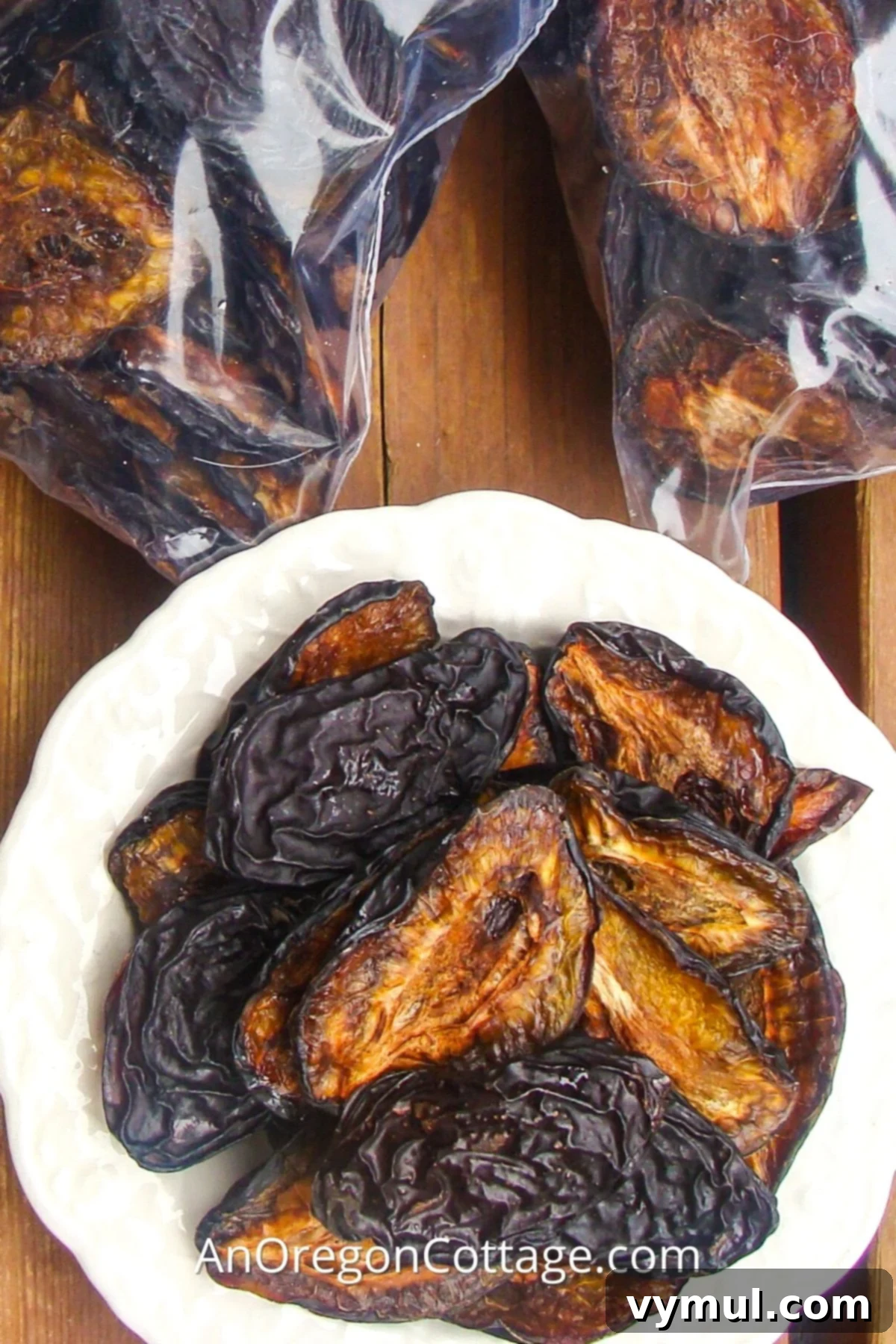
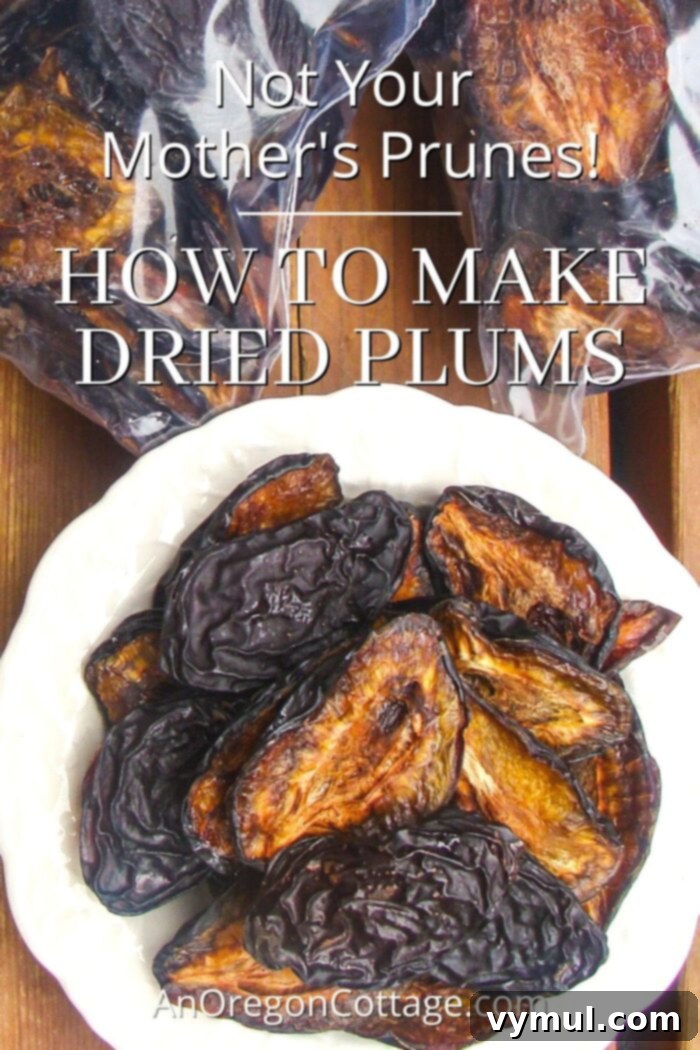
Learn how to dry plums that definitely DO NOT taste or feel like typical store-bought prunes. Our family can’t get enough of these chewy-tart delicious snacks – and they are healthy for bones, too!
Some links in this article are affiliate links and if you click on them I will receive a small commission at no cost to you.
Homemade Dried Plums: Your Guide to Delicious, Healthy Dehydrated Snacks (Not Like Store-Bought Prunes!)
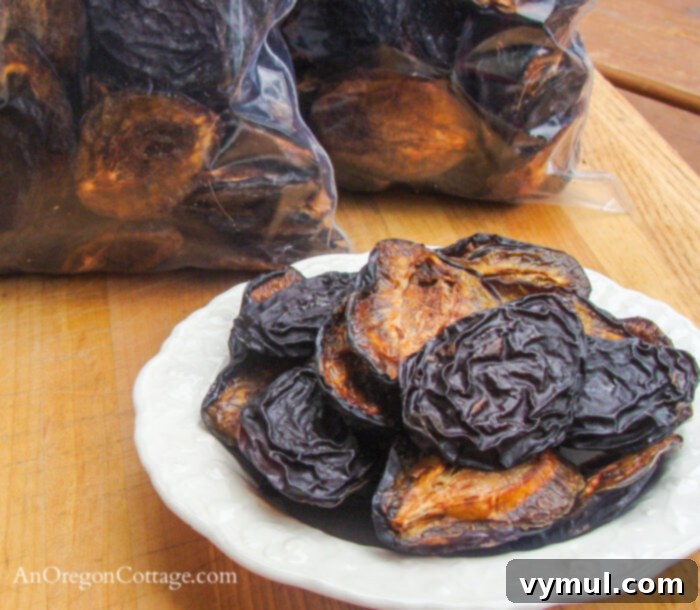
Of all the fruits I preserve – whether through freezing, canning, or drying – homemade dried plums are undeniably my absolute favorite. While they might appear unassuming at first glance, these little gems boast an incredible sweet-tart flavor and a satisfyingly chewy, never wet, texture. They are the perfect healthy snack, cherished by my children and me alike, offering a burst of natural goodness that satisfies cravings without any guilt.
Now, I can already hear what you’re thinking: “Is she talking about prunes?” And my answer is, well, not exactly. While they are technically a form of dried plum, they are emphatically NOT the typical store-bought prunes that often come to mind. Forget that often off-putting wet, squishy texture, the distinctive smell, or the overly sweet, one-dimensional prune-like flavor you might be used to. Every single person who tries my homemade version agrees: these are a completely different experience, elevating the simple dried plum to a gourmet snack.
(And frankly, I still refer to the packaged product as “prunes,” even after companies decided to rename them “dried plums” a few years ago. Because the dried plums I make are truly in a league of their own, bearing no resemblance to their mass-produced counterparts in taste, texture, or overall appeal.)
Why Dry Plums at Home? The Superiority of Homemade Dehydrated Plums
There’s a significant difference between commercially produced prunes and the delightful dried plums you can create in your own kitchen. When you opt to dry plums at home, you gain complete control over every aspect of the process, from the initial selection of ripe fruit to the desired final texture. This hands-on approach allows you to avoid unwanted additives, regulate the sweetness naturally present in the fruit, and achieve that perfect chewy consistency that is often conspicuously missing from store-bought varieties. It’s a simple, yet incredibly rewarding, method of food preservation that consistently yields a snack far superior in terms of taste, texture, and nutritional value. Moreover, there’s immense satisfaction and peace of mind in knowing exactly what goes into your family’s healthy treats, ensuring a pure and wholesome product.
The Surprising and Significant Health Benefits of Homemade Dried Plums
Beyond their irresistible sweet-tart taste and appealing chewy texture, homemade dried plums are a nutritional powerhouse. They are an excellent source of dietary fiber, which is crucial for maintaining a healthy digestive system and promoting regularity, and contain potent antioxidants that help combat oxidative stress and inflammation throughout the body. They also naturally provide psyllium, further aiding in digestive regularity and contributing to a balanced gut microbiome. However, among all these impressive health benefits, one stands out as particularly exciting for many:
Powerful Support for Bone Health
Recent scientific studies have revealed that incorporating dried plums into your daily diet can significantly improve bone mineral density and help reduce bone loss. This news was incredibly thrilling for me, especially since I already adored my homemade dried plums! This remarkable benefit is attributed to a unique and comprehensive combination of vitamins, minerals, and polyphenols naturally found in plums. These include essential nutrients like Vitamin K, boron, and various powerful antioxidants, all of which play a vital and synergistic role in bone metabolism, formation, and overall density. Even more remarkably, some cutting-edge research, such as studies highlighted by Better Bones, indicates that they may even have the ability to reverse existing bone loss – a truly astonishing discovery that profoundly underscores their value as a functional food and a proactive step for maintaining skeletal health as we age.
So, with such incredible benefits, get ready to embrace all the wonderful, healthy dried plums your dehydrator (or oven!) can possibly produce!
Choosing the Best Plums for Dehydrating: A Guide to Varieties
While I firmly believe that virtually any plum variety will yield a superior dried product when prepared at home – primarily because you have the advantage of controlling the drying process to achieve a perfectly firm, chewy texture – certain types truly excel and are highly recommended for optimal results. The distinct sweet-tart flavor profile and ideal texture that I absolutely love in my homemade dried plums predominantly come from Italian or European “prune” plums.
These specific plums are naturally less juicy and possess a more pronounced tartness compared to the typical round, larger, and often sweeter plum varieties. They are also easily recognizable by their elongated, oval shape and deep purple or reddish-blue skin. Their inherent characteristics make them perfectly suited for dehydration, as they dry more efficiently and retain their complex flavor wonderfully.
Other excellent choices that work well for drying include Damson plums, which are renowned for their intense tartness, making them fantastic for a robust and flavorful dried plum. When you dehydrate these European-style plums to a stage where they are still pliable and leathery but completely dry, they undergo a magical transformation into small, concentrated pieces of fruit, much like a gourmet fruit leather. Don’t be deterred if their appearance doesn’t perfectly match conventional dried fruit; their often crinkled or irregular look belies a concentrated, wonderful flavor that will truly surprise and delight your taste buds.
The entire process of drying plums is also one of the simplest and most hands-off food preservation methods available. I can typically fill my food dehydrator with prepared plums in about half an hour. After that initial prep, it’s mostly a matter of periodic checking, rotating trays for even drying, and finally packaging the plums as they slowly dehydrate over the next 10 to 24 hours (the exact time depends on the plum type, size, and ambient humidity). The active, hands-on time involved is incredibly minimal, making it an ideal and rewarding project for even the busiest of schedules, allowing you to create a stash of healthy, delicious snacks with minimal effort.
How to Dry Plums: Your Comprehensive Step-by-Step Guide
Drying plums is a surprisingly straightforward process that anyone can master, transforming fresh seasonal fruit into a delectable and long-lasting snack. By meticulously following these simple steps, you’ll soon be enjoying your very own homemade dried plums, perfectly tailored to your preferred taste and texture.
Essential Supplies You’ll Need
- Fresh Plums: The star of our recipe! Preferably choose firm, ripe Italian/European Style Plums (sometimes referred to as “prune plums”) for their ideal sweet-tart balance and naturally lower moisture content, which speeds up drying. However, regular round plums can also be used; simply refer to our FAQ section below for specific tips on successfully drying juicier varieties.
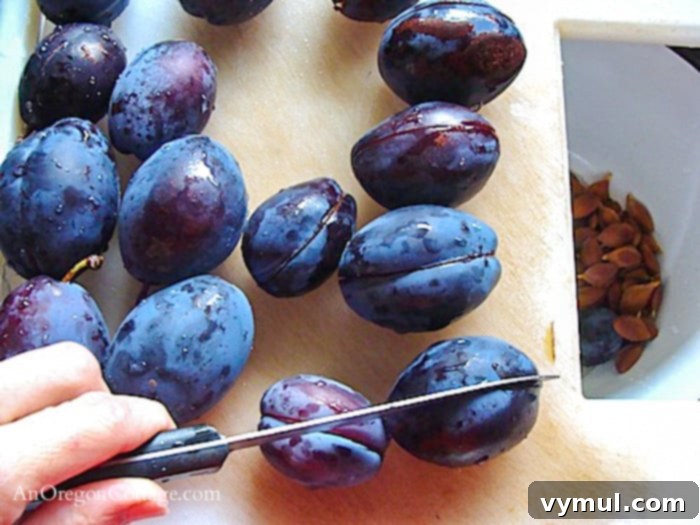
- Cutting Board: An over-the-sink cutting board is an absolute game-changer for this and other fruit preservation tasks. Its design allows plum juices to drain directly into the sink and makes it incredibly easy to collect discarded pits in a bowl placed underneath, thereby keeping your workspace remarkably clean and efficient.
- Sharp Knife: A sharp kitchen knife is indispensable for making clean, precise cuts and for easily detaching the pits from the plum halves. This will make the preparation much smoother and safer.
- Electric Dehydrator: This is generally the most efficient and consistent method for drying plums, offering controlled heat and airflow. I personally rely on an Excalibur model like this, known for its excellent air circulation and even drying capabilities. If you don’t own a dedicated food dehydrator, don’t worry – oven drying is also a viable option! Please see the comprehensive FAQ section for detailed instructions and valuable tips on how to successfully dry plums in a conventional oven.
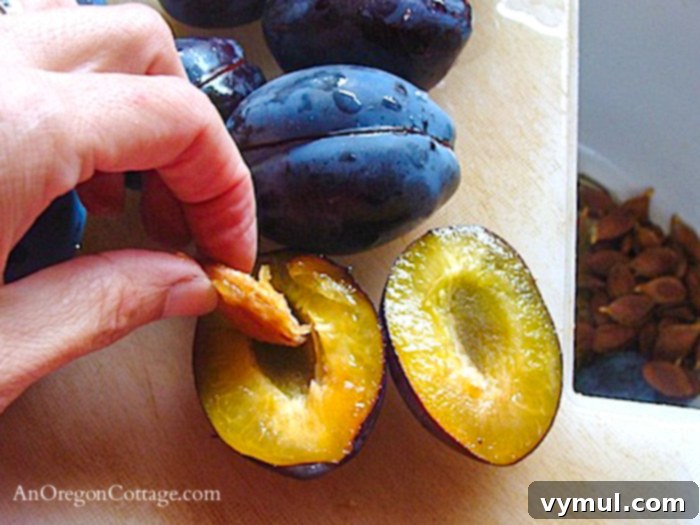
Easy Steps to Dry Plums in a Dehydrator
- Wash and Prepare Plums: Begin by thoroughly washing your fresh plums under cool, running water. Ensure they are clean and free from any leaves, stems, or debris. Gently pat them dry or allow them to air dry briefly.
- Halve and Pit Plums: Carefully slice each plum in half all the way around its natural seam, encircling the pit. Once halved, gently grab each section of the plum and twist them apart in opposite directions. The pit should easily detach from one of the halves. Discard all pits. If you encounter any plums where the pit is particularly stubborn (a “clingstone” variety), a helpful trick is to try slicing the plum into quarters or even smaller, more manageable pieces around the pit to facilitate its removal.
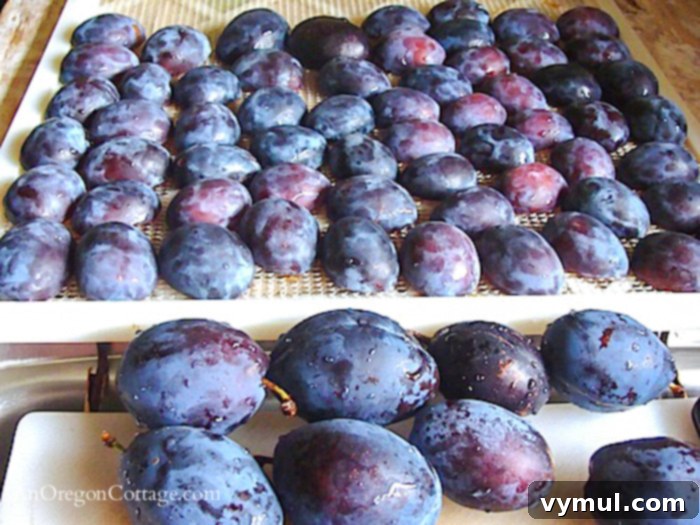
- Arrange on Dehydrator Trays: Place the prepared plum halves onto your dehydrator trays. You have two main options for how to orient them:
- Cut-side down: This method allows you to fit significantly more plums on each tray, thereby maximizing your dehydrator’s capacity and making the most of your drying batch. Furthermore, placing them cut-side down helps prevent the edges of the plum halves from curling inward as they dry, resulting in a flatter, more uniform product that is ultimately easier to store. While some initial sticking to the trays may occur, it generally resolves as the plums dehydrate and firm up.
- Cut-side up: This method may help reduce initial sticking to the dehydrator trays, particularly for very juicy plums. However, it might slightly reduce the overall number of plums you can fit on a tray, and the plum halves might tend to curl or become less uniform in shape.
Regardless of your chosen orientation, it is perfectly fine, and even encouraged, to pack the plum halves relatively close together on the trays. Remember, they will shrink considerably during the drying process, creating more space.
- Dehydrate According to Guidelines: Set your electric dehydrator according to its manufacturer’s recommendations for drying fruit. For reference, I use an Excalibur dehydrator and typically operate it at its maximum temperature setting of 145 degrees Fahrenheit (approximately 63 degrees Celsius). The total drying time will vary significantly depending on the plum variety (moisture content), the size of the plum pieces, the humidity in your environment, and the specific model and efficiency of your dehydrator. Generally, expect the process to take anywhere between 10 to 24 hours.
- Monitor, Turn, and Flip: Begin checking your plums after the initial 4 to 6 hours of drying. At this point, it’s a good practice to turn the trays and, if necessary, flip the plum halves for more even dehydration across the entire batch. Once the plums appear somewhat dry, have started to firm up, and begin to release more easily from the trays, flip them cut-side up (if they were initially placed cut-side down) to help ensure complete drying of the interior flesh. If they are still excessively moist and sticky, leave them as they are and continue the drying process.
- Check for Doneness and Harvest: Continue checking the plums every 2 hours thereafter. A fully dried plum should exhibit a pliable, leathery, and distinctly chewy texture. Crucially, there should be absolutely NO signs of moisture when the plum is squeezed or torn apart; no sticky residue, no visible wetness. As individual plums reach this ideal state of dryness, remove them from the dehydrator and set them aside for the conditioning phase. Allow the remaining plums to continue drying until they also reach the desired consistency.
PRO TIP for Overnight Drying: Life happens, and sometimes you need to step away from the dehydrator. If your plums have only been drying for a few hours and it’s approaching bedtime, it’s generally perfectly fine to leave them in the dehydrator to continue drying overnight. For an added layer of peace of mind, you can consider lowering the temperature setting slightly before retiring. Alternatively, if the plums have been drying for the majority of the day but aren’t quite finished, you can simply turn the dehydrator off completely for the night. In the morning, check the plums, remove any that are now fully dried, and then resume the drying process for the remaining fruit. This flexibility makes home drying very manageable and reduces stress.
Storing Your Delicious Homemade Dried Plums for Long-Term Enjoyment
Once your plums are thoroughly dried (and if you’re ever in doubt about their dryness, refer to the “How to Test for Dryness” tip below), proper storage is an absolutely critical step to maintaining their exceptional quality and significantly extending their shelf life. Before packaging them for long-term storage, it’s highly recommended to “condition” your dried fruit. This essential process involves placing the cooled, dried plums loosely in a clean, airtight glass jar or container for a period of 7-10 days, shaking the container daily.
Conditioning allows any residual moisture that might be unevenly distributed throughout the batch to equalize, thereby preventing the development of mold and ensuring a more consistent product. If, during this conditioning period, you observe any condensation forming inside the container, it’s a clear indication that the plums are not yet dry enough and should be returned to the dehydrator for additional drying time.
After successful conditioning, you can proceed to pack your dried plums into airtight glass jars or freezer-safe baggies. For baggies, a clever trick is to utilize the straw trick to effectively remove as much air as possible from the bag, which is crucial for preventing oxidation and spoilage. You have a couple of excellent options for long-term storage, depending on your preferences and how quickly you plan to consume them:
- Room Temperature Storage: For immediate consumption or storage up to a year, place your securely packaged dried plums in a cool, dark, and dry area, such as a pantry or a cupboard away from direct sunlight and heat sources. My family goes through these homemade treats so quickly that I rarely, if ever, encounter issues with molding. This is likely because we really prefer them on the drier, more leathery side. As long as they are truly dry and have been properly conditioned, they will keep beautifully and retain their wonderful flavor.
- Freezer Storage: If you prefer your dried plums to be slightly less firm and more pliable, or if you simply want to ensure maximum longevity (up to 2 years or even more), storing them in the freezer is an excellent and highly recommended option. My brother-in-law, who initially introduced me to the wonders of dried Italian plums, stores his in the freezer precisely because he dries them to a slightly more pliable consistency than I do. He often enjoys them straight from the freezer as a refreshing, chewy treat and then allows the remaining plums in the bag to thaw at room temperature for later snacking.
TIP: How to Test to See if Fruit is Dry Enough for Room Temperature Storage:
If you are at all uncertain whether your plums are sufficiently dry for safe room temperature storage, perform this simple yet effective test: Place a small sample of your cooled dried fruit (about 1/2 to 1 cup) in a sealed, airtight glass jar or a zip-top baggie. Leave this container on your kitchen counter or in a warm spot for a day or two (24-48 hours). If, during this observation period, any condensation appears inside the container, it is a definitive indication that the fruit still contains too much moisture. In this crucial scenario, you must either return the entire batch of plums to the dehydrator for additional drying time until no condensation forms, or you can opt to store them safely in the freezer for longer preservation.
Well-dried and properly stored plums will easily last up to a year, and often even longer if kept in ideal conditions. However, to be completely honest, they rarely last that long in our home! Each year, I strive to dry a larger batch of plums, constantly hoping to extend their availability beyond two to four months. Nowadays, as empty nesters, we typically finish the last of our supply by May or June at the very latest. When our children were still living at home, actively raiding the snack stash, we considered ourselves incredibly lucky if any dried plums remained by January! It’s a true testament to how incredibly addictive, satisfying, and utterly delicious this healthy snack truly is. No matter how much willpower we attempt to summon, it’s incredibly challenging to eat just one. Or even two… or six… you get the idea – they’re simply irresistible!
Dried Plums FAQ: Your Most Common Questions Answered
Absolutely! While I primarily use a dedicated food dehydrator for its convenience and consistent results, drying plums in a conventional oven is a perfectly viable and effective alternative, especially if you don’t own a dehydrator. To do this successfully, you’ll need to use the absolute lowest possible temperature setting your oven offers, which is typically around 150-200 degrees Fahrenheit (65-93 degrees Celsius). Crucially, you must also keep the oven door slightly ajar (a wooden spoon or oven mitt can help prop it open) to allow the continuously evaporating moisture to escape, preventing the plums from simply baking. One helpful reader successfully dried plum halves in her oven at 180 degrees Fahrenheit (82 degrees Celsius) for approximately 8 hours, achieving a lovely chewy texture. Always test for doneness, as larger or juicier plums may require significantly more time. Another inventive reader utilized a convection oven on its lowest setting (170 degrees Fahrenheit / 77 degrees Celsius). They placed three trays of halved, pit-side-up plums in the oven, meticulously rotating them from top to bottom every three hours. They also made sure to open the oven door hourly or so to effectively release accumulated steam. After about 10 hours of active drying, they turned the oven off and left the plums overnight inside the cooling oven to further dry and cool. The next morning, they consolidated the sufficiently dried plums onto one cooking sheet and continued drying any less-dry ones for another 3 hours until perfectly done. This illustrates that oven drying is definitely achievable, though it may require more frequent attention and a bit of experimentation to find the optimal settings and timing for your specific oven.
Yes, this drying method is quite versatile and can certainly be applied to other varieties of plums beyond the Italian/European prune types. However, it’s important to note that regular round plums are typically much juicier and often sweeter than prune plums. This means they will require some specific adjustments to ensure successful dehydration. You will generally need to cut them into thinner slices or smaller pieces to expose more surface area, which facilitates faster and more thorough drying. Consequently, the overall drying time will likely be longer compared to the naturally drier Italian plums. While the resulting flavor profile will be different (usually sweeter and perhaps less tart than dried Italian plums), they will still make a delicious, healthy, and satisfying dried fruit snack.
No, I personally never remove the skins from the plums before dehydrating them. There are several reasons for this: the plum skins contribute significantly to the overall texture of the dried fruit, providing a robust, slightly chewy base that wonderfully complements the softer, leathery flesh. Moreover, the skins contain valuable nutrients and dietary fiber, so leaving them on enhances the nutritional profile of your snack. Finally, keeping the skins on simplifies the preparation process considerably and enhances the structural integrity of the dried plums, making them a more satisfying and wholesome snack.
Yes, it is highly recommended and generally essential to pit and halve (or quarter, depending on the plum’s size and pit type) all plums before beginning the drying process, including tart Damson plums. Removing the pit and cutting the fruit into smaller, uniform pieces exposes significantly more surface area to the circulating air in the dehydrator or oven. This dramatically decreases the overall drying time, ensuring more efficient and consistent moisture removal. Attempting to dry whole, unpitted plums would considerably prolong the dehydration process and greatly increase the risk of uneven drying and potential spoilage due to trapped moisture around the pit.
While it is technically possible to attempt drying plums with the pit still intact, it is generally not advisable for optimal results. Drying plums with the pit in will significantly increase the overall drying time because the pit acts as a barrier, trapping moisture within the fruit’s core, which can lead to uneven drying and potential issues. If you encounter plums with particularly clingy pits that are difficult to remove in halves, a much better and more effective solution is to carefully slice around the pit, cutting the plum into quarters or even smaller, more manageable pieces. This method allows for easier pit removal and, more importantly, ensures that the fruit’s flesh is adequately exposed to the air for proper and consistent dehydration.
No, absolutely not. In my experience, there is completely no need to treat plums with citric acid, lemon juice, or any other pre-drying solution to prevent browning. Plums naturally resist significant discoloration during the dehydration process, and I have consistently found that they turn out perfectly beautiful and flavorful without any additional treatment. This keeps the preparation process wonderfully simple, minimizes extra steps, and ensures a pure, unadulterated plum flavor in your delicious homemade dried snacks.
Go ahead and try these incredible homemade dried plums – I dare you to eat just one! You’ll quickly understand why they’re a family favorite and a healthy staple.

Print Recipe
Pin Recipe
SaveSaved!
How To Dry Plums (Not Your Mother’s Prunes!)
Equipment
-
Sharp Knife
-
Cutting Board
-
Food Dehydrator
Ingredients
- Italian Plums (or other firm, ripe plum variety; drying time may increase for juicier plums)
Instructions
-
Thoroughly wash fresh plums under cool running water.
-
Carefully slice each plum in half around the pit. Twist gently to separate the halves and remove the pit. If pits are stubborn, quarter the plums to facilitate removal.
-
Arrange plum halves on dehydrator trays, ideally cut-side down to maximize space and achieve a flatter final product. Packing them relatively close together is acceptable as they will shrink during drying.
-
Dry according to your dehydrator’s manual (a common temperature is 145°F / 63°C). Begin checking for dryness and rotating trays in 4-6 hours. Once plums start to release from trays, flip them (if cut-side down) to complete drying. Total drying time can range from 10 to 24 hours.
-
Continue checking plums every 2 hours, removing any that are fully dry – they should be pliable, leathery, and show no moisture when squeezed – and leaving the remaining plums to complete drying.
-
Once cooled, condition the dried plums by placing them loosely in an airtight container for 7-10 days, shaking daily, to equalize any remaining moisture before final storage.
Notes
To dry in a conventional oven: Set your oven to its absolute lowest temperature setting (typically 150-200°F / 65-93°C) and prop the oven door slightly ajar to allow moisture to escape. Bake plum halves for approximately 8-12 hours, or until they achieve a chewy texture with no moisture exuding from them when squeezed (total time will vary based on plum size, juiciness, and your oven’s specific efficiency). Remember to flip the plums periodically for more even drying.
Nutrition

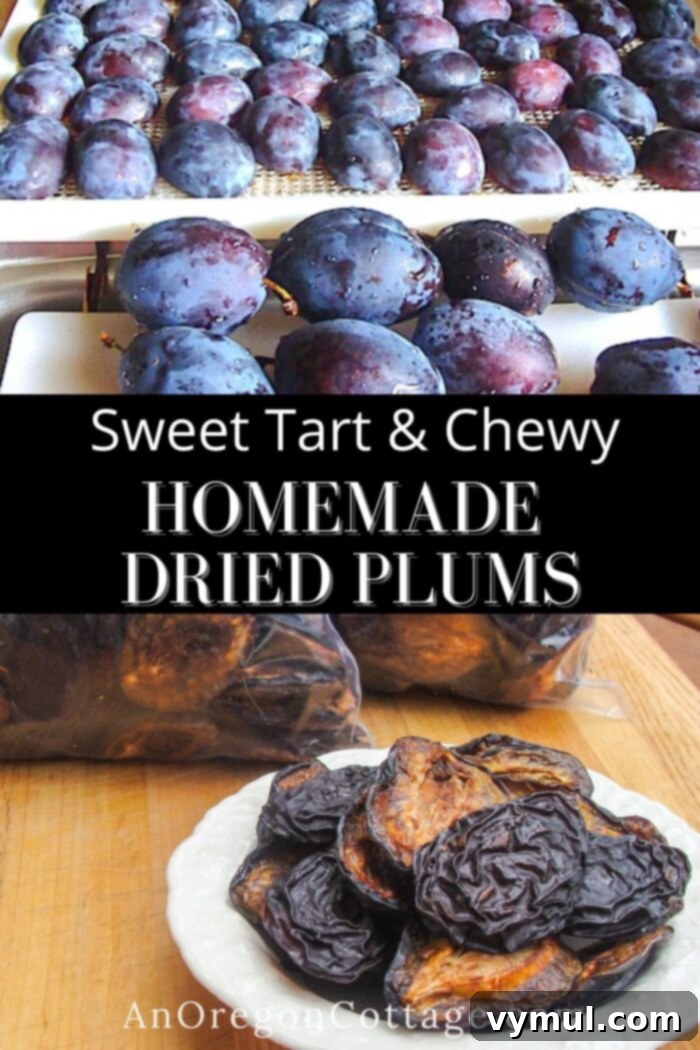
More Delicious Preserving Recipes to Explore
If you enjoyed learning how to dehydrate plums and are keen to expand your food preservation skills, be sure to check out these other fantastic recipes. Home preserving is a rewarding way to enjoy seasonal produce all year long, helping you reduce food waste and savor fresh flavors!
Click For Recipe
Click For Recipe
Click For Recipe
Click For Recipe
This recipe was originally published in 2012, updated in 2018, and again in 2022. This version has been further enhanced for clarity, SEO, and additional helpful details in 2023 to provide the most comprehensive guide possible.
Disclosure: Affiliate links in this article will earn commission based on sales, but it doesn’t change your price. Click here to read my full disclaimer and advertising disclosure.