DIY Accent Wall Stenciling: Create a Stunning Focal Point in Hours
Transforming a plain wall into a captivating focal point for any room is easier than you think! With just a few hours, some basic tools, and this comprehensive tutorial on how to stencil an accent wall, you can achieve a professional-looking design that breathes new life into your living space. Say goodbye to dull walls and hello to personalized style!
Some links in this article are affiliate links. Should you choose to click on them and make a purchase, I will receive a small commission at no additional cost to you. This helps support the content I create.
Have you ever contemplated the magic of stenciling an accent wall? For those of us who have endured the arduous task of wallpaper removal – a nightmare that often spans not just hours, but days, or even weeks of laborious scraping and steaming – the very thought of applying wallpaper to any surface, anywhere, sends shivers down the spine. It’s a commitment I personally vowed never to make again, and you can certainly quote me on that!
However, the allure of a subtle, elegant pattern on a wall is undeniable. It has a unique way of making a room feel instantly “decorated,” adding depth and character without overwhelming the space. This is precisely where the brilliance of stencils shines through. They offer a fantastic alternative with a multitude of compelling advantages:
- Non-Committal Design: Unlike wallpaper, which is notoriously difficult to remove, a stenciled design offers ultimate flexibility. If you ever tire of the pattern, or if future homeowners decide on a different aesthetic 10-20 years down the line, painting over it is a straightforward and simple task.
- Effortless Application: Stenciling is significantly easier and less labor-intensive than the complex process of hanging wallpaper, which often requires precise measurements, cutting, and pasting.
- Cost-Effective Elegance: Achieve a high-impact look without the high price tag. Stencils and a can of paint are typically far less expensive than rolls of designer wallpaper.
- Time-Saving Project: In my experience, stenciling an accent wall takes considerably less time to complete compared to wallpapering. While quick paper-hangers certainly exist, stenciling often proves to be a more efficient path to a beautifully patterned wall.
For years, I’d harbored a desire to introduce some form of a trellis pattern onto an accent wall in our bedroom. I meticulously explored various options, including the innovative idea of a duct tape wall, inspired by creative pioneers like The Nester. However, the intricate mathematical calculations involved in achieving a perfect geometric design filled me with a genuine sense of dread. The thought of attempting a freehand painting of the pattern was even more intimidating.
So, when the opportunity arose to participate in a week-long stenciling series in collaboration with Royal Design Studios – a treasure trove of incredible stencil designs suitable for both walls and furniture – a bright idea instantly clicked. Stenciling! It was the obvious, perfect solution. I enthusiastically accepted the invitation without a moment’s hesitation.
And the result? I absolutely adore how it turned out! Through this project, I made some delightful discoveries that banished my initial apprehensions:
- No Math Required: To my immense relief, there was absolutely no complex math involved. The stencil provided all the guidance needed.
- Minimal Paint Usage: The project required very little paint. I was able to use a small amount of white paint that we already had on hand, making it incredibly budget-friendly.
- Roller Application is Key: Applying the paint with a foam roller proved to be incredibly easy and efficient, leading to smooth, even coverage.
- Quick Completion: The entire process, from start to finish, took only a few hours. In fact, for my half-wall, it was less than two hours – an incredibly fast transformation!
How to Stencil an Accent Wall: A Step-by-Step Guide
Ready to embark on your own accent wall transformation? Gather your materials and let’s get started!
Essential Supplies for Your Stenciling Project
Having the right tools is crucial for a smooth and successful stenciling experience. Here’s a detailed list of what you’ll need:
- Large Wall Stencil: The star of the show! Choose a design that complements your room’s aesthetic. I personally used this Nova Trellis Wall Stencil for a classic, elegant look. Consider the scale of the pattern relative to your wall size.
- Small Foam Paint Roller: This is ideal for applying an even, thin coat of paint. Foam rollers prevent over-saturation and help minimize bleed-through, giving you crisp lines.
- Paint Tray: Essential for holding your paint and allowing you to evenly load your roller without dipping too deep.
- Small Paint Brush (Optional but recommended): Primarily used for wiping excess paint from the can rim after pouring into the tray, ensuring a clean workspace. It can also be useful for minor touch-ups later.
- Paper Plate: Acts as a blotting surface to offload excess paint from your roller before applying it to the stencil.
- Paper Towels: Handy for blotting, cleaning up small spills, and keeping your hands and tools tidy throughout the process.
- Paint: Choose an eggshell latex wall paint. This type of paint offers durability and a subtle sheen that works well for accent walls. Make sure it’s a color that contrasts subtly with your existing wall color, or matches trim for a cohesive look. I used paint that perfectly matched our wainscoting.
- Painter’s Tape: High-quality painter’s tape is critical for protecting adjacent surfaces and securing your stencil. Opt for a tape designed for clean removal without damaging your wall.
Step-by-Step Stenciling Instructions: Achieve a Flawless Finish
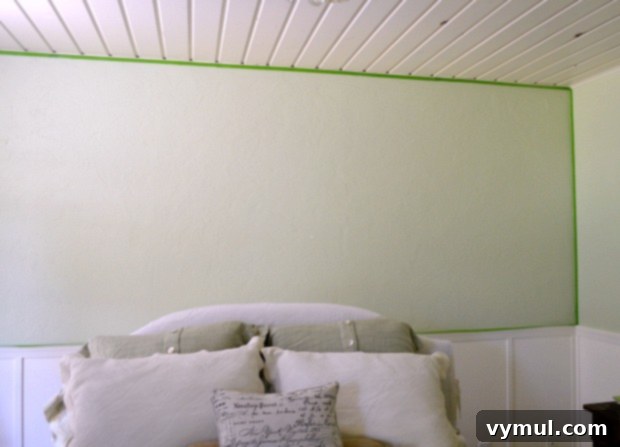
1. Prepare Your Wall with Painter’s Tape for Crisp Edges
This step might seem obvious, but it’s crucial for a professional-looking finish. Even if you’re skilled at freehand painting without tape, when it comes to stenciling, taking the time to tape off the edges of your wall is non-negotiable. You’ll be pressing the foam roller quite firmly against the stencil, especially near the edges, and without tape, paint is highly likely to seep onto adjacent walls, ceilings, or trim. The sheer joy of peeling off perfectly clean tape at the end, revealing crisp, unblemished lines, is truly unparalleled. Don’t skip this critical preparation step!
2. Strategically Place Your First Stencil and Secure It
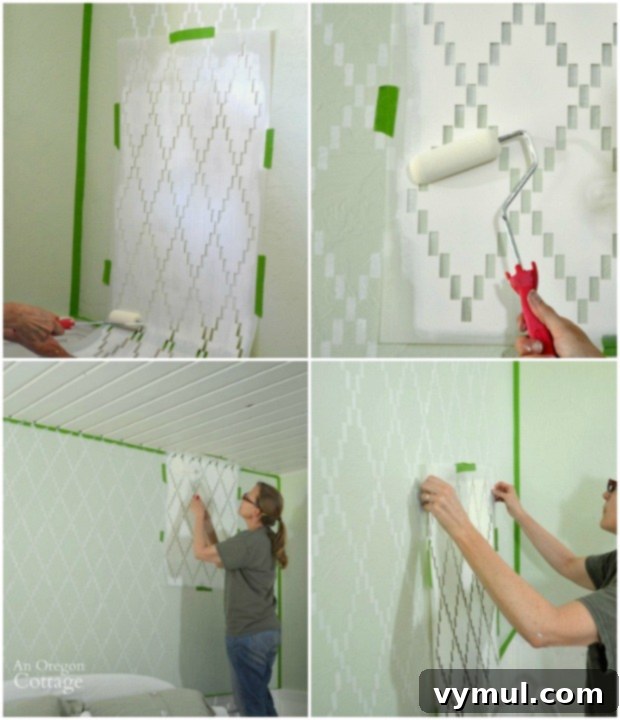
Before you even think about paint, carefully determine your starting point. This decision is crucial as it influences the overall symmetry and flow of your design. My chosen stencil didn’t include smaller pieces for ceilings or corners, and I wanted to avoid a uniform “framed” appearance around the entire wall. Therefore, I opted to start in one corner, positioning it far enough from the edge so that I could seamlessly blend the design once the main wall sections were complete. I also gently curved the stencil at both the ceiling line and the wainscoting edge. This subtle bend helps the pattern appear integrated and natural at the top and bottom of the wall, rather than abruptly cut off. Once positioned, use several pieces of painter’s tape to firmly secure your stencil to the wall, ensuring it won’t shift during application.
3. Master the Art of Paint Application with a Foam Roller
The secret to successful stenciling lies in paint moderation. The key, as with any stenciling project, is to avoid overloading your roller (or brush) with too much paint. Excessive paint will invariably seep under the edges of the stencil design, resulting in blurry lines and frustrating bleed-through. Achieving the right amount of paint with a roller is straightforward:
- Pour a small amount of paint into your tray.
- Roll the foam roller in the paint, just as you would when painting a regular wall, ensuring it’s evenly coated.
- Immediately transfer the roller to a paper plate lined with a few paper towels. Roll the excess paint off two to three times until the roller feels almost dry to the touch, but still holds paint.
Now, your roller is perfectly loaded for stenciling. I found that if more paint was needed to finish a stencil section, a quick roll on the paper plate alone provided ample paint without risking oversaturation. By consistently using this blotting method, I experienced virtually no bleed-through in the main sections of the wall. (The corners, however, presented a unique challenge, which we’ll address next).
4. Seamlessly Continue Your Design: Repeat and Align
One of the most surprising and satisfying aspects of stenciling is how quickly the project progresses. The paint, especially straight latex without glazes, is applied thinly and dries almost immediately. This means you can confidently move and re-tape your stencil without worrying about smudging or waiting for lengthy drying times, which makes this stage incredibly efficient:
- Place and Secure: Carefully position the stencil, aligning its guide marks with the previously painted section. Press painter’s tape pieces firmly to secure it to the wall. (Remarkably, I used the same pieces of painter’s tape for the entire wall, and they maintained their stickiness through all the reapplications.)
- Roll on Paint: Apply paint with your foam roller using the technique described in Step 3. You can vary the pressure and number of passes to achieve different effects – a lighter application for a subtle look or slightly heavier for more prominence. Remember, most stenciling often looks best with natural variations in paint density, creating a handcrafted appeal.
- Lift and Repeat: Gently pull the stencil off the wall. Match its markings to the next blank section, press the tape pieces to secure, and roll on the paint again. Continue this rhythmic process until you’ve completed the main expanse of your wall.
5. Tackling Those Tricky Corners and Edges
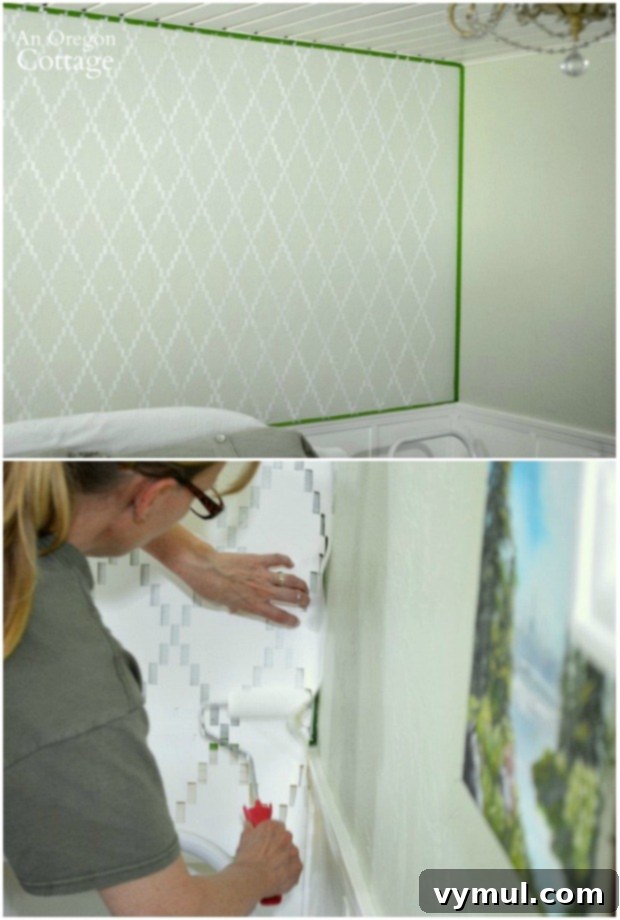
Ah, the corners! Let’s be honest: this was admittedly the least enjoyable part of the process. My goal was for the stencil design to appear as if it extended seamlessly all the way to the very edges of the wall. However, my stencil had a one-inch border around its design, and the pattern itself began with the points of diamond shapes. Attempting to start the pattern directly at the corner felt like it would result in an awkward, unfinished look. This is precisely why I opted to work inward from the sides, completing the entire central section of the wall first, and then returned to tackle the challenging corners and edges.
I didn’t discover any single “easy” method for these areas. The stencil, while flexible, retains a certain stiffness. My approach involved carefully matching the stencil to the already painted parts of the wall, then gently bending and creasing the sides or bottom of the stencil as needed while I rolled the paint. It required a bit of patience and finesse, but the results were worth the extra effort. And believe it or not, despite the bending and pushing, I managed to avoid getting any white paint on the plain wall – only on the painter’s tape! This reaffirms the importance of Step 1: always take the time to tape!
6. Reveal Your Masterpiece and Add Finishing Touches
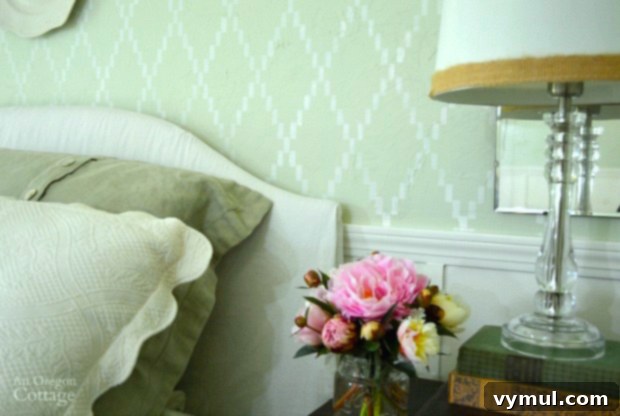
Once your final section is complete and the paint is dry to the touch, it’s time for the gratifying reveal. Carefully and slowly pull up all the painter’s tape. Stand back and admire your beautifully sharp edges and your newly transformed accent wall! While I personally appreciate the subtle light and dark variations inherent in stenciling, I did take an extra step. Using a small artist’s brush, I went back and gently touched up any rectangles within my pattern that appeared too light or faded. My roller application, like many DIY projects, probably wasn’t perfectly uniform (surprise, surprise!), and our wall’s existing texture also contributed to some marks being so light they almost vanished from a distance. I estimate I touched up about 10-20 areas in the main section of the wall by simply dabbing a small brush stroke of paint (always blotting the brush on the paper plate first to prevent globs). This touch-up step is entirely optional, of course, but for fellow type-A personalities, it might feel like a necessary refinement!
Embracing Imperfection: The Charm of a DIY Home
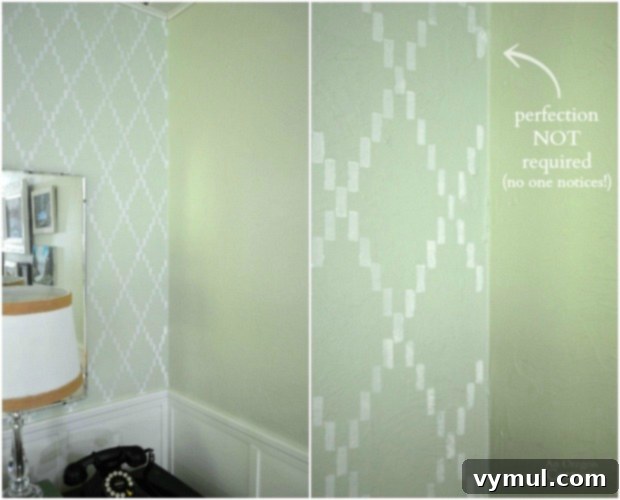
It’s important to remember that perfection isn’t always the goal, especially in DIY projects. Our personal DIY mantra has always been “it’s the cottage look.” The truth is, often no one notices these minor imperfections but us, the creators. A perfectly lived-in home embraces signs of real life and the occasional imperfection, which we believe adds character and warmth. It’s one of the core reasons this philosophy is even integrated into our tagline!
I suppose I’m only “type-A” to a certain extent. To me, worn, chippy, vintage, and imperfect DIYs all contribute to the charm of a home that is genuinely well-used and deeply lived in. These are the details that tell a story and make a house a home.
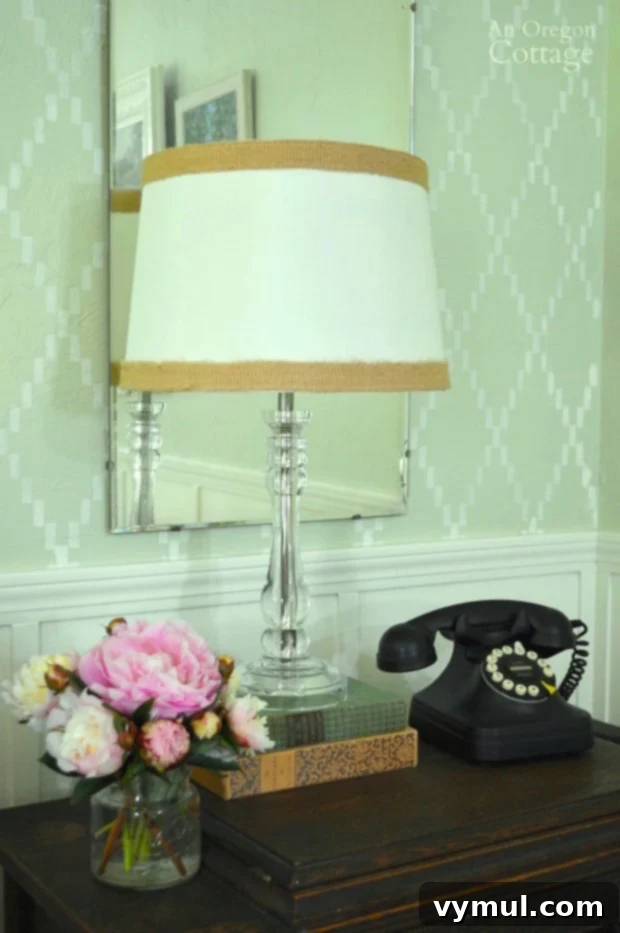
And please, don’t let the thought of tackling the corners intimidate you. Once you’ve rearranged your furniture and brought your decor items back into place against your cool new backdrop, the subtle imperfections melt away. The wall seamlessly transitions into exactly what it’s meant to be – a supportive, stylish backdrop for your beautiful room.
Refining Your Decor: A Continuous Journey
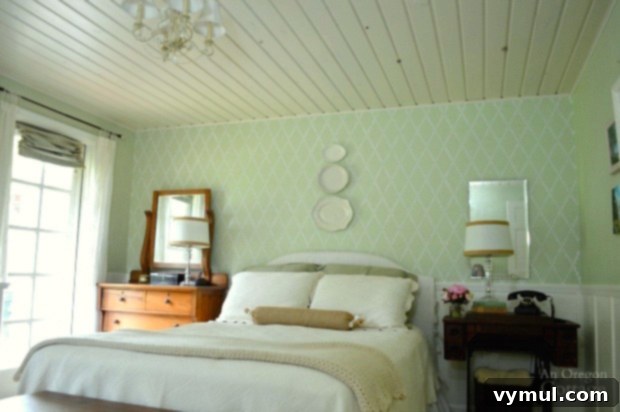
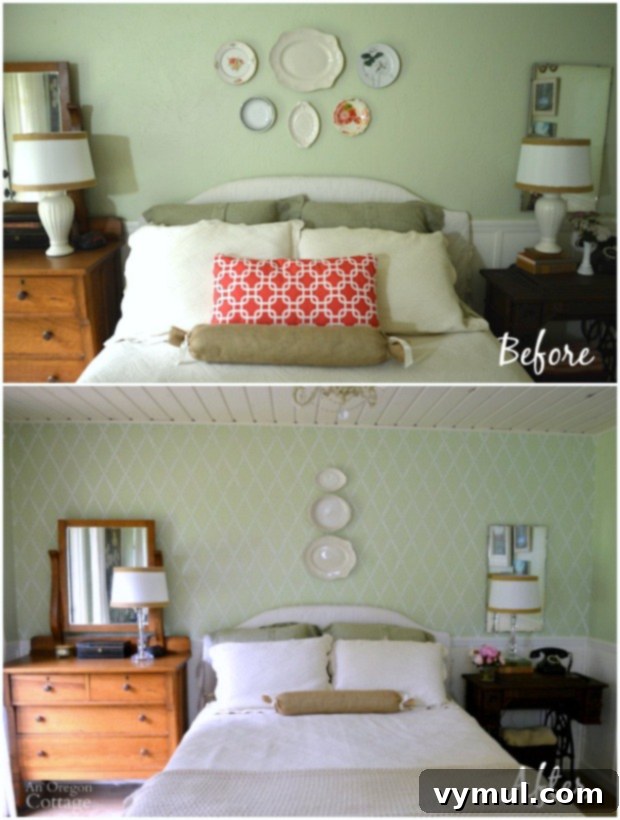
The “before-and-after” visuals also beautifully illustrate some other design updates I incorporated into the bedroom:
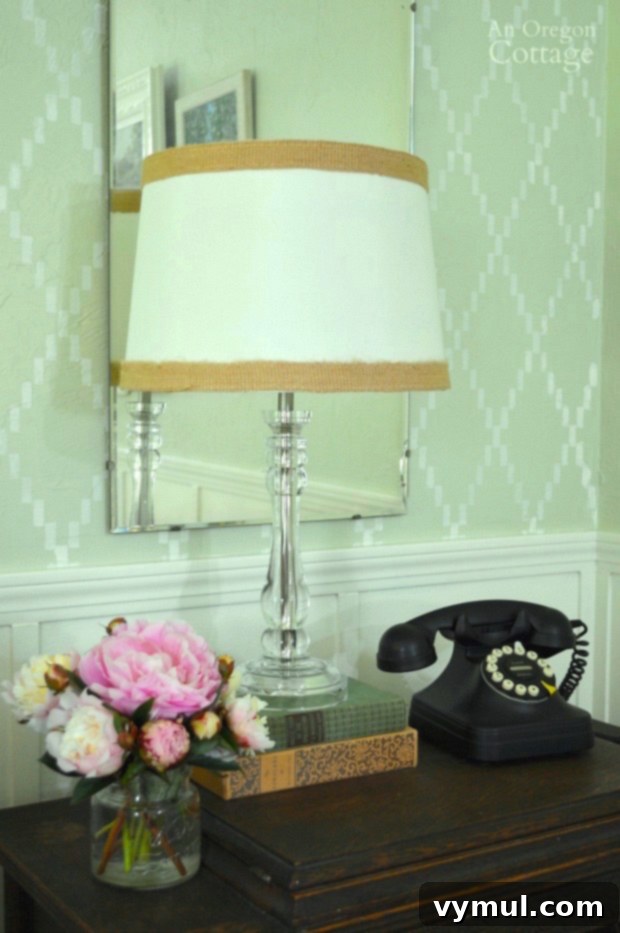
I finally made the decision to embrace clear lamp bases after an exhaustive, yet unsuccessful, attempt to paint thrifted ceramic lamps in three different colors (starting with silver, then cream, and even trying oil-rubbed bronze before ultimately giving up). It was truly the best decision ever! I had yearned for this specific style for years, and instead of continuing the futile search for them second-hand, I decided to bite the bullet and simply purchase a pair. Sometimes, it’s okay to invest in exactly what you want.
I’m also gradually transitioning from the thrifted plates and coral decor that were part of the One Room Challenge a couple of years ago. I find myself continually drawn back to the calming, two-color scheme that has always defined our bedroom’s aesthetic. It simply works for me, creating a serene and timeless atmosphere.
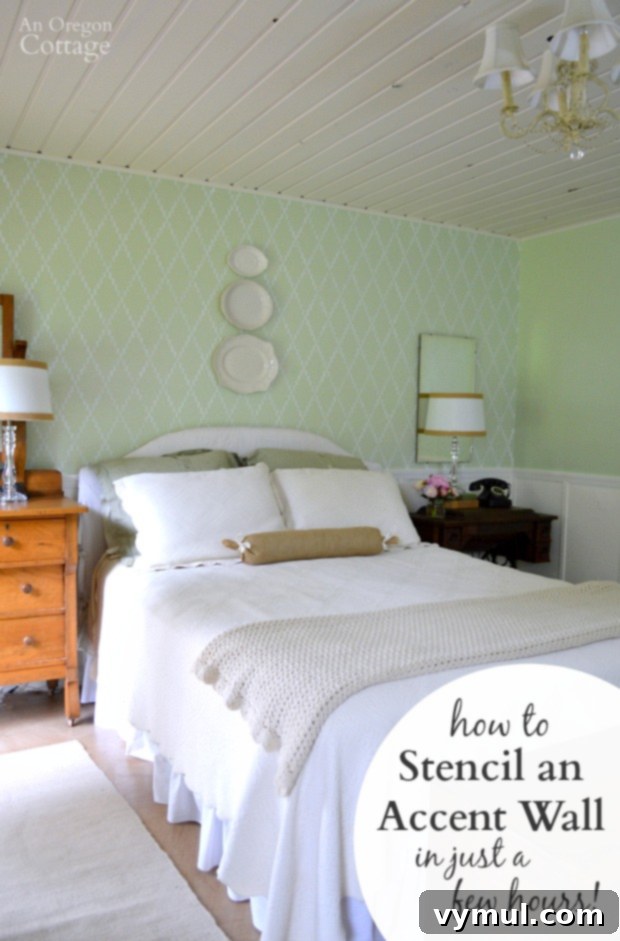
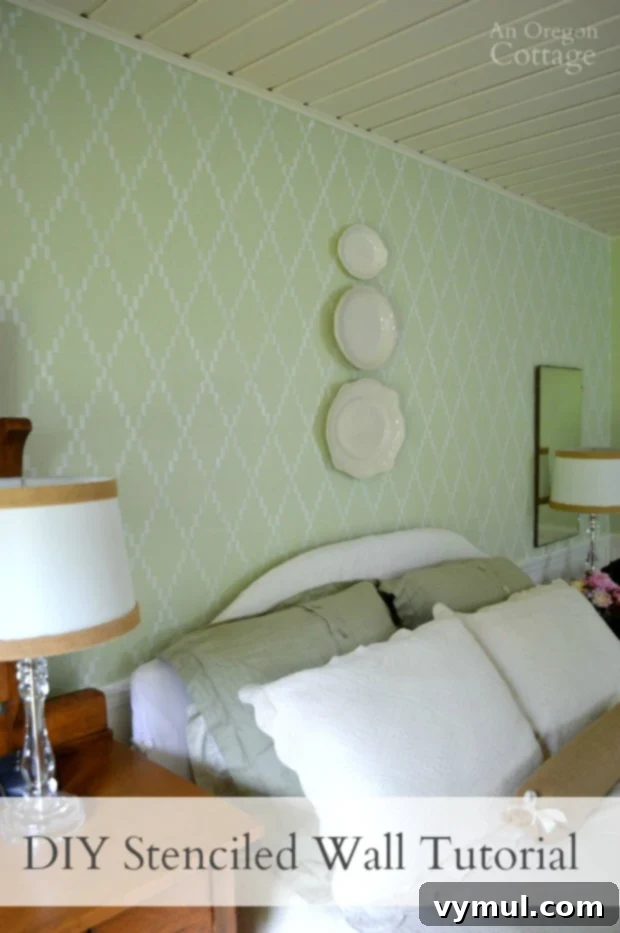
And the striking combination of crisp white ironstone against the sophisticated green-and-white trellis pattern? To me, at this very moment, that is absolute perfection!
(Oh, and I must confess, I genuinely dislike our current lopsided, light-dark nightstand situation! It’s glaringly apparent in these pictures that it simply doesn’t harmonize with the room. However, I’m constrained by the placement of Brian’s dresser in that specific spot, and I absolutely adore using his great-grandma’s antique treadle sewing machine as my side table. Hmm, perhaps it’s time to re-evaluate and rethink that particular arrangement!)
Conclusion: Join the Stenciling Revolution!
This DIY accent wall project proves that a dramatic room transformation doesn’t require extensive time, a massive budget, or professional skills. With a well-chosen stencil and a few hours of enjoyable work, you can create a stunning focal point that reflects your personal style and enhances your home’s character. Embrace the process, trust your instincts, and prepare to be amazed by what you can achieve!
This exciting DIY project is proudly part of the #7daysofstencils series – a fantastic collaboration of 7 bloggers dedicated to bringing you a week filled with fun and inspiring stenciling projects!

Disclosure: I received product and/or compensation for this post as part of a brand collaboration. As always, the opinions, thoughts, and DIY projects shared here are entirely my own. I am committed to ONLY promoting products or services that I genuinely love and believe you will find helpful and valuable – that’s my unwavering promise! This post also contains carefully selected affiliate links. By clicking on these links and making a purchase, you help support the continued creation of content for AOC at no additional cost to you! For a more comprehensive understanding of our policies, please refer to AOC’s entire disclosure page here.