
Real-World Raised Bed Vegetable Garden Tour: Effortless Gardening for Abundant Harvests

Welcome to an inspiring real-life raised bed vegetable garden tour! Originally showcased in July 2013, this snapshot of our garden reveals its robust structure and burgeoning growth, perfectly illustrating the potential of raised bed gardening. At this time of year, everything is thriving beautifully, yet the foundational design remains clearly visible, making it an ideal example to demonstrate how raised bed vegetable gardens function effectively in a practical, everyday setting. We’re republishing this tour with updated insights and a fresh perspective, complete with a new pinnable image, hoping to ignite your passion for vegetable gardening – especially for those looking to embrace a more “lazy” or low-effort approach.
This isn’t a meticulously styled magazine garden or a pristine test plot. Here, you’ll encounter the authentic elements of a working garden: well-used hoses, the charming imperfections of homemade cold frames, and bed borders that have settled comfortably over time. We pride ourselves on resourceful, DIY solutions, such as hoop houses, towering tomato supports, and sturdy bean trellises crafted from repurposed cattle fencing, metal posts, and simple PVC pipes. Yes, it’s undeniably real – and while it might not always boast picture-perfect aesthetics, we find immense beauty in its neat edges, vibrant green foliage, and, crucially, its remarkable lack of weeds. This isn’t due to endless hours of arduous weeding; rather, it’s a testament to our adoption of no-till gardening methods, which significantly reduce weed growth!
Raised garden beds offer a myriad of benefits that make gardening more accessible, productive, and enjoyable. They provide better drainage, allowing soil to warm up faster in spring, extending your growing season. The elevated edges prevent soil compaction, creating an ideal environment for root development. Furthermore, raised beds allow for precise control over soil quality, enabling you to tailor nutrient-rich mixes for specific crops. Their defined borders also contribute to a tidier, more organized garden space, simplifying maintenance and making it easier to implement weed prevention strategies. For beginners and seasoned gardeners alike, raised beds can transform gardening from a chore into a truly rewarding experience.
To give you a comprehensive overview of our garden as we embark on this tour, here are a few essential notes:
- Our overall garden footprint spans approximately 60′ x 30′ and is fully enclosed by a robust fence. While this might seem substantial, it’s important to remember that raised beds are incredibly versatile and can be scaled to fit any available space, from a small balcony to a spacious backyard.
- The perimeter fence line inside the garden is thoughtfully planted with a diverse array of fruit trees, various fruiting shrubs, established asparagus patches, bountiful strawberry beds, and a functional windbreak hedge. This not only maximizes production but also creates a microclimate beneficial for the entire garden.
- Our primary “traditional” raised beds, designed for intensive annual crop production, measure 4′ x 12′ and feature sturdy 10″ tall sides, providing ample depth for root growth and excellent drainage.
- In addition to these, we have four larger, more permanent beds, each spanning roughly 9′ x 20′. These were initially outlined with salvaged 4×4 posts. Over the garden’s decade-long life, these posts have naturally degraded, and we are now gradually transitioning these areas into “no-edge” beds by simply mounding the rich soil directly up from the surrounding gravel paths. This natural transition maintains the benefits of raised beds while reducing reliance on structural borders.
- For those interested in the grand scheme, you can view a hand-drawn plan detailing our garden’s overall design here.
Real Life Raised Bed Vegetable Garden Tour: A Closer Look

1. The Welcoming Entrance: A Grape Arbor Gate
The journey into our vibrant vegetable garden begins with a charming and functional entrance. The primary access point is a sturdy metal gate, which was a fixture of the property when we first moved in. To enhance its beauty and productivity, we constructed a substantial grape arbor directly over it. This impressive arbor is home to a single, vigorous ‘Flame’ seedless grapevine. It’s truly astonishing how this one plant completely engulfs the entire structure by the season’s end, transforming the entryway into a lush, shaded passage. Its growth intensifies each year, producing an abundant harvest. Based on our experience, even for an arbor as generous as ours (approximately 8′ x 3′), planting more than one grape vine would likely lead to an overwhelming pruning schedule. One well-maintained vine provides plenty of delicious fruit and magnificent foliage without demanding excessive labor, perfectly aligning with our easy-care gardening philosophy.
2. Traditional Raised Beds: Versatility and Innovation
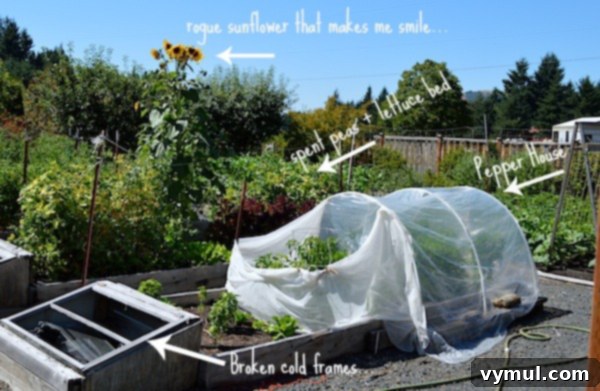
Our traditional raised beds are the workhorses of the garden, dedicated to a diverse array of annual crops. These beds are home to our bountiful tomato plants, various cole crops such as robust broccoli, tender cauliflower, and crisp cabbage, as well as an abundance of leafy greens like lettuce, sweet peas, crunchy carrots, earthy beets, and a delightful mix of both hot and sweet peppers. The first bed you encounter, though its contents shift annually due to our commitment to crop rotation, typically houses our ingeniously designed, high-tech pepper house.
The need for this pepper house to be easily movable prompted my husband, Brian, to devise a remarkably effective and simple system. It consists of PVC pipes inserted into holes drilled into a two-by-four, anchored securely by large rocks. This allows us to relocate the entire structure as needed. Additionally, I’ve incorporated a clever row-cover-and-clothespin system to provide extra protection for the hot peppers planted outside the main enclosure. We often joke about patenting these homegrown innovations – they truly represent the spirit of practical, real-world gardening!
On a serious note, I absolutely adore our pepper house. Its secret lies in the perforated plastic cover, which eliminates the need for constant opening and closing, allowing it to remain in place throughout the entire growing season. This simple modification is the only way I can consistently guarantee a harvest of fully ripe peppers well into September and even October. And when I say “ripe,” I mean vibrantly colored peppers – because, frankly, green peppers are simply unripe and carry a bitterness that disappears with full maturation. The extended warmth and protection offered by the pepper house are invaluable for maximizing yield and flavor.

This accompanying photograph vividly illustrates the profound difference the perforated plastic hoop house makes for our pepper plants. Notice how the peppers cultivated within the protective environment of the hoop house are visibly larger, boast a healthier, deeper green hue, and show more robust growth compared to their counterparts planted outside. To further enhance the heat retention crucial for pepper development, I apply a layer of black plastic mulch directly on the soil surface within the house, with soaker hoses strategically placed underneath. This combination creates an optimal microclimate, trapping warmth and maintaining consistent soil moisture. With this integrated system, our pepper plants often continue to produce an impressive harvest well into November, far beyond what would typically be possible in our climate. It’s a testament to how simple, thoughtful innovations can dramatically extend the growing season and increase yields in raised bed gardening.

3. Larger Permanent “Raised” Beds: Maximizing Space and Rotation
I strategically designed these four expansive permanent beds with a specific purpose: to cultivate larger quantities of staple crops like corn and potatoes, while also facilitating easy and effective crop rotation. This approach ensures soil health, prevents pest buildup, and optimizes yields year after year. Typically, I allocate two of these substantial beds for various corn varieties, one for our beloved potatoes, and the remaining bed for an assortment of pole beans, dry beans, and cucumbers.
As you can observe in the picture, which features one of our roughly 9’x20′ beds, I am a firm believer in intensive planting – cramming a significant amount of produce into every available square foot. I’ve previously shared my enthusiasm for why I consistently choose to grow Emerite Beans here, highlighting their prolific yields and delicious flavor. Similarly, I’ve outlined five compelling reasons why growing cucumbers on a trellis is a game-changer for any gardener, saving space and promoting healthier plants. Just beyond this bed, you can catch a glimpse of our six traditional raised beds, two of which are dedicated exclusively to a staggering eighteen vigorous tomato plants, promising a summer filled with fresh, juicy harvests. This arrangement showcases how different raised bed styles can complement each other within a larger garden design.
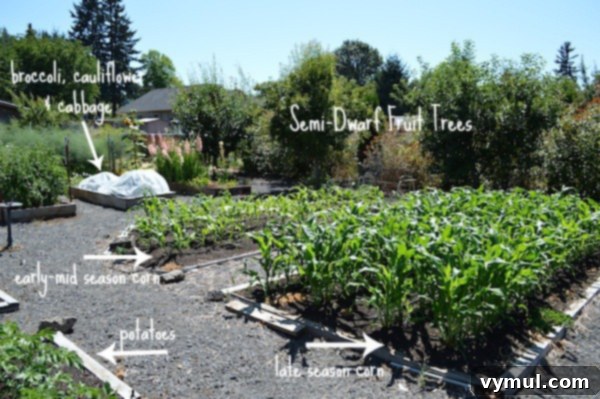
The remaining three large permanent beds are thoughtfully divided between our thriving corn and potato crops, serving as cornerstones of our food production. While you might spot an occasional, persistent dandelion stubbornly clinging to the edge of the lower right corn bed, such occurrences are rare exceptions. The truth is, I virtually never have to weed these particular beds, thanks to our highly effective no-till gardening practices. For a detailed guide on how we achieve this remarkable weed-free environment, you can read all about how to grow corn without weeding here. This method significantly reduces maintenance, allowing us to focus on the joy of gardening rather than the drudgery of weeding.
Our Yukon Gold potatoes, a favorite variety, will soon be hilled up with a generous layer of straw. This technique not only protects the developing tubers from sunlight but also conserves moisture and suppresses weeds, further simplifying care. To ensure a continuous supply of fresh corn throughout the season, we employ a staggered planting strategy for our two corn beds. By planting them 1-2 weeks apart and using different varieties, we ensure that our harvest ripens over an extended period of a month and a half. This thoughtful planning prevents us from being overwhelmed with a glut of corn for a brief period, only to then run out; instead, we enjoy a steady, manageable supply.
Another key strategy for success, particularly with delicate crops, involves our broccoli and cabbage bed. We keep this bed under protective row covers for the majority of the growing season. This proactive measure is, in our experience, the only consistently reliable way to grow healthy broccoli without succumbing to destructive aphid infestations. While a few persistent cabbage worms might occasionally find their way in, the row cover significantly minimizes their numbers, protecting the bulk of our harvest from damage. These simple, yet effective, techniques underscore how raised bed gardening, combined with smart practices, leads to abundant and healthy yields.
4. Other Raised Beds: Experiments and the Unpredictability of Nature
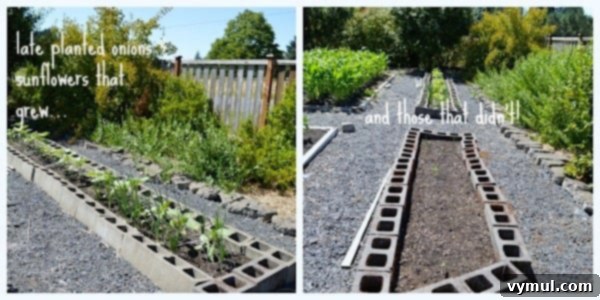
Capitalizing on extra space and a surplus of cinder blocks inherited from the previous owners, we ingeniously created these additional long raised beds. Every year, these beds are primarily dedicated to growing substantial crops of onions and, much to our delight, towering sunflowers. Sunflowers are an absolute joy to cultivate – their magnificent height and vibrant blooms add unparalleled beauty and character to the garden, while their seeds provide a rewarding harvest.
However, gardening, even with years of experience, often presents us with charmingly bizarre and unpredictable scenarios. These two specific beds serve as a perfect illustration of nature’s whims. Despite receiving identical soil preparation, consistent watering regimes, and having the same sun exposure, the results were strikingly different. The late-planted onions and sunflowers in the longer bed thrived exceptionally well, producing a robust and healthy crop. Yet, in the adjacent, shorter bed, the growth was almost nonexistent. It’s one of those moments that makes you scratch your head, reminding us that even with the best planning and effort, gardening remains a continuous journey of learning, adapting, and embracing the delightful mysteries of the natural world. These experiences, though sometimes frustrating, add a rich layer of authenticity to our raised bed gardening adventure.

5. Raised Beds for Permanent Crops: Asparagus and Beyond
Along one of the defined edges of our expansive garden, we’ve dedicated two long, purpose-built 4′ x 18′ raised beds specifically for our permanent asparagus crops. These beds are an exemplary illustration of why raised beds are ideally suited for perennial vegetables. Asparagus plants thrive when their root systems remain undisturbed, and they greatly benefit from a consistently weed-free environment – conditions perfectly met by the contained, well-drained, and manageable nature of raised beds. This thoughtful placement ensures their long-term health and productivity, year after year.
For those new to asparagus cultivation, it’s fascinating to observe what the plant looks like once you cease harvesting its tender spears. The image captures this stage: you need to allow the asparagus to “fern out” into its feathery, mature foliage. This crucial process enables the plant to photosynthesize effectively, sending vital energy back down to its extensive root system. This annual replenishment is absolutely essential for feeding the roots, ensuring a strong, vigorous return and a bountiful harvest in the subsequent year. The bed on the left in the photograph did not undergo harvesting in the spring, which aligns with a specific strategy. Our goal for this particular patch is to cut down the ferns in August, and then initiate a secondary harvest of fresh shoots for a period of three weeks in September. This innovative approach allows us to extend the delightful asparagus harvest season, providing fresh spears over a longer duration. Raised beds make such specialized care and management straightforward, solidifying their role as an indispensable tool for productive and enduring vegetable gardens.
So, that concludes our real-world garden tour, offering an authentic glimpse into how we strategically utilize raised beds in our vegetable garden to streamline our gardening efforts and achieve impressive yields. We sincerely hope that this tour has provided valuable insights and sparked inspiration within you to consider planning and implementing a raised bed or two somewhere in your own yard. Embracing raised bed gardening is a fantastic step towards a more manageable, productive, and ultimately, more joyful gardening experience!