Build Your Own Inexpensive Automatic Garden Watering System with PVC & Soaker Hoses
Imagine a lush, thriving garden without the daily chore of manual watering. This comprehensive guide will show you how to easily build your own **automatic watering system for gardens** that is both effective and incredibly affordable. Using simple PVC parts, efficient soaker hoses, and basic DIY skills, you can create a customized irrigation solution for both raised garden beds and traditional planting areas. Say goodbye to the constant worry of watering and enjoy more time savoring your garden’s bounty!
Some links in this article are affiliate links, meaning if you click on them and make a purchase, I may receive a small commission at no extra cost to you.
For years, manual watering was a persistent challenge in our vegetable gardens. The thought of dragging hoses, constantly monitoring water levels, and the ever-present question, “Did I remember to turn the water off?” often loomed. We always preferred using soaker hoses directly in the beds due to their efficiency in delivering water straight to the roots, which also significantly helps in minimizing weed growth in unplanted areas. However, the manual connection of main hoses to these soakers remained a tedious task.
I can recall countless evenings lying awake, suddenly struck by the possibility that the well pump was still running, signaling forgotten hoses. This often led to a late-night scramble to rectify the oversight. When we initially designed and built our previous raised beds, gravel paths, and fences, an integrated watering system wasn’t part of the grand plan. Later, the idea of tearing up our established garden to install proper irrigation felt like an overwhelming and costly endeavor.
Consequently, I spent years hauling heavy hoses around a large garden, connecting them to an indoor timer that I frequently forgot to set or activate. Vacations became a logistical nightmare, as the complex system of hose-dragging and timed watering was too much to ask of anyone house-sitting. The repetitive chore and the late-night water checks grew tiresome and inefficient.
When planning our farmhouse’s new vegetable garden, we were determined to avoid these past frustrations. The clear solution was to design and implement an automatic watering system concurrently with the construction of our new low-maintenance, raised bed garden. This proactive approach allowed us to integrate the irrigation seamlessly from the start.
Our vision for this DIY garden watering system was clear. It needed to be:
- Simple to Build and Set Up: Accessible for anyone with basic DIY skills, avoiding complex plumbing or electrical work.
- Simple to Use: A true “set-it-and-forget-it” system that minimized daily intervention.
- Inexpensive: Utilizing readily available and affordable materials like PVC and standard soaker hoses to keep costs down.
- Easy to Repair: Designed for straightforward maintenance, allowing for quick fixes of any issues that might arise.
- Adjustable: Providing the flexibility to control water flow to individual beds, catering to different plant needs or empty sections.
- Aesthetically Pleasing: Blending into the garden landscape without being overly obtrusive or distracting.
It is with immense satisfaction that we now share the detailed steps for building this simple yet highly effective irrigation system. By combining basic PVC pipe pieces, common tools, easily found watering supplies, and standard DIY abilities, we transformed our garden into a far more manageable and enjoyable space. Brian and I have documented every step, including a helpful video, so you can confidently replicate this project in your own garden. For smaller gardens, you’ll find the process even quicker and more budget-friendly!
First Steps to Planning Your DIY Automatic Watering System
Before you gather your supplies and begin the physical construction, two crucial preliminary steps are required. These planning phases will ensure you purchase the correct quantities of materials and establish an efficient design for your garden irrigation.
STEP 1: Map Out Your Garden Space
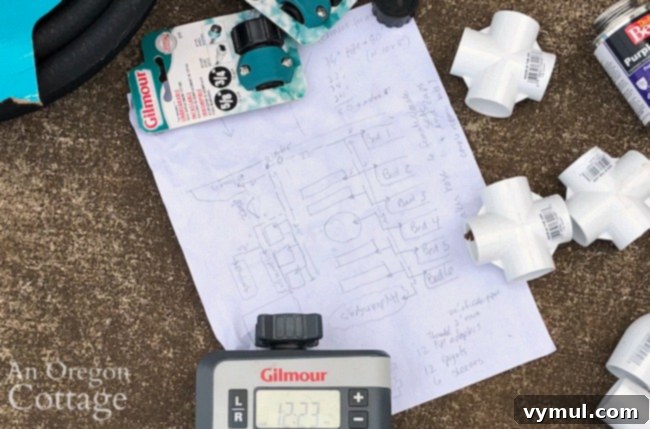
Begin by meticulously measuring your entire garden area. Once you have accurate dimensions, draw a detailed map of your garden. This map doesn’t need to be an architectural masterpiece, but it should clearly show the layout of your raised beds, regular planting areas, pathways, and the location of your primary water source.
PRO TIP: If you’ve already started planning your easy-care vegetable garden, you might already have a detailed map in your free Garden Notebook Journal. This saves a lot of time!
STEP 2: Plan Your Water Lines and Irrigation Layout
Using your garden map, diagram precisely where you want your main water lines and feeder lines to run. Consider the most logical and efficient routes to reach each planting bed. For our system, we opted for a straightforward design: a central main line that branched off into individual arms, with a soaker hose attached to each garden bed. This keeps the system incredibly simple and scalable.
IMPORTANT CONSIDERATION: Water Pressure: Before finalizing your layout, think about your property’s existing water pressure and the maximum length of a single irrigation line it can adequately support. If your garden is expansive or if you experience lower water pressure, you may need to run multiple main lines. These can be managed with hose splitters or multi-port timers (double, triple, or quadruple connectors) to keep individual runs shorter and ensure consistent pressure across all beds.
READER TIP: Calculating Water Flow Rate: A helpful reader shared this excellent advice: “To accurately factor the rate of water required for your system and the amount of water available from your source, you can calculate your gallons per hour (GPH). Fill a 3 or 5-gallon bucket and time how long it takes. Then, multiply by a conversion factor (easily found with a quick Google search) to determine your GPH. Next, add up the stated water rates for all your planned soaker hoses or drip emitters (these figures are typically on the product packaging). Most gardens will have sufficient water, but this calculation ensures you’re on the safe side, preventing system underperformance.”
Step 3: Gather Your Supplies (with Printable Checklist)
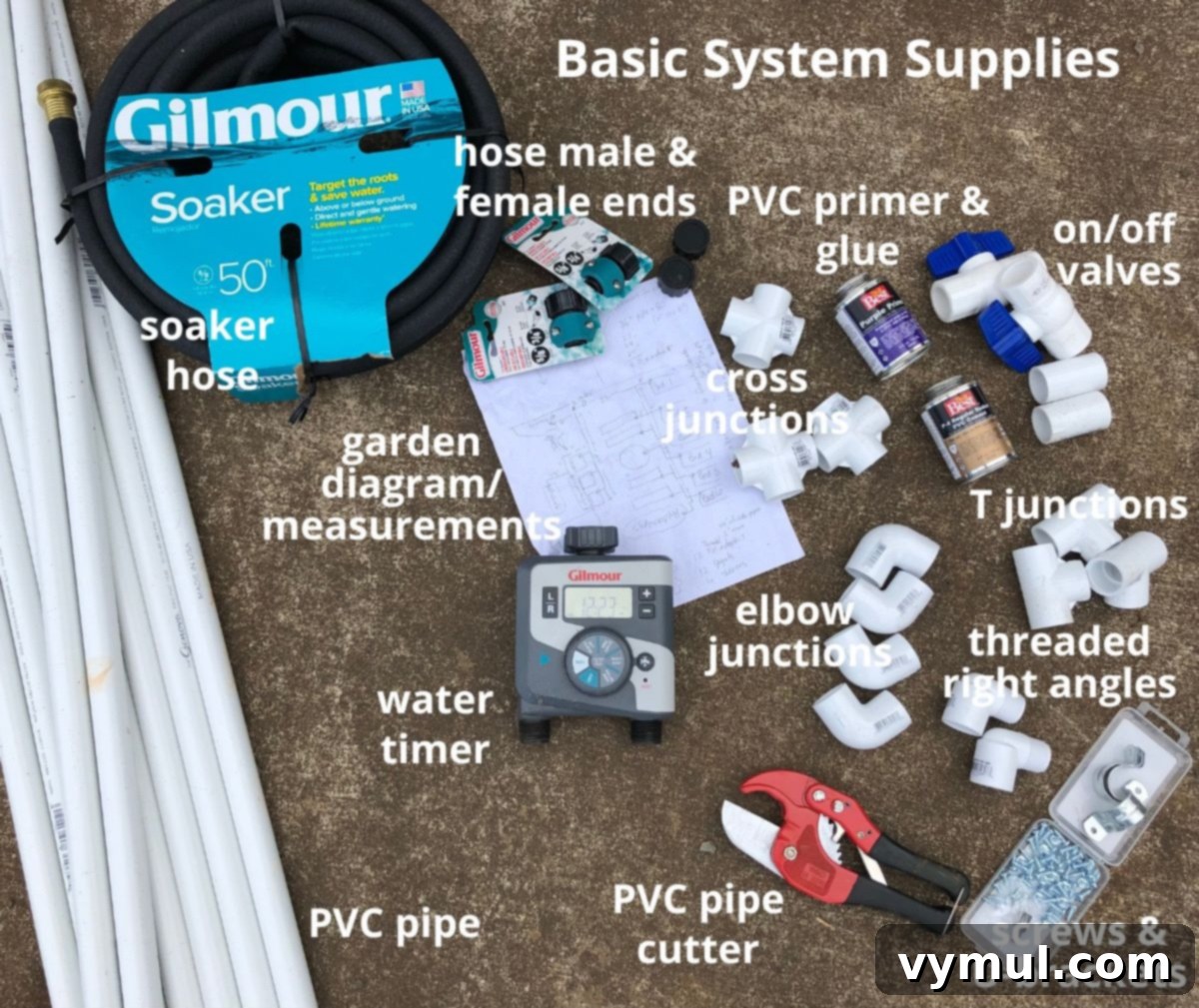
With your garden map and water line plan complete, you’re ready to assemble the necessary components for your DIY automatic watering system. The main items you’ll need are:
- PVC Pipe, Junctions, and Elbows: These form the backbone of your main water lines. Opt for 3/4-inch PVC pipe for good flow. Ensure you have a variety of fittings: straight couplers, 90-degree elbows for turns, and T-junctions for branching off to individual beds.
- PVC Pipe Cutter: While a hacksaw can work, a dedicated PVC pipe cutter makes clean, precise cuts quickly and effortlessly, which is crucial for good seals.
- PVC Primer and Glue: Essential for creating watertight and durable connections between PVC pipe segments and fittings. The primer cleans and softens the PVC, allowing the cement (glue) to chemically bond the pieces together.
- Water Timer: This is the heart of your automation. A reliable timer (like this Dual Electronic Water Timer we used) allows you to set precise watering schedules, freeing you from manual intervention. Consider dual-zone timers if you have different watering needs in different parts of your garden.
- Anti-Siphon Backflow Preventer Valve: This crucial component prevents contaminated garden water from flowing back into your clean drinking water supply. While we used a dedicated anti-siphon valve, a 4-in-1 type faucet adapter (which often includes a pressure reducer and filter) is also an option. For soaker hoses, high pressure is generally desirable to ensure water reaches the furthest points, so a dedicated pressure reducer might not always be necessary unless your water pressure is exceptionally high and could damage the hoses.
- Soaker Hoses: The choice of soaker hose matters. We’ve found these flat cloth-type soakers to be excellent for larger beds, as they are easier to lay out and maintain consistent water seepage. For smaller beds or wrapping around individual trees/shrubs, traditional rubber 5/8″ soaker hoses are still valuable because they can be cut and repaired to custom lengths.
- On/Off Hose Valves: These valves are installed at the end of each feeder pipe leading to a garden bed, allowing you to independently control water flow to specific zones. This is vital for adjusting to different crop needs or turning off water to empty beds.
- Hose Male and Female Ends: You’ll need these for connecting the soaker hoses to the on/off valves and for repairing or custom-cutting soaker hoses.
- Hose End Caps: Used to seal the ends of soaker hoses, ensuring water pressure is maintained throughout the length of the hose.
- Sand: A layer of sand in your trenches protects your PVC pipes from sharp rocks and makes future repairs easier.
- Tools: Beyond the PVC cutter, you’ll need a shovel, an adz or pick for trenching, a measuring tape, a drill with screws, and metal U-brackets for securing pipes.
Utilize your detailed garden plan to accurately calculate the lengths of PVC piping and the number of fittings required. Follow this sequence to ensure you cover all components:
- Main PVC Pipe Length: Starting from your water source, estimate the total linear feet of 3/4-inch PVC pipe needed for your main lines and all feeder lines running up to the beds. Write this total down – for reference, our system required approximately 80 feet.
- PVC Fittings Count: Again, beginning at your water source and following your diagram, count every PVC fitting you’ll need. This includes right-angle elbows for turns, 3-way “T” junctions for branches, and any 4-way cross junctions if your design requires them. Your map will be indispensable here for an accurate count.
- Threaded Right-Angle End Pieces: These are crucial for the connection points at the top of your raised beds. They allow you to screw in the standard on/off hose valves. Add the precise number of these to your list.
- On/Off Valves: Finally, tally the total number of on/off hose valves. You’ll need one for each feeder pipe leading into a garden bed, providing individual water control for each zone.
To simplify your shopping process even further, we’ve created a free printable checklist that includes all the necessary supplies, tools, and materials like sand:
Automatic Watering System Supplies Checklist (PDF)
Simply click the image or link above, download the PDF to your computer, print it out, and fill in the quantities or cross off items you already own. Then, head to your local home improvement store to gather everything you need!
DIY Watering System Video Tutorial
For a visual walkthrough of each step, watch our detailed video. This video complements the written tutorial below, providing invaluable guidance as you construct your automatic garden watering system.
How to Build an Automatic Watering System for Gardens: Step-by-Step Guide
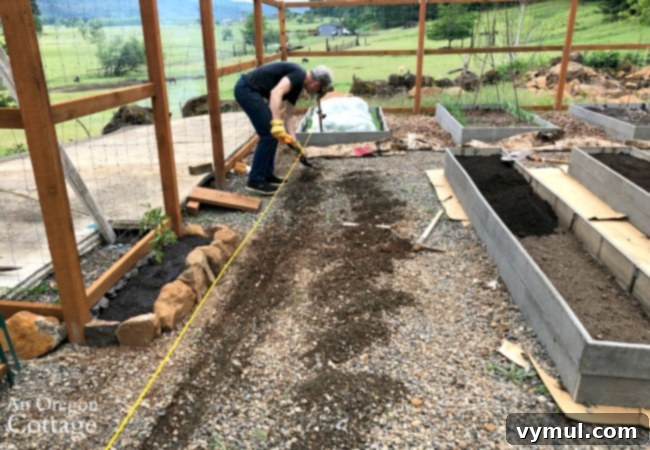
Step 1: Dig Trenches for the PVC Pipe
Before you begin any digging, it is absolutely critical to check for underground utilities such as water, electrical, or gas lines. Contact your local utility locating service (often 811 in the US) to have lines marked. Adjust your planned route if necessary to avoid any hazards. Once clear, stretch a string line a foot or two above your intended main trench path. This will serve as a guide to help you dig a perfectly straight trench.
Using an adz or pick for breaking ground, and then a narrow spade or trenching shovel, dig your main trench. It should be consistently 3 to 4 inches deep. The width doesn’t need to be excessive, just enough to comfortably lay the PVC pipe. For those in regions with freezing winters, consider digging deeper trenches (e.g., 8-12 inches) to protect the pipes from frost heave and potential damage, though our system is designed to be drained annually.
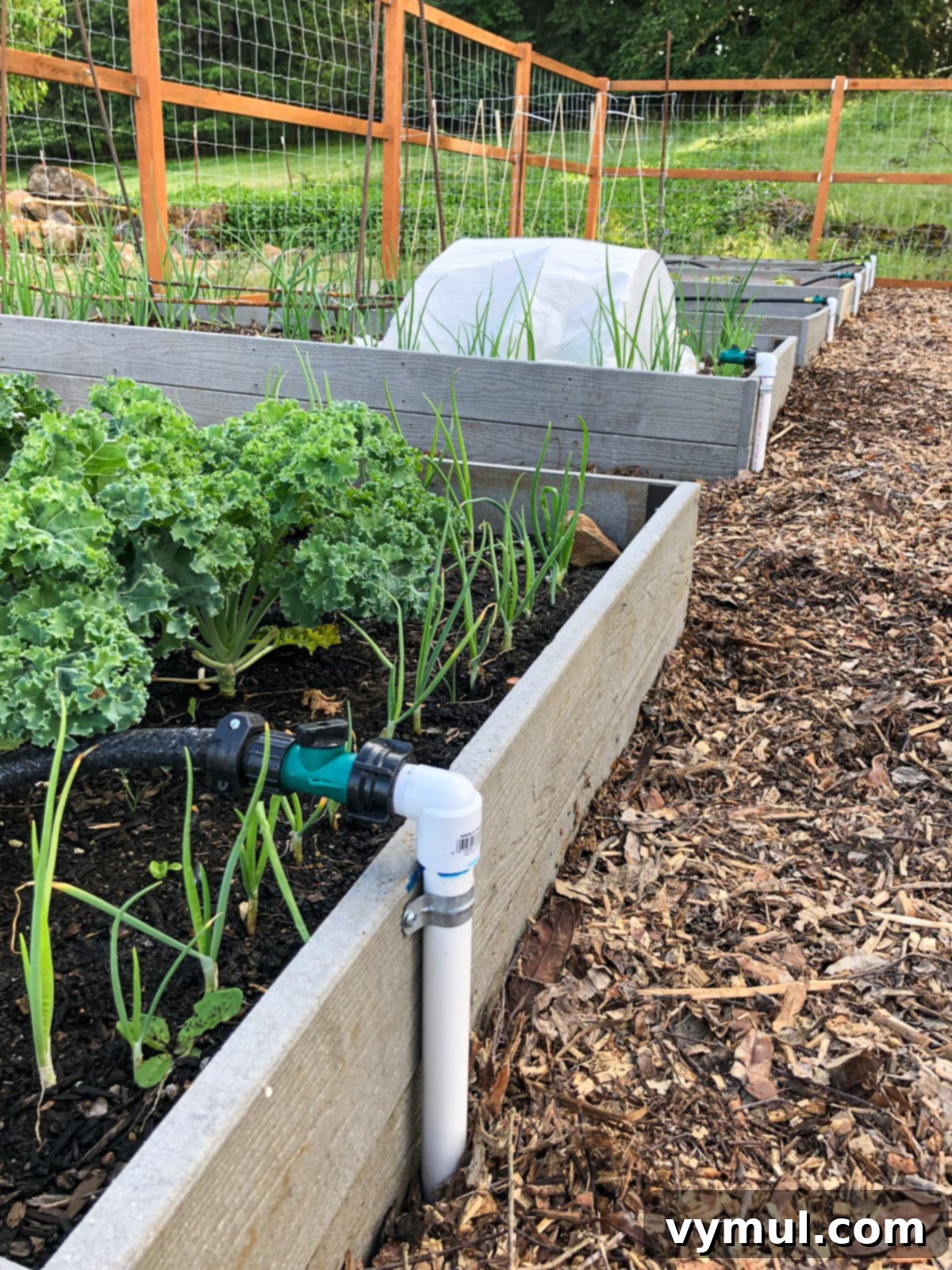
Next, dig the side trenches that will lead to each garden bed, following your detailed plan. We positioned our feeder pipes at one of the corners of the beds. This strategic placement makes it much easier to snake the soaker hoses in a circular pattern around the bed, providing even water distribution, rather than starting in the middle. Adapt this placement based on the size and shape of your specific garden beds.
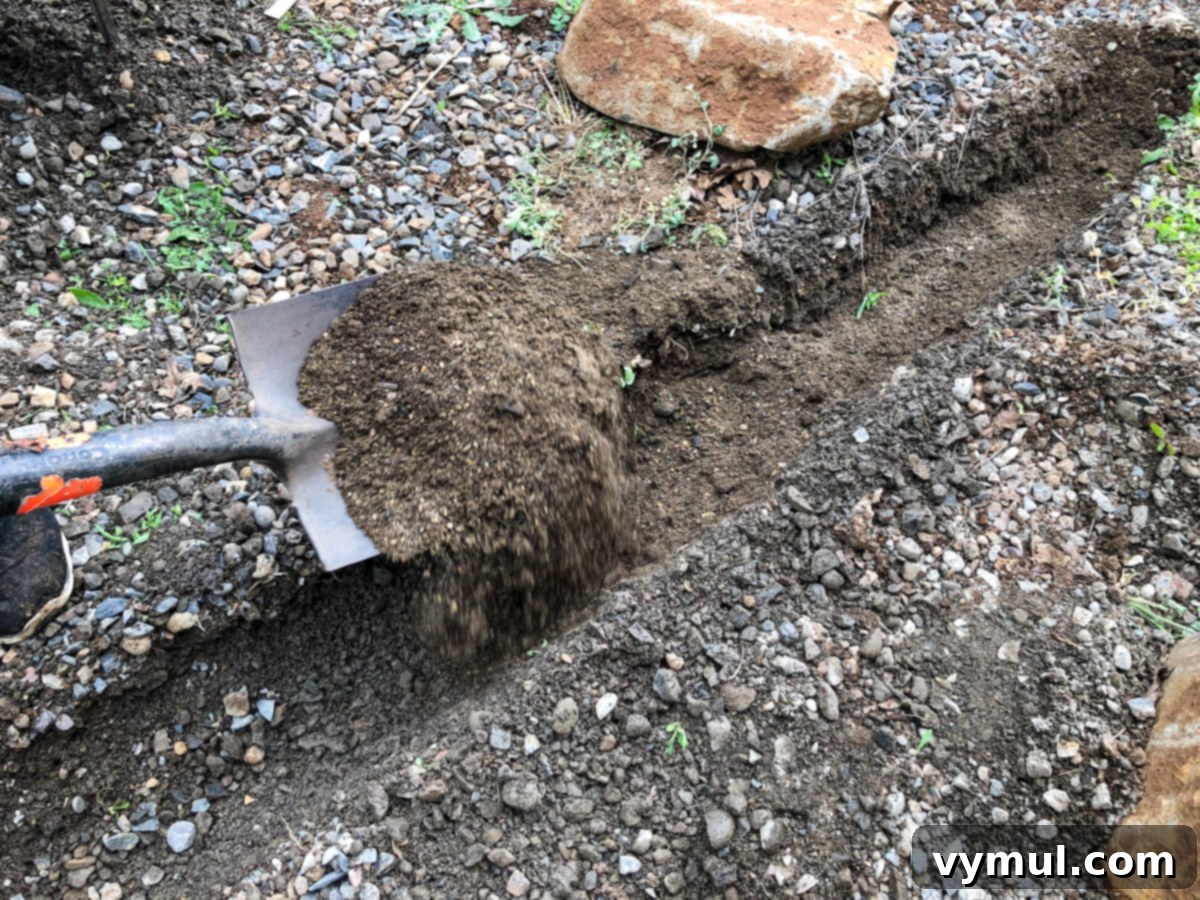
Step 2: Lay a Bed of Sand in the Trenches
Once your trenches are dug, add a layer of sand, approximately an inch deep, to the bottom of each trench. This step is particularly important if your soil is rocky, as sharp stones could eventually puncture or damage the PVC pipe over time due to ground movement or pressure. Sand provides a soft, protective cushion for the pipes, helping to prevent such issues and making any future repairs much easier by allowing for simple excavation.
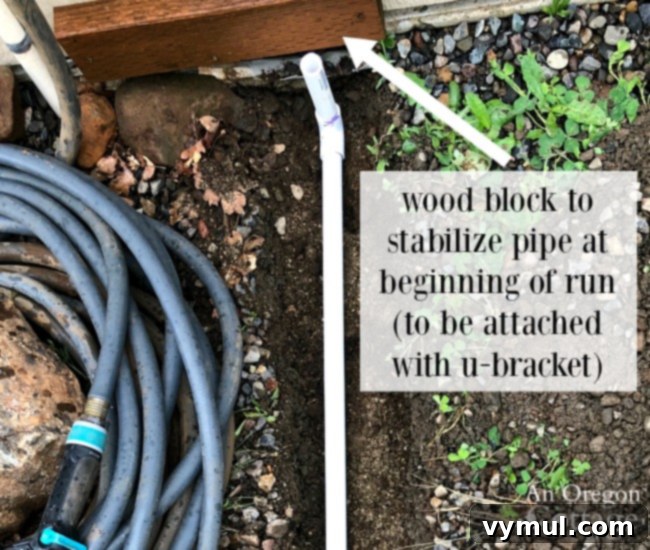
Step 3: Assemble & Lay the PVC Pipe Lines
For a robust connection at the water source, we recommend screwing a sturdy wood block directly below your spigot. This provides a solid anchor point for the initial PVC pipe connection. Begin assembling your main line here, leaving a short vertical piece extending upwards to make the final connection to your water timer and spigot later.
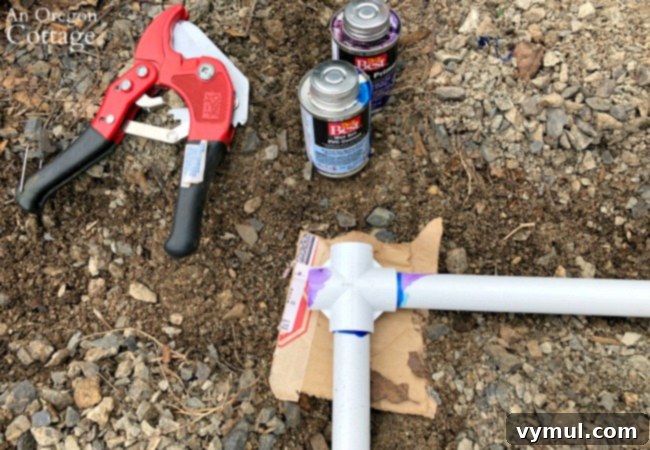
The PVC assembly process is straightforward, requiring precise cuts and quick, secure gluing:
- Measure and Mark: Place a section of PVC pipe directly into your trench along its intended path. Use a pencil to mark where it needs to be cut to fit snugly into the next fitting. Remember to account for the pipe sliding approximately one inch into each fitting. While PVC is somewhat flexible and allows for minor deviations, strive for accuracy.
- Prime Both Surfaces: Apply the purple PVC primer to both the end of the pipe and the inside of the fitting where they will join. The primer cleans and prepares the plastic for a strong chemical bond, drying almost instantly.
- Apply Glue and Connect: Immediately after priming, apply a generous, even layer of PVC cement (glue) to both primed surfaces. Work quickly, as the glue also dries rapidly. Push the pipe completely into the fitting, twisting slightly as you do so to ensure the glue spreads evenly and the pieces align correctly. Hold firmly for a few seconds for the initial bond to set.
That’s the basic process! You’ve successfully connected your first PVC pieces. Continue this marking, cutting, priming, and gluing process along your entire proposed main line and side branches.
PVC Assembly Tip #1: Keep it Clean: When working with primer and glue, lay your pieces on a small patch of cardboard or wood. This prevents sand, dirt, or debris from sticking to the wet primer or glue, which could compromise the seal.
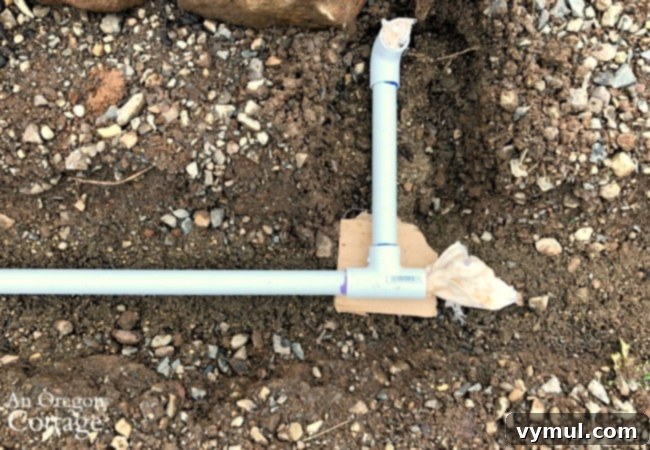
PVC Assembly Tip #2: Prevent Debris: To avoid any sand, dirt, or small rocks from accidentally entering your system during assembly, loosely stick a small wad of paper or a piece of cloth into the open end of any pipe that is awaiting its next connection. Remove it just before applying primer.
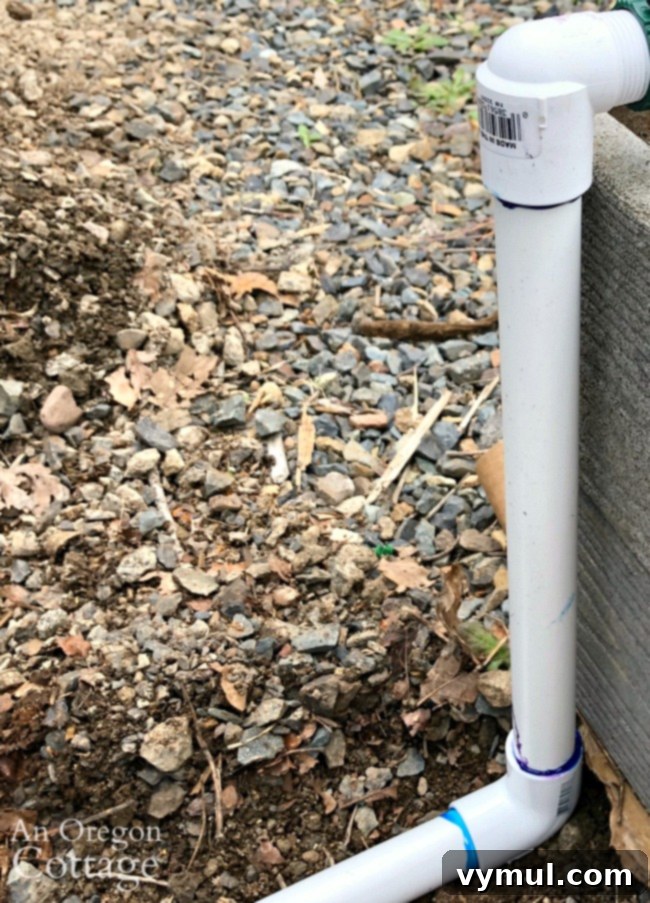
Constructing Raised Bed Feeder Pipes
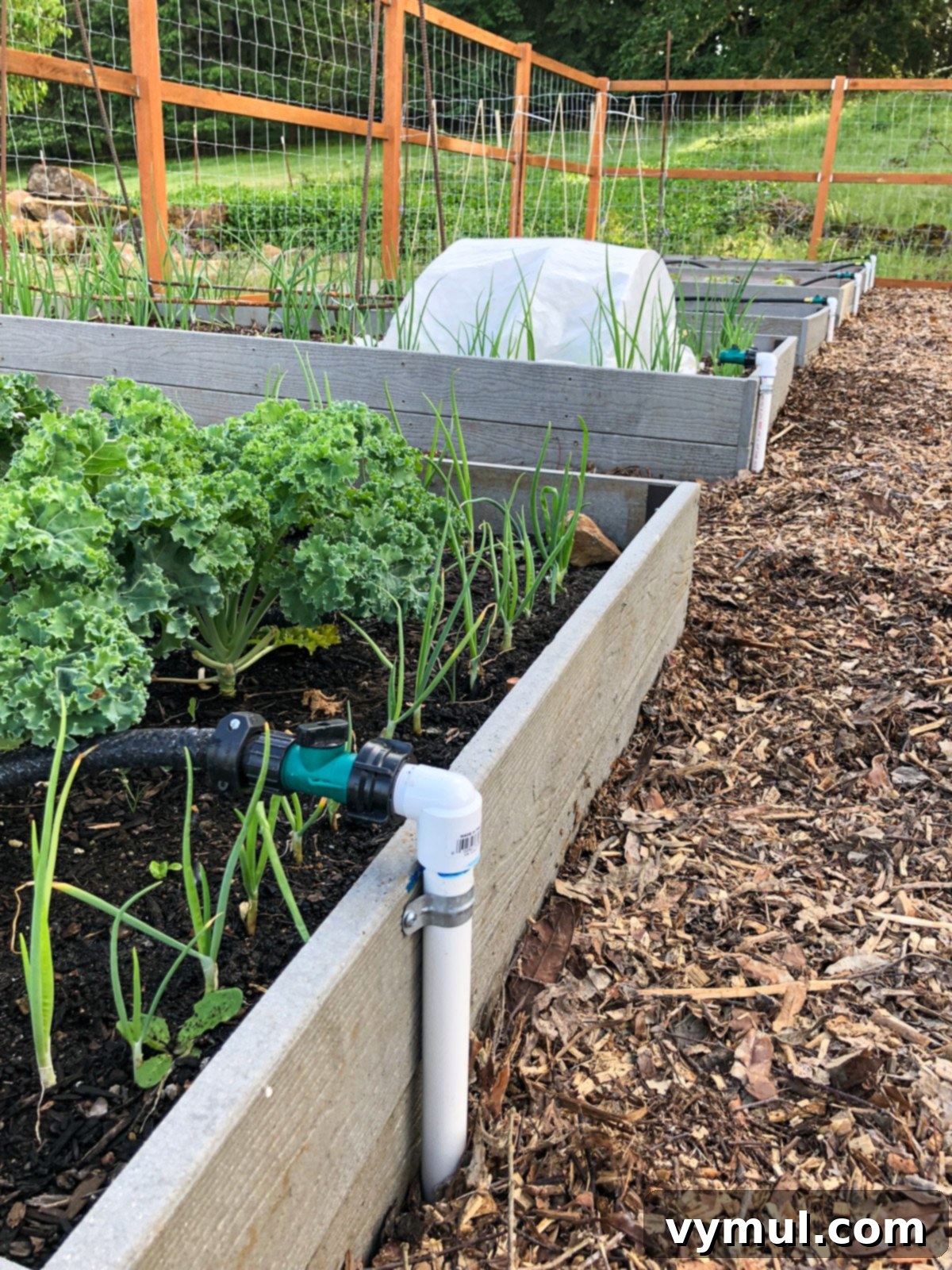
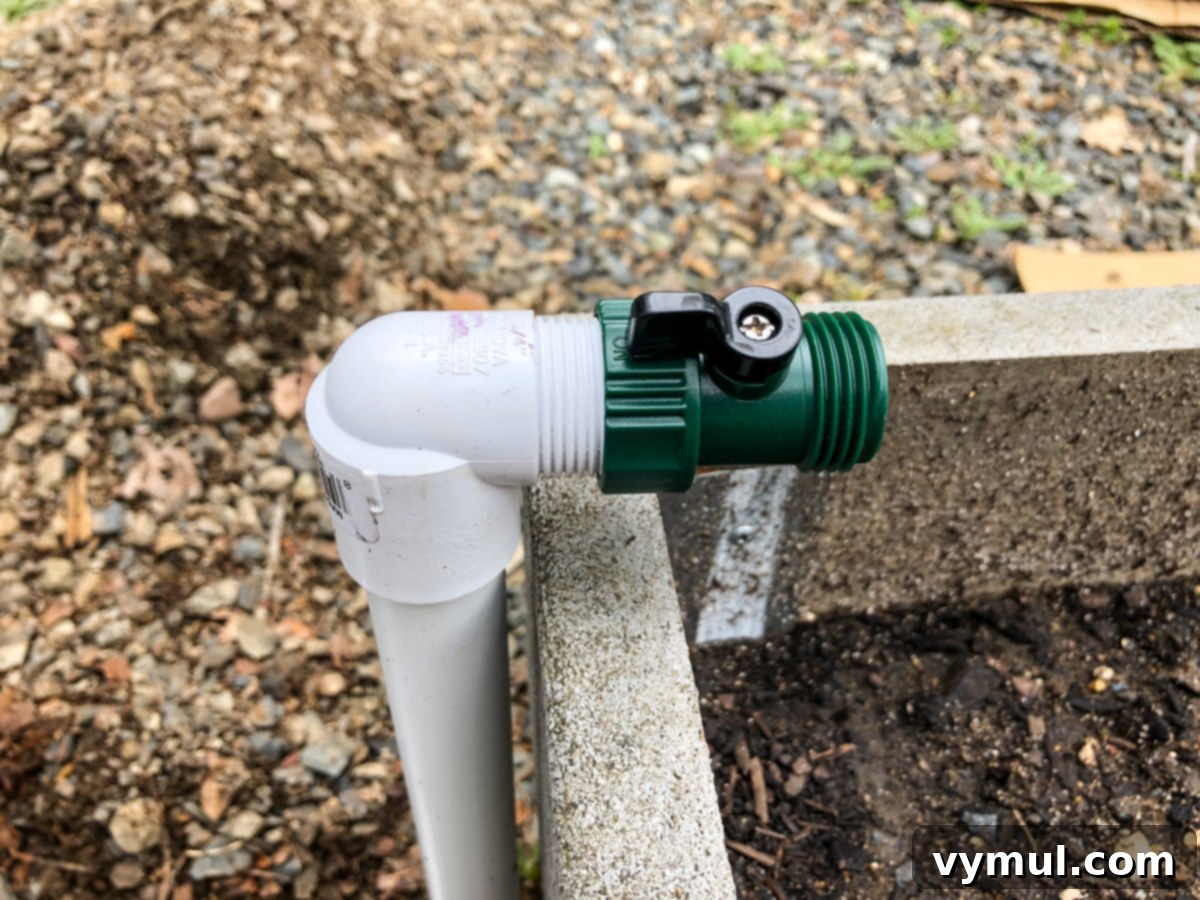
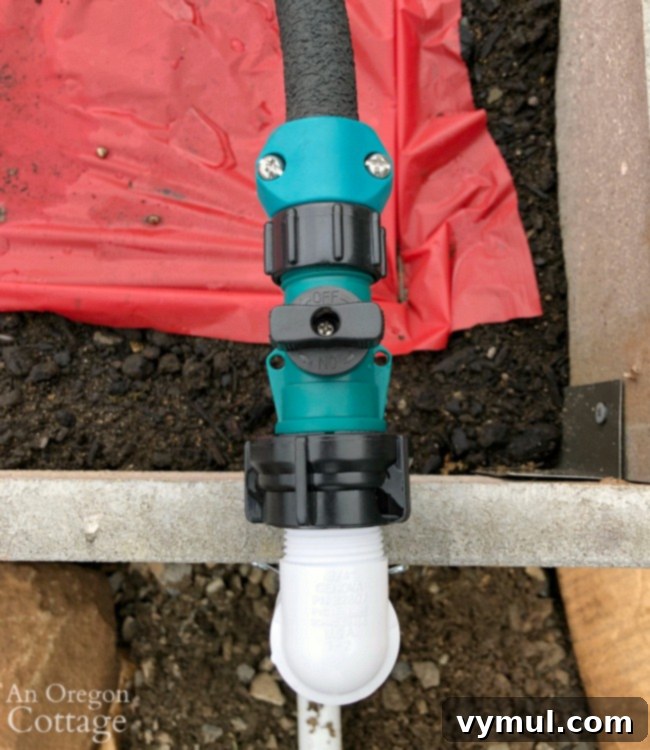
The process for attaching corners and T-junctions that branch off the main line and extend upwards into your raised beds is the same. When creating a side line for a bed, first glue a right-angle turn onto the main line where the branch will start. Then, attach a vertical piece of pipe to this right-angle fitting, cut to the appropriate height to reach the top edge of your raised bed. Finally, glue a threaded right-angle fitting to the top of this vertical pipe. This threaded end will allow you to easily screw on the on/off hose valve.
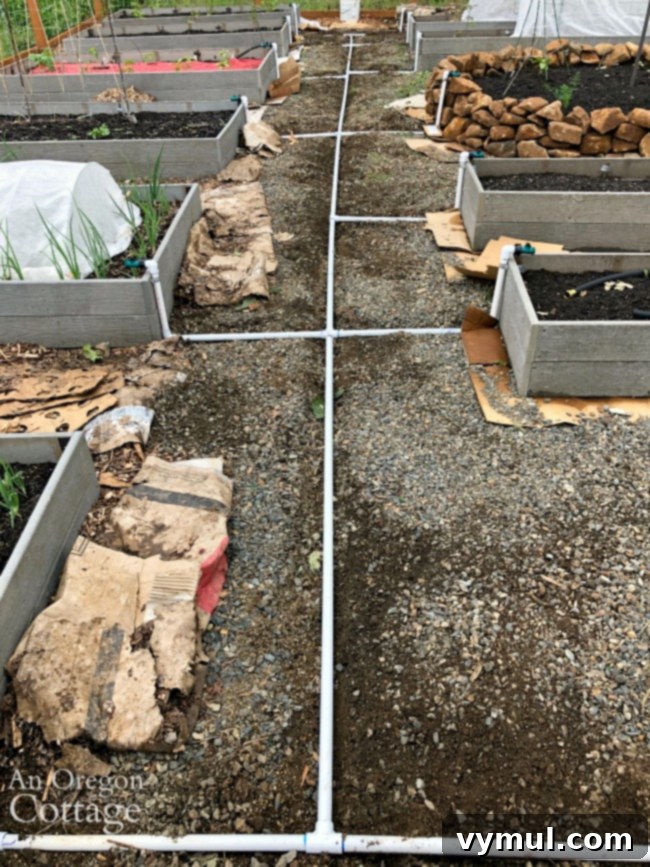
As soon as each feeder pipe extending into a raised bed is fully assembled and glued, secure it firmly to the side of the bed. Use metal U-brackets, screws, and a drill for this. This crucial step provides stability and prevents the newly glued joints from breaking apart as you continue assembling other sections of the main line or manipulating the pipe during later stages. We strategically placed these brackets closer to the top of the beds, offering maximum stability when you’ll be turning the hose valves on and off frequently.
TIP: Securing Pipes to Non-Wood Beds: For beds that cannot be directly screwed into, such as our round rock bed shown above, use a piece of rebar hammered into the ground immediately adjacent to the bed. You can then attach your PVC pipe to the rebar with sturdy ties or additional U-brackets.
Step 4: Attach On/Off Valves to Feeder Pipes
Once all the PVC pipe sections are meticulously glued, and all feeder pipes are securely fastened along your main lines and up to your raised beds, it’s time to attach the on/off hose valves. Screw these valves onto the threaded right-angle fittings at the top of each feeder pipe. Ensure they are hand-tightened for a good seal. Crucially, turn all the newly installed valves to the “off” position. This prepares your system for the all-important leak test. Do not bury your pipes yet!
Step 5: Connect Your Pipes to the Water Timer & Spigot
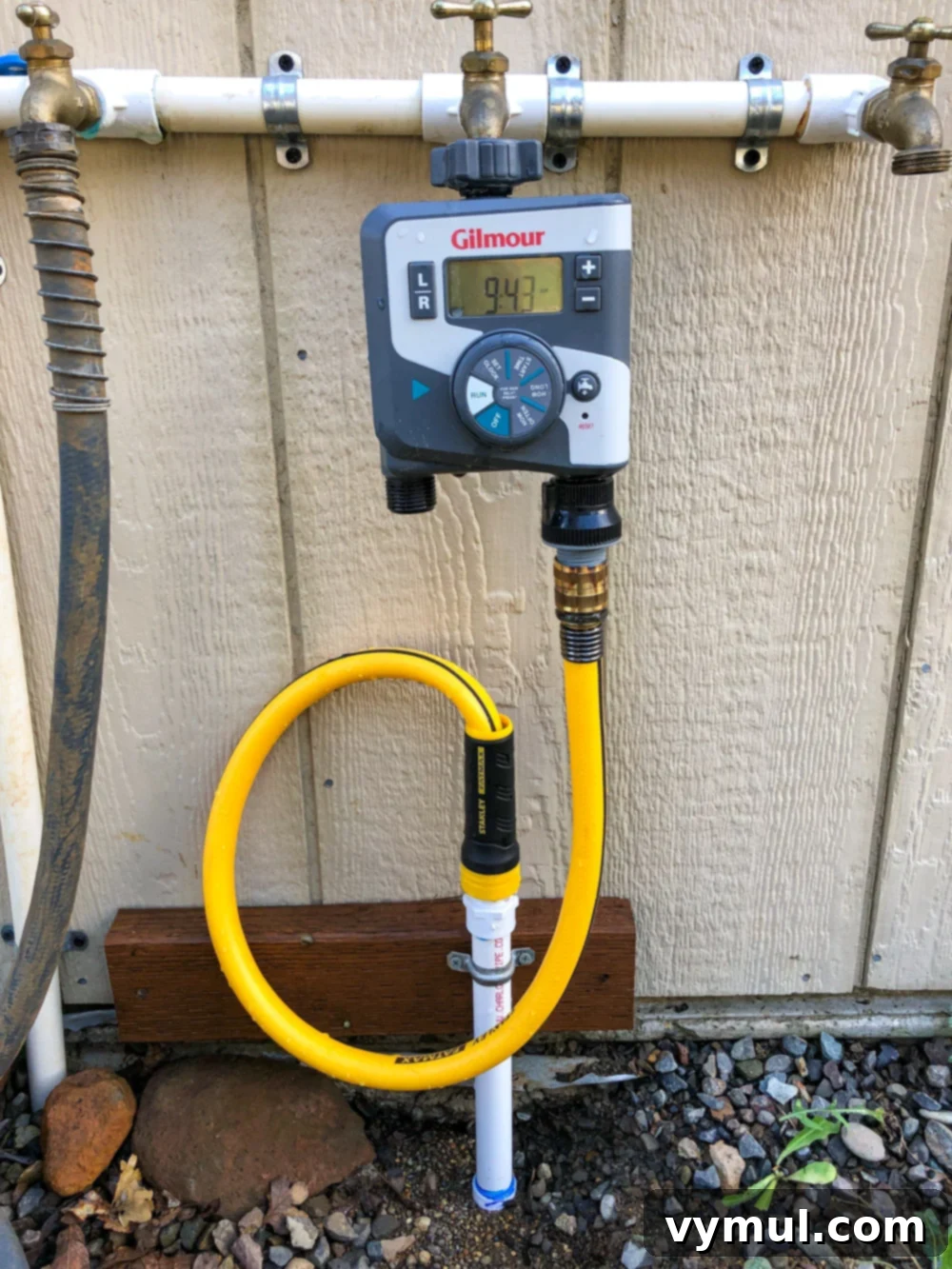
Return to your primary water source (the spigot). First, connect your automatic watering timer directly to the spigot. Next, attach the anti-siphon backflow control valve to the outflow port of the timer. Now, you can accurately measure the remaining length needed to connect your main PVC pipe line to this timer/backflow valve setup. For this final connection, a short, flexible mini-hose (readily available at any hardware store) works perfectly, allowing for a slight degree of movement and easier attachment.
Step 6: Set Your Timer & Thoroughly Test for Leaks
With your entire automatic watering system hooked up, it’s time to program your water timer. For optimal plant health and deep root growth, aim for longer, less frequent watering sessions. A good starting point is:
- Watering Duration: 3-4 hours of soaking. This duration may vary. More beds connected simultaneously will result in less flow to each, potentially requiring a full 3-4 hours. Fewer beds might only need 2 hours. Monitor the water penetration in your beds during the first day of operation and adjust as necessary.
- Watering Frequency: 5-7 day intervals. This depends heavily on your local weather conditions. In mild, warm weather, once a week may suffice. During the hottest, driest periods, you might need to water every 3-4 days. Always observe your plants for signs of stress and adjust accordingly.
To perform a comprehensive leak test of your newly installed watering system:
- Initiate Manual Flow: On your watering timer, locate and press the “faucet” or “manual” button. Select a duration of about 5 minutes to bypass your programmed schedule and allow water to flow immediately.
- Inspect for Leaks: Carefully walk along the entire length of your PVC pipes, paying close attention to all glued joints and connections. Look for any drips, seeps, or puddles that indicate a leak. Address any leaks immediately by turning off the water, allowing the pipe to dry, and reapplying primer and glue, or tightening threaded connections.
- Verify Valve Functionality: Visit each individual on/off hose valve at your raised beds. Systematically turn each valve on and off, ensuring that water flows freely when open and completely stops when closed. This confirms proper valve installation and function.
Step 7: Adjust Water Line Pipes & Cover with Sand
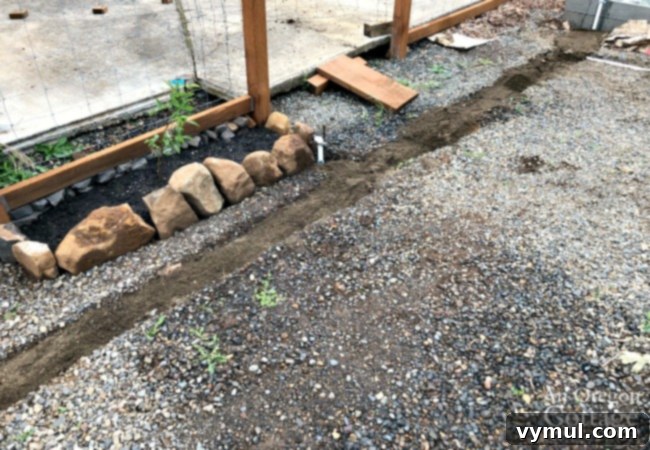
Once you are completely confident that there are no leaks throughout your system, perform a final check of the pipe depth. Ensure that all PVC pipes are slightly below ground level. If any sections appear too shallow, carefully dig out a little more soil underneath to achieve the proper depth.
Now, you can cover the entire PVC pipe water line with sand, bringing it up to ground level. Sand is the ideal material for this purpose because its fine, uniform particles will not contain sharp rocks that could potentially puncture the pipe over time. Furthermore, if future repairs ever become necessary, sand is significantly easier to excavate and backfill compared to compacted soil or rocky dirt. If high-quality, fine dirt is readily available, it can also be used, though sand is generally preferred for optimal pipe protection and ease of future access.
Step 8: Lay Your Path Material Over the Trenches
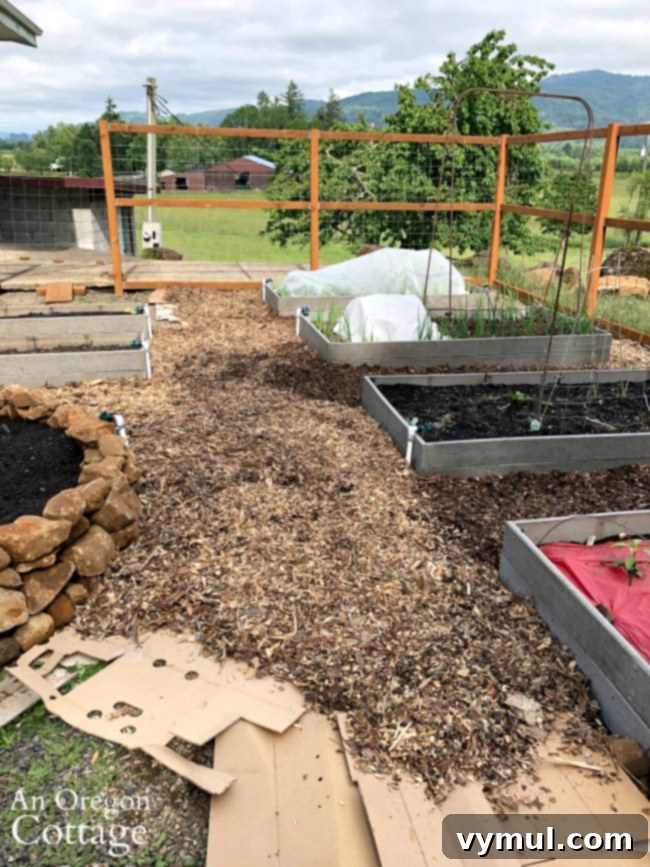
With your PVC pipes safely buried and covered with sand, you can now lay down your chosen path material over the trenches. Ideally, this path material will incorporate a weed control layer, offering long-term, low-maintenance benefits for your garden pathways.
For our garden, we opted for a highly effective and eco-friendly method: layering cardboard and then covering it with wood chips. This approach immediately smothers existing weeds and significantly prevents new ones from sprouting, creating pathways that are easy to maintain and refresh as needed. In our previous gardens, gravel paths often became problematic, as it was difficult to prevent dirt and compost from accumulating within them, leading to a constant battle with weeds. The gravel visible in some photos was already present when we acquired the property and lacked any weed barrier underneath, resulting in a substantial weed problem. Our solution involves simply layering cardboard and wood chips directly over this existing gravel, which we plan to refresh annually.
UPDATE: Visual Guide to Paths: We’ve created a video demonstrating how to effectively lay cardboard and wood chips for garden paths, including a comparison between free and purchased wood chips. CLICK HERE to watch our path material video.
Step 9: Attach Soaker Hoses and Customize Lengths
The final step in constructing your watering system is to attach the soaker hoses to the on/off valves for each raised bed. Carefully snake the soaker hose around the perimeter of the bed, then work your way towards the center, ensuring even coverage. You can fine-tune the arrangement of the hose once you observe the water distribution during your first watering cycle.
PRO TIP: Make Hoses Flexible: Before you start snaking your soaker hoses, lay them out in direct sunlight for a few days. The warmth will make the material more pliable and significantly easier to maneuver and position gracefully around your garden beds.
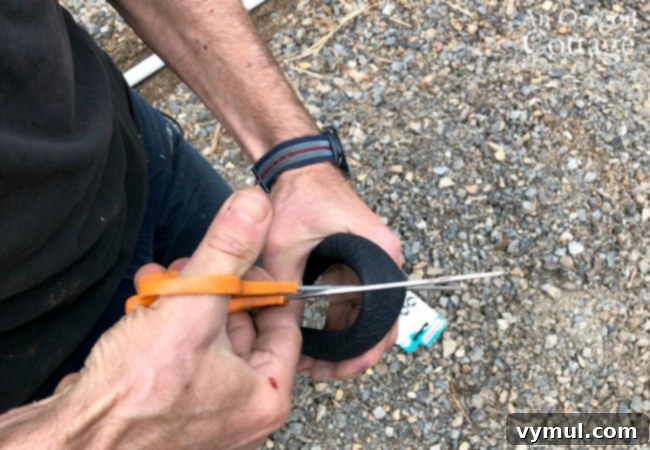
Customizing 50-foot Soaker Hoses for Smaller Beds
We used a combination of 25-foot and 50-foot soaker hoses. For our 8-foot beds, 25-foot lengths were ideal. To utilize our 50-foot hoses efficiently, we simply cut them in half. For the newly cut ends, we attached either a male or female garden hose repair mender as needed. This allows you to create custom-length soaker hoses tailored perfectly to your garden’s dimensions. This technique is highly recommended if you can’t easily find 25-foot soaker hoses or if your beds are 10-feet long or less. For longer beds, the full 50-foot length might be more appropriate.
You will need standard male and female garden hose repair menders – here is a recommended set of male and female ends.
UPDATE: How-To Video for Soaker Hoses: We’ve produced another video specifically demonstrating how to cut soaker hoses to size and offering additional tips for working with them. CLICK HERE to watch.
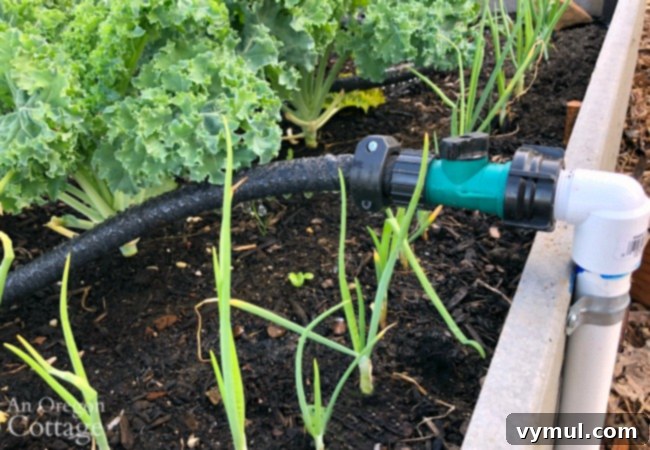
Step 10: Run Your Completed Garden Watering System
With all soaker hoses connected, use the “faucet” or “manual” button on your timer to bypass the scheduled program and run your entire system for a few minutes, or longer if desired. During this final run, walk through your garden, closely observing all soaker hoses and valves. This is your chance to make any final adjustments:
- Tighten Connections: Some connections, particularly those involving hose repair kits or threaded parts, might need a bit more tightening to prevent drips.
- Adjust Soaker Hose Layout: Observe how the water is seeping from the hoses. If you notice dry spots or areas receiving too much water, gently rearrange the soaker hoses within the beds to achieve more uniform coverage.
Once everything is flowing smoothly and evenly, your DIY automatic garden watering system is complete and ready to provide consistent, hands-free irrigation to your plants!
Why Choose Soaker Hoses with Shut-Off Valves Over Drip Systems?
Our decision to implement this specific garden watering system, utilizing soaker hoses with individual shut-off valves instead of a typical drip irrigation system, was driven by several key advantages:
- Flexible Water Control: The individual on/off valves provide unparalleled flexibility. We can quickly adjust the water flow to specific beds or completely turn off irrigation to certain sections as needed.
- Optimized for Crop Rotation: Unlike drip systems that deliver water only to specific plant bases, soaker hoses water a broader area of the bed. This is ideal for vegetable gardens where crop rotation is essential, allowing us to plant different crops in various locations each year without reconfiguring the irrigation layout.
- Adapting to Plant Needs: This system allows for nuanced watering based on plant development. For instance, when tomatoes are ripening, they often require less water. We can simply turn off the valve to that bed. Conversely, a newly planted bed for fall crops or germinating seeds might need more frequent watering. We can shut off other beds and use the timer’s manual faucet button to provide short, regular watering cycles until the young plants are established, without affecting the rest of the garden.
This adaptability makes the soaker hose system incredibly versatile and efficient for a dynamic vegetable garden.
Preparing Your Watering System for Winter: Blow Out or Drain?
Winterizing your automatic watering system is crucial, especially in colder climates, to prevent damage from freezing water. For our region, where hard freezes are typically short-lived and not extremely deep, our winterization process is quite simple: we unhook the soaker hoses from the on/off valves and allow the PVC main lines to drain naturally. Any residual water is unlikely to cause damage in our mild conditions.
However, if you reside in an area that experiences deeper or prolonged freezing temperatures, a more thorough approach is highly recommended. In such cases, using an air compressor to “blow out” the water lines is the most effective method. This process forces all remaining water out of the PVC pipes, ensuring that no water is left to freeze and potentially crack the pipes, saving you from costly repairs in the spring.
We are absolutely delighted with this automatic garden watering system! It has been operating successfully for many years now, proving its durability and effectiveness. We put it to the ultimate test shortly after installation by leaving for a two-week vacation. Not only did our plants continue to grow and thrive without a hitch, but our daughter, who was house-sitting, was ecstatic to be relieved of the daunting task of watering the entire garden. This system isn’t just beneficial for your plants and your peace of mind; it can even foster better relationships, eliminating those classic “did you water the garden?” arguments!
Inspiring Reader Experiences
“Initially, I was going to do permanent PVC drip lines, drill a million holes and run hoses all over the place until I saw your post. Genius! My OCD would not allow me to leave the exposed pipes white, so I did a quick coat of automotive primer and copper spray paint. It looks amazing. Easy. Nothing leaked!! Thank you for sharing your great idea.” -Teresa
“My grandson (11) and I (61) installed this ourselves. I have it attached to 7 rows, 3 beds and 2 small fruit trees in boxes. It will be so much easier than dragging hoses to attach to the existing drip lines. Thank you for the clear and easy installation instructions, video and supply list.” -Nanabee
“Thank you. My grandson and I watched the video. It is taken us a few days to get the trench prepped in between other things and the heat, but I appreciate the simplicity to a job that was intimidating me. My garden is more haphazard and overgrown than yours, but your system is so easy to adapt as needed. It sure will be nice not to be dragging a hose around and hooking and unhooking it to water throughout the summer!” -Barbara
NEW: Printable Automatic Watering System Steps & Recipe Card
If you’ve successfully used this tutorial to build your own system, please consider leaving a rating and review – we’d genuinely appreciate your feedback!
Print
Pin
Save
Saved!
DIY Watering System for Gardens Tutorial
1 hour
4 hours
5 hours
1 system
Jami Boys
Tools
-
shovel
-
adz digger
-
Measuring Tape
-
drill and screws
Materials
- garden diagram with measurements
- PVC pipe, junctions and elbows
- PVC pipe cutter
- PVC primer and glue
- Water timer
- Anti-siphon backflow preventer or 4-in-1 faucet adapter
- Soaker hoses flat cloth-type soakers for larger beds and/or 5/8″ soaker hoses that can be cut to size
- On/off hose valves
- Metal u-shape brackets
- Hose male and female ends
- Hose end caps
- Sand
Instructions
Planning
-
Measure your garden thoroughly and draw a detailed map of your space.
-
Based on your garden layout, diagram the precise routes for your main and feeder water lines.
-
Using your plan, calculate the required lengths of PVC piping and the number of fittings, then create a shopping list (refer to our printable checklist).
Building the System
-
Dig trenches 3-4 inches deep for the PVC pipe, ensuring to check for utility lines beforehand. (Consider deeper trenches in freezing climates.)
-
Add a protective layer of sand to the bottom of all trenches.
-
Assemble and lay the PVC pipe lines. Cut pipes to fit, apply purple primer to both pipe and fitting, then quickly apply PVC glue and firmly join the pieces, twisting slightly for a secure bond.
-
Continue this process along your entire proposed layout. Keep surfaces clean by using cardboard, and prevent debris from entering pipes by plugging open ends with paper or cloth.
-
For raised bed feeder pipes: Glue a right-angle turn to the main line, then a vertical pipe to the desired height, and finally a threaded right-angle fitting at the top. Secure this feeder pipe to the side of the bed with metal U-brackets and screws for stability (or rebar for non-screwable beds).
-
Attach on/off hose valves to each threaded elbow at the beds and turn them all to the ‘off’ setting in preparation for testing.
-
At the water source, connect your water timer to the spigot, then the backflow control valve to the timer. Use a mini-hose to connect the valve to your main PVC pipe line.
-
Set your timer for desired watering frequency (e.g., 3-4 hours soak every 5-7 days, adjusting for weather). Test the system for leaks by using the timer’s manual flow function for 5 minutes, inspecting all joints, and verifying water flow from each valve.
-
Once leak-free, ensure all pipes are slightly below ground level, digging out any shallow sections as needed.
-
Cover the PVC pipe lines with sand up to ground level.
-
Lay your chosen path material (e.g., cardboard and wood chips) over the covered trenches.
-
Attach soaker hoses to the on/off valves, cutting them to size with male-female repair kits and end caps if necessary. Lay hoses out in the sun beforehand to increase flexibility.
-
Perform a final run of your entire system using the timer’s manual button, checking all soakers and valves for proper function and adjusting hose arrangements for optimal water distribution.
Notes
For mild winter climates, simply unhook the soaker hoses and allow the PVC pipes to drain. In areas with deep or prolonged freezes, use an air compressor to blow out all water from the system to prevent pipe damage.
Did you make this?
Mention @anoregoncottage or tag #anoregoncottage!
This article has been thoroughly updated and expanded from its original publication in 2019 to provide more comprehensive instructions and insights.
This article contains affiliate links which earn commission based on sales, but it doesn’t change your price. For more information, you can read the site’s entire disclosure page here.