Our New Farmhouse Vegetable Garden Plan: Battling Shade & Deer for Easy-Care Success
Welcome to the exciting, and sometimes challenging, journey of establishing a brand new vegetable garden at our farmhouse! This isn’t just any garden; it’s a project filled with unique considerations, from managing varied sunlight patterns to implementing robust deer protection. I’ve been deep in the planning stages, meticulously sketching layouts and considering every detail. Below, I’m sharing my initial vegetable garden plan for this fresh start. Please take a look and share your thoughts – your insights could be invaluable as we transform this vision into a thriving reality!
It probably comes as no surprise that I began envisioning and sketching garden layouts for our new farmhouse fixer long before we even closed on the property. My office is currently littered with crumpled pieces of graph paper, each representing a discarded idea or a new possibility! Thankfully, I’ve found a useful solution to this, as the Garden Success Plan Notebook includes printable graph paper pages, allowing me to start fresh whenever inspiration strikes (or frustration mounts!).
Creating this specific vegetable garden plan has proven to be significantly more challenging than my previous projects, whether it was the small urban plot at our Portland bungalow or the expansive garden at our last property (you can explore a tour of that garden here). Those designs seemed to flow effortlessly, almost designing themselves, benefiting from abundant, uninterrupted sunlight and relatively flat terrain. This new farmhouse property, however, presents a unique set of complexities that require thoughtful and strategic planning for a successful, low-maintenance garden:
- **Significant Western Sun Blockage:** A prominent hillside and dense woodland to the west effectively block the afternoon sun from approximately 3 PM onwards. This creates a challenging microclimate, severely limiting the crucial late-day sun exposure many vegetables require.
- **Shaded “Perfect Spot”:** We have an existing leveled area that is ideally situated close to the house, offering convenience and easy access. Unfortunately, this prime location also suffers from considerable shade cast by both the aforementioned hillside and a tall, single-car garage, further complicating plant placement.
- **Managing a Large Existing Space:** While we initially desired a more compact, manageable garden, the pre-leveled area available to us is quite substantial. This requires careful design to ensure the space is utilized efficiently without becoming overwhelming to maintain.
- **Frequent Deer Activity:** Evident signs of deer visits throughout the property mean that any successful garden design must incorporate robust and effective deer deterrents from the outset. This isn’t just about protecting plants; it’s about safeguarding the entire investment of time and effort.
Despite these hurdles, I believe I’ve finally developed a cohesive plan that we can confidently move forward with. However, like all initial garden designs, I anticipate adjustments and refinements along the way. To help you visualize the space and understand my design choices, I’ll first share some photographs of the raw garden area, followed by my current sketches and the lingering questions I still have. I warmly invite any suggestions or ideas you might have – I know many of you are incredibly experienced gardeners and your insights would be invaluable!
Farmhouse Vegetable Garden Plan: A Detailed Look at the Space
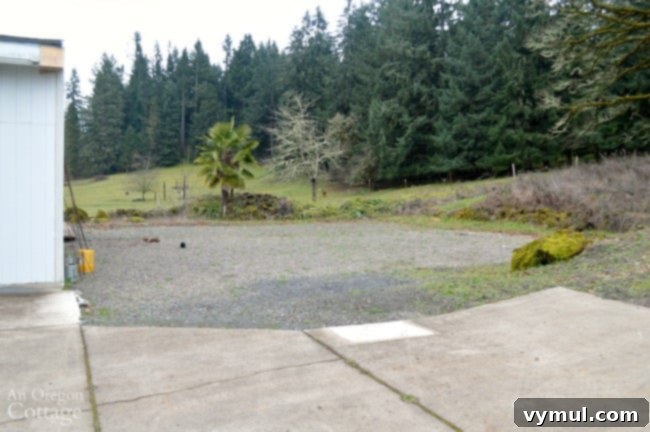
This image showcases the primary space we’re working with – a generously sized, leveled gravel area. This footprint was created after a manufactured home, which previously stood here due to a hardship, was removed before the property went on the market. Measuring approximately 45 feet deep by 39 feet wide, it offers a significant blank canvas for our new vegetable garden. The area is naturally bordered on the right by large, strategically placed rocks that act as a retaining wall for the sloping land beyond.
To the left, you can see a single-wide garage, which appears somewhat detached as it was once connected to the manufactured home. This structure is perfectly positioned to serve as an invaluable utility space for the garden, housing our riding mower and other larger garden tools. With its unusually high windows, I’m particularly excited about the potential to transform a portion of it into an ideal seed-starting station, benefiting from ample natural light for young seedlings.
Note on Sun Exposure: While we considered other locations, the only alternative area on the property that receives longer sun exposure is a far corner near the road. However, this spot presents its own set of challenges: it lacks convenient water access, and its distance from the house makes daily maintenance impractical. Furthermore, I prefer not to garden alongside a relatively busy road. Given that we have this fantastic, already-leveled space readily available and relatively close to the main house, it remains the most logical and appealing choice for our primary vegetable garden, despite the sun limitations imposed by the wooded hillside which wonderfully shades most of the property during the intense summer afternoons.
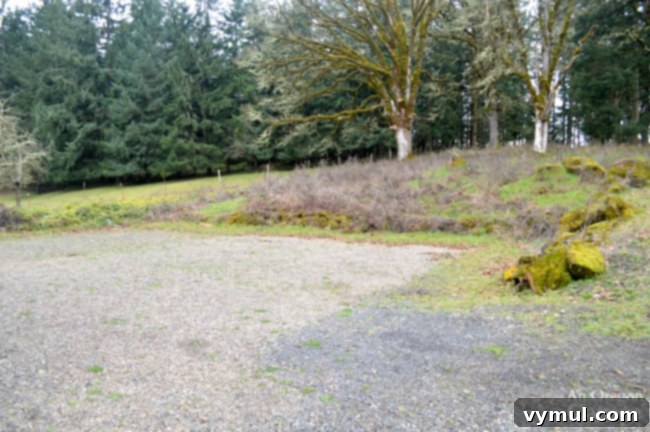
This perspective offers a clearer view of the westward slope, which gently descends towards what we affectionately call our “1-acre wood,” complete with the robust rock boulder wall serving as a natural boundary. Understanding this topography is crucial for managing water runoff and designing effective garden beds.
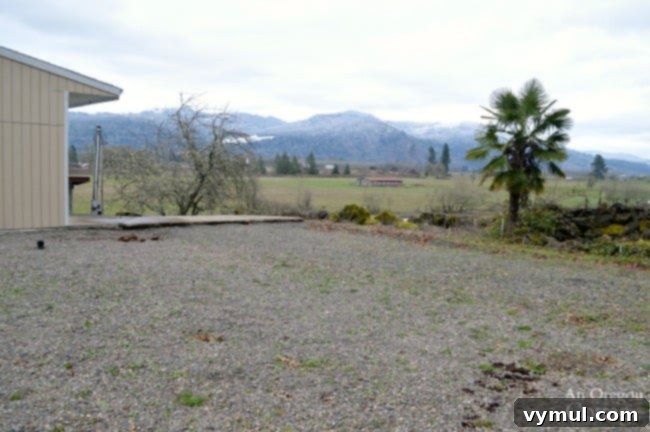
Turning our gaze eastward, this photograph captures the view from the back of the garden area, encompassing the garage and the surrounding hills in the background. Side note: Just imagine the tranquility and joy of gardening in such a beautiful setting! I am absolutely loving the potential here.
This particular section of the gravel area receives the most sunlight throughout the day, basking in the sun’s warmth from early morning until approximately 3 PM. While the sun might linger a little later into the summer months, the substantial hillside and mature trees remain the primary factors blocking the western sun, defining the garden’s solar limits. This specific sun pattern is a cornerstone of our garden layout decisions, prioritizing optimal placement for sun-loving crops.
Note on Sunlight Requirements: Traditional gardening guides often state that “full sun” equates to a minimum of six hours of direct sunlight per day, and for many plants and regions, this holds true. However, my extensive gardening experience in Oregon has taught me that most sun-loving vegetables truly thrive and produce their best yields when exposed to all-day sun. My previous garden, for instance, received about ten hours of sun daily, from 7 AM to 5 PM. When the dwarf fruit trees planted on the western edge matured and began casting more shade, the adjacent garden beds experienced a noticeable reduction in plant size and overall health. This firsthand experience heavily influences my current planning, reinforcing the need to maximize every possible hour of direct sunlight for our vegetable crops, especially given the existing shade challenges.
To the upper right in the image, you can observe a small pond and a lone palm tree that were inherited with the property. The palm tree unfortunately casts a significant shadow, making its removal a necessity for maximizing sunlight in the garden area (and frankly, it doesn’t quite fit the aesthetic we envision for this region). Similarly, while a pond can be beautiful, we prefer to avoid the ongoing maintenance it demands, so it will be carefully dismantled. The good news, however, is that this area already has an existing water line, which can be easily repurposed to create a convenient garden spigot. Since this section enjoys some of the longest sun exposure, integrating this water source into our garden plan is a high priority, contingent upon how we can strategically incorporate the deer fence around it.
Considering all these factors – the sunlight patterns, deer activity, existing structures, and water availability – here is the initial plan I’ve meticulously developed:
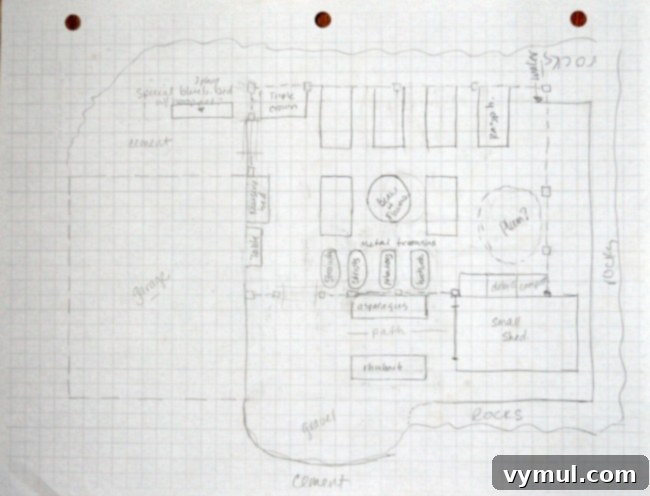
This is my original hand-drawn sketch, pulled directly from my trusty garden success notebook. While it might be a bit challenging to decipher every detail, I wanted to include it to demonstrate that the initial stages of new garden planning don’t require elaborate software or perfect lines. A simple, basic sketch is a critical first step that should never be overlooked, particularly when you’re aiming for an easy-care garden design. I intentionally didn’t fuss over rulers or achieving perfect symmetry; this sketch serves purely as my personal reference and a foundation for more detailed planning.
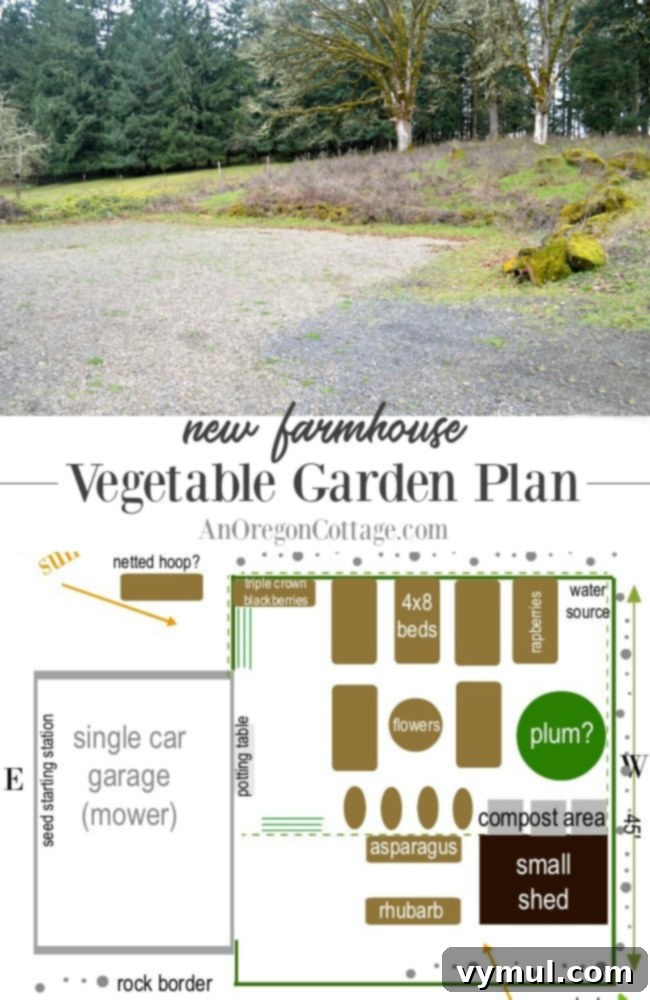
However, to provide a much clearer and more comprehensive visual for you, I translated that initial sketch into a more detailed computer-generated plan:
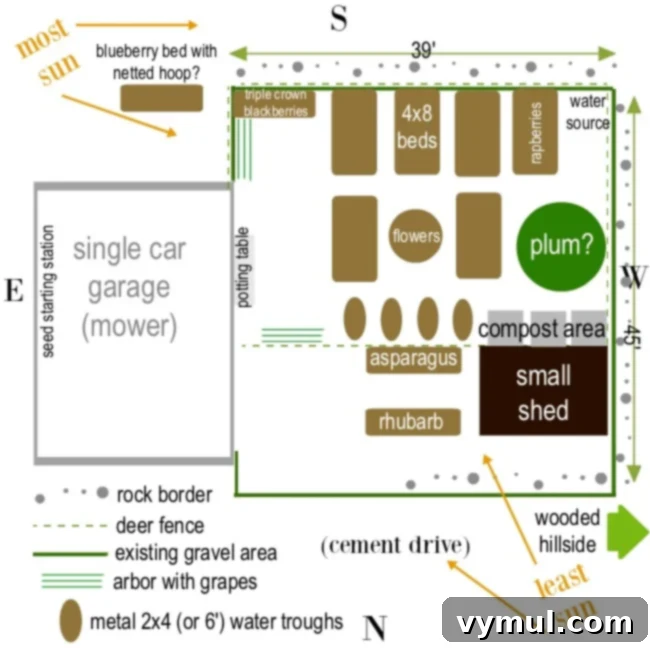
This digital rendering offers significantly more detail, specifically designed to give you a comprehensive overview of my vision. Here are some of the key considerations and the rationale behind each element of this proposed garden layout:
- **Strategic Deer Fence Placement:** I’ve consciously positioned the main deer fence behind the existing garage (which will serve as a shed for garden tools and seed starting). This strategic placement means that if, in the future, we decide to convert the garage into a “She Shed” or another functional space, access won’t require walking directly through the main vegetable garden. This separation ensures both practicality and ease of access for future garden projects and daily use.
- **Deer-Resistant Plantings:** The areas directly in front of the shed, outside the main deer fence, must host plants that are naturally resistant to deer browsing. After some research, I’ve learned that rhubarb is generally considered poisonous to deer, making it a good candidate. Asparagus is another excellent choice, as deer typically avoid it. These choices provide a natural barrier and add aesthetic appeal without requiring additional fencing.
- **Addressing the Low-Sun, Deer-Prone Area:** A substantial portion of the garden footprint remains empty in this plan. This area receives the least amount of direct sunlight and is also outside the main deer fence, meaning it needs to be exclusively planted with deer-resistant varieties. I’m currently pondering the best use for this space. Options could include a dedicated shade garden with native plants, a perennial herb garden, or even an extension of the tool storage area with larger, less frequently used items. This is a significant question mark that requires further creative problem-solving.
- **Plum Tree Placement Dilemma:** The plum tree is marked with a question mark because its ultimate placement hinges on further research into its specific sun requirements. If it demands more sun than this location can provide within the deer fence, it will need to be planted elsewhere on the property. In such a scenario, temporary fencing would be essential to protect it until it reaches a size where it’s less vulnerable to deer damage.
- **Optimizing Sunlight with Raised Beds:** The four 4×8 raised beds are strategically placed towards the back of the garden, where they receive maximum sun exposure for the longest duration. Building raised beds with a North-South orientation is crucial, as this alignment allows for the most even distribution of sunlight across the plants throughout the day, minimizing self-shading. These beds will form the core of my main vegetable garden, facilitating easy crop rotation to maintain soil health and prevent pest build-up.
- **Dedicated Cutting Flower Bed:** I’ve always wanted a dedicated space for cutting flowers, positioned away from potential deer damage. The circular bed in the plan is designed for this purpose, providing a beautiful source of blooms for the farmhouse while remaining secure within the fenced area.
- **Innovative Watering Trough Solutions:** Ever since visiting Agritopia, I’ve been inspired to incorporate metal water troughs into a vegetable garden. This idea gained practical urgency after our last house, where voles consistently decimated our in-ground potato crops. These troughs offer a perfect solution for growing potatoes and other root vegetables, providing a contained environment that is largely inaccessible to burrowing pests. One trough will be dedicated to strawberries, ensuring they are kept neat and protected, while the other three will host a variety of root vegetables, providing excellent drainage and manageable soil conditions.
- **Automated Watering System Integration:** While not explicitly depicted in this initial layout, an integral part of our long-term plan is to implement a sophisticated, automated watering system. This will utilize a combination of drip irrigation, soaker hoses, and timers to ensure efficient and consistent moisture delivery, minimizing water waste and reducing daily manual watering chores. More details on its design and installation will definitely be shared as we progress with its creation.
As you can see, this plan is by no means finalized or “set in stone.” There are still several unknowns, even with my detailed additions to the layout. A significant consideration is my desire to relocate a 16×10 shed from another less-than-ideal spot on the property to this garden area. Not only would it make more practical sense to have it integrated here (it’s currently precariously perched on a hillside), but it would also fill a substantial portion of this already established space. My husband, Brian, however, harbors some valid concerns about the feasibility of moving such a large structure without it potentially falling apart. So, that particular element remains a major logistical and structural question mark.
So, there you have it – the current iteration of our new farmhouse vegetable garden plan. I’m eager to hear your thoughts! What aspects of the plan resonate with you? Are there any elements you would definitely keep or suggest changing? And for those of you who have tackled similar challenges, especially with low-sun conditions or frequent deer visits, what strategies or solutions have you found most effective? Your experienced perspectives are truly appreciated!
Oh, and if you’re actively searching for reliable gardening supplies and tools, don’t forget to explore my Amazon Shop. I’ve curated a selection of all the gardening essentials I’ve personally used and recommend, along with many other helpful items.