Transform Your Old Freezer: The Ultimate DIY Chalkboard Door for Smart Food Organization
Are you looking for an innovative, aesthetically pleasing, and highly functional way to manage your frozen food inventory? Say goodbye to forgotten freezer contents and drab appliance facades! This comprehensive tutorial guides you through creating a DIY chalkboard freezer door, turning your ordinary or aging freezer into a charming, organized, and truly indispensable kitchen asset. It’s a fun, unique, and incredibly practical home improvement project that will revolutionize how you interact with your frozen provisions.
Please note: Some links within this article are affiliate links. Should you click on them and make a purchase, I may receive a small commission at no additional cost to you. Your support helps maintain this content!
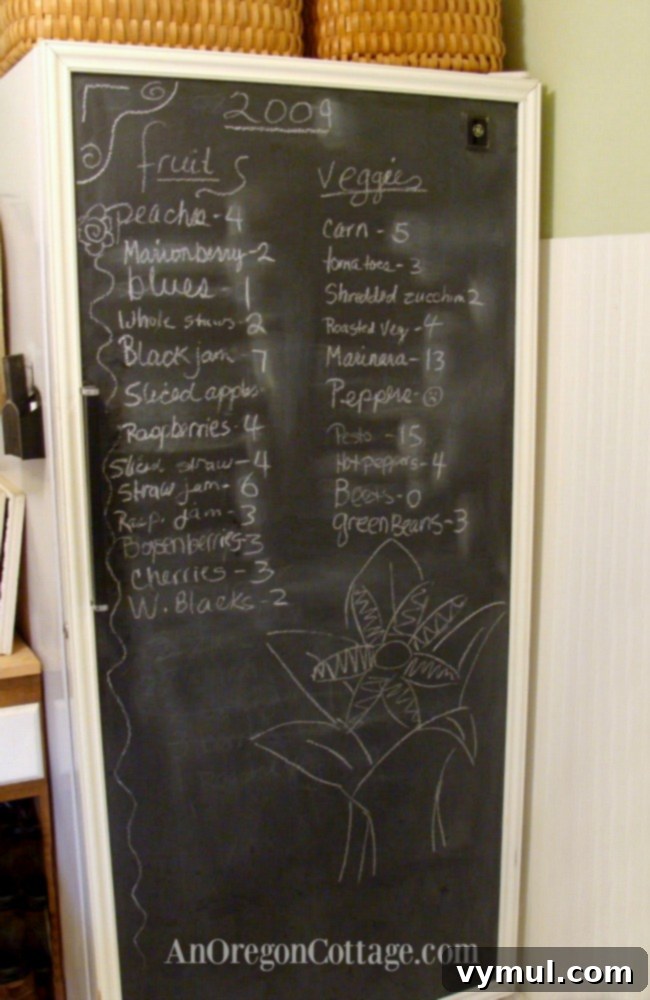
Our journey to a more organized and stylish kitchen began with a rather unsightly appliance. Our very first full-sized freezer, a workhorse that allowed us to preserve an abundance of produce from our flourishing garden and stock up on sales, was a relic from circa 1992. It sported a faded white finish, tell-tale rusted edges, and an unfortunate black and gray “racing stripe” down one side. While perfectly functional, its appearance left much to be desired.
For years, its humble aesthetic was not an issue; it resided discreetly in our Portland bungalow’s basement or tucked away in the garage. However, a significant home transformation changed everything. When we embarked on our ranch-to-cottage garage remodel, integrating a new laundry and mudroom, the freezer suddenly became visible through elegant French doors. Its rusty, striped facade was no longer ignorable. It became clear that a creative solution was needed to elevate its look and seamlessly blend it into our newly designed space.
Little did I know, this simple home improvement project would become one of my absolute favorite features in the entire room! With just a few coats of chalkboard paint and some decorative wood molding, that old, neglected freezer was utterly transformed. The visual upgrade was undeniable, making the appliance a charming, intentional element of the decor. But beyond its improved appearance, the chalkboard door offered an unexpected and invaluable benefit: an incredibly easy and efficient system for tracking everything stored inside.
I genuinely didn’t anticipate how truly indispensable this DIY chalkboard freezer door would become. It quickly proved to be an immense time-saver, simplifying the process of keeping tabs on our garden-fresh produce that I diligently froze. Moreover, it made managing inventory of bulk-bought meats and other sale items an absolute breeze. The simple act of having chalk and an eraser readily available in a magnetic holder on the side of the freezer meant updating totals was effortless, whether I was adding new provisions or retrieving items for a meal. No more digging, no more forgotten expiration dates, and certainly no more food waste due to uncertainty about what was actually in the freezer.
DIY Chalkboard Freezer Door: Step-by-Step Transformation
Ready to give your freezer a stylish and functional makeover? This project is surprisingly straightforward and yields impressive results. Follow these detailed steps to create your own practical and beautiful chalkboard freezer door.
Essential Supplies for Your Chalkboard Freezer Project
Before you begin, gather all the necessary materials. Having everything on hand will ensure a smooth and efficient DIY process. These items are generally affordable and widely available at most hardware or craft stores.
- Medium grit sandpaper: Crucial for preparing the surface for optimal paint adhesion.
- High-quality Chalkboard Paint: The star of the show; choose a durable formula for frequent use.
- Foam roller and foam brush: For smooth, even paint application and tackling tricky corners.
- Quality Chalk: My personal favorite for smooth, easy writing is this brand, ensuring clear and vibrant marks.
- 1-inch picture molding: Not picture frame molding, but molding with a flat back (like the linked example) to create a neat border. Measure enough to frame the entire freezer door.
- Miter saw (or miter box with hand saw): Essential for precise, angled cuts on the molding.
- Paint or stain for molding: To finish the molding in a style that complements your kitchen decor.
- Liquid Nails (or other strong adhesive): For securely attaching the molding to the freezer door.
- Clamps: To hold the molding firmly in place while the adhesive cures.
- Magnetic shelf holder and eraser: For convenient storage of your chalk and eraser right on the freezer.
Detailed Directions for Your DIY Chalkboard Freezer Door
- Prepare the Freezer Surface: Begin by thoroughly cleaning the freezer door to remove any grease or grime. Once clean and dry, use a medium-grit sandpaper to lightly sand the entire front surface. The goal isn’t to remove all the existing finish, but rather to dull the shine and create a slightly textured surface that the chalkboard paint can adhere to effectively. Pay extra attention to any rusty edges, sanding them smoothly to ensure a flawless finish. Wipe away all sanding dust with a damp cloth and allow it to dry completely.
- Apply the First Coat of Chalkboard Paint: Using a foam roller, apply a thin, even coat of chalkboard paint across the main surface of the freezer door. For areas around the handle or any other recessed details, switch to a foam brush to ensure complete coverage without drips. Avoid applying too much paint at once, as this can lead to uneven drying and unsightly texture. Allow this first coat to dry completely according to the manufacturer’s instructions on the paint can. Adequate drying time between coats is critical for a durable finish.
- Apply Subsequent Coats: Once the first coat is fully dry, apply a second coat using the same technique. Observe the coverage and finish; if the surface still appears uneven or shows through the original color, proceed with a third coat. Many chalkboard paint projects benefit from three thin coats to achieve a rich, consistent, and smooth chalkboard finish that will be easy to write on and erase cleanly. Ensure each coat dries thoroughly before applying the next.
- Prime Your New Chalkboard Surface: This step is essential for preventing “ghosting” (where previous writing leaves faint marks) and ensuring your chalkboard is ready for use. Take a piece of chalk and, using its side, completely cover the entire painted surface with a thin layer of chalk. Don’t press too hard, just get an even coating. Then, use a clean, dry rag or a dedicated chalkboard eraser to wipe off the chalk. This process leaves a fine residue of chalk on the surface, conditioning it and making it easy for future chalk applications to adhere and erase cleanly, giving it that authentic chalkboard look and feel.
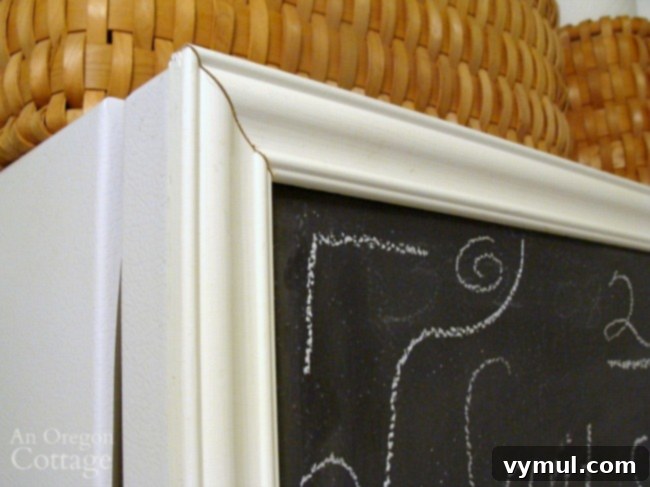
- Install the Decorative Molding: Carefully measure the perimeter of your freezer door where you want the molding to sit. Using a miter saw or a miter box with a hand saw, precisely cut your 1-inch picture molding to create neat, 45-degree angle corners for a professional mitered look. Before attaching, paint or stain the molding in your chosen color or finish, allowing it to dry completely. Once dry, apply a continuous bead of Liquid Nails (or your preferred strong adhesive) to the back of one piece of molding. Carefully position it along the edge of the freezer door and secure it with clamps.
PRO TIP: Applying all four pieces of molding at once can be challenging due to the difficulty of clamping on a slick metal surface. To minimize frustration and potential shifting, we recommend working on one or two edges of molding at a time. Allow the Liquid Nails to dry and set firmly for several hours (or overnight, depending on instructions) before moving on to the next section. This method ensures each piece is securely adhered before adding pressure to adjacent pieces, resulting in a cleaner, more robust frame.
Once all the molding is securely in place and the adhesive has fully cured, your chalkboard freezer door is ready for action! Don’t forget to position your magnetic shelf holder on the side of the freezer, keeping it stocked with fresh chalk and an eraser. This ensures you’re always prepared to update your inventory and keep your frozen foods perfectly organized.
Utilizing Your Chalkboard Freezer Door for Efficient Organization
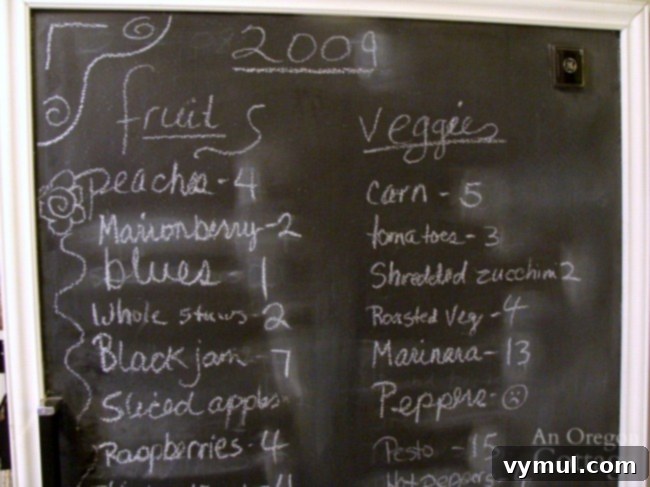
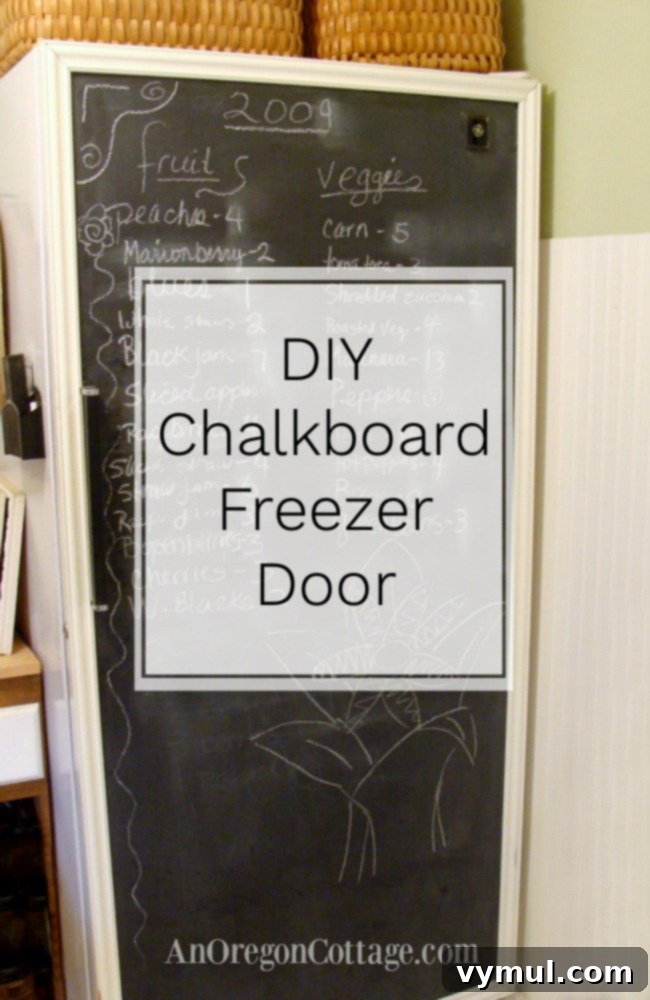
The beauty of a DIY chalkboard door lies in its complete customizability. You have the creative freedom to draw anything you desire and implement any organizing system that perfectly aligns with your household’s needs. As you can observe from our example, our system is purely utilitarian; I simply scribbled words in my everyday handwriting. However, I can easily envision an artistic individual transforming this surface with beautiful hand-lettered chalk labels and intricate designs, elevating the humble freezer to a decorative masterpiece!
To spark your imagination and provide a tangible starting point, here’s an example of how I personally utilized our chalkboard door to manage seasonal produce and general freezer contents:
- Seasonal Rollover: Around May, when the new produce season burst forth with fresh asparagus, sweet peas, and juicy strawberries, I would initiate a new section on the chalkboard. At the very bottom of the door, I would meticulously list all the frozen items that remained from the previous season.
- Inventory Migration: In the photographic example, notice how the “2009” title was moved to the bottom. Alongside it, I’d write down the names of any leftover produce (e.g., “blueberries,” “corn”) and the corresponding number of packages still in the freezer. This visually separated the old from the new, encouraging us to use up older items first.
- New Season, Fresh Start: The top section would then be cleared and dedicated to the new year – in this instance, “2010.” All previous category numbers from the prior year were erased, signifying a fresh start for tracking the abundant produce of the incoming growing season. This method provided a clear, at-a-glance overview of what was available and helped prevent valuable food from getting lost in the depths of the freezer.
And let me tell you, I absolutely adored this system! It completely eliminated the constant struggle of trying to remember what I had stashed in the freezer. More importantly, it ensured that packages from previous years, which often got buried and forgotten, were regularly consumed. This simple visual cue drastically reduced food waste and made meal planning infinitely easier.
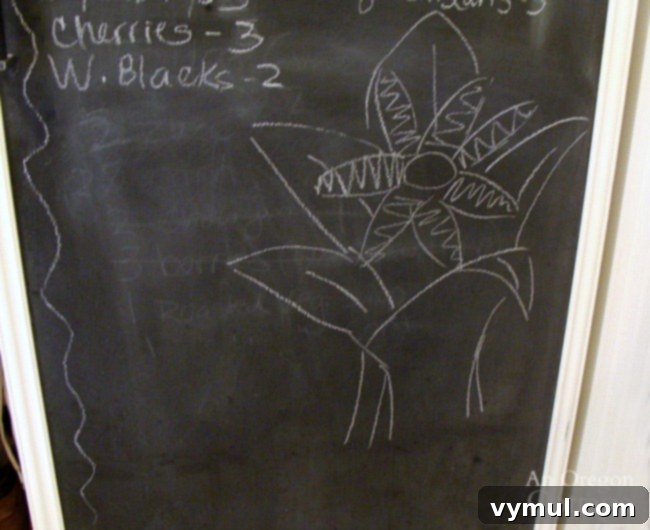
Creative Bonus! Beyond its organizational prowess, the bottom section of your chalkboard door can also double as a delightful art display. Our daughter once drew the beautiful flower shown above, transforming a functional appliance into a canvas for youthful creativity. It’s a fantastic, interactive activity for kids of all ages. You could even take this a step further and apply a magnetic primer underneath the chalkboard paint. This innovative addition would allow you to use magnetic letters, words, or even small magnetic toys, offering another layer of fun and learning for children right in the kitchen.
Interestingly, after I had completed this project and was drafting this very tutorial, I came across various pieces of advice suggesting extensive surface preparation for painting freezers or refrigerators. This often involved complex priming and etching steps. However, in my experience, a simple light sanding was sufficient. I painted directly over the prepared surface, and the results were fantastic – it looked superb and provided an excellent, smooth writing surface that held up beautifully over time. This budget-friendly, minimal-prep approach makes the DIY chalkboard freezer door even more appealing.
Ultimately, for an investment of less than $25 (and potentially even less if you already have some of the basic supplies on hand), we achieved a significantly more attractive freezer and gained an exceptionally powerful organizational tool. That, in my book, truly defines a successful DIY project, offering both aesthetic improvement and practical utility without breaking the bank!
Update on Longevity: I’m pleased to report that the chalkboard finish and molding remained in pristine condition for over four years, performing flawlessly throughout its lifespan, until the freezer itself finally gave out and we had to replace it. And oh, how I missed that chalkboard door! Its absence truly highlighted its invaluable role in our daily routine.
I’m incredibly curious to hear from you! If you’ve undertaken a similar project or found unique ways to utilize a chalkboard freezer door, please share your experiences. Be sure to leave a comment below and inspire others with your clever ideas!

This article has been thoroughly updated and expanded for clarity and comprehensiveness. It was originally published in February of 2010.
Disclosure: Please note that affiliate links present in this article may earn a commission based on sales, but this will not affect your purchase price. Click here to read my full disclaimer and advertising disclosure for more information.