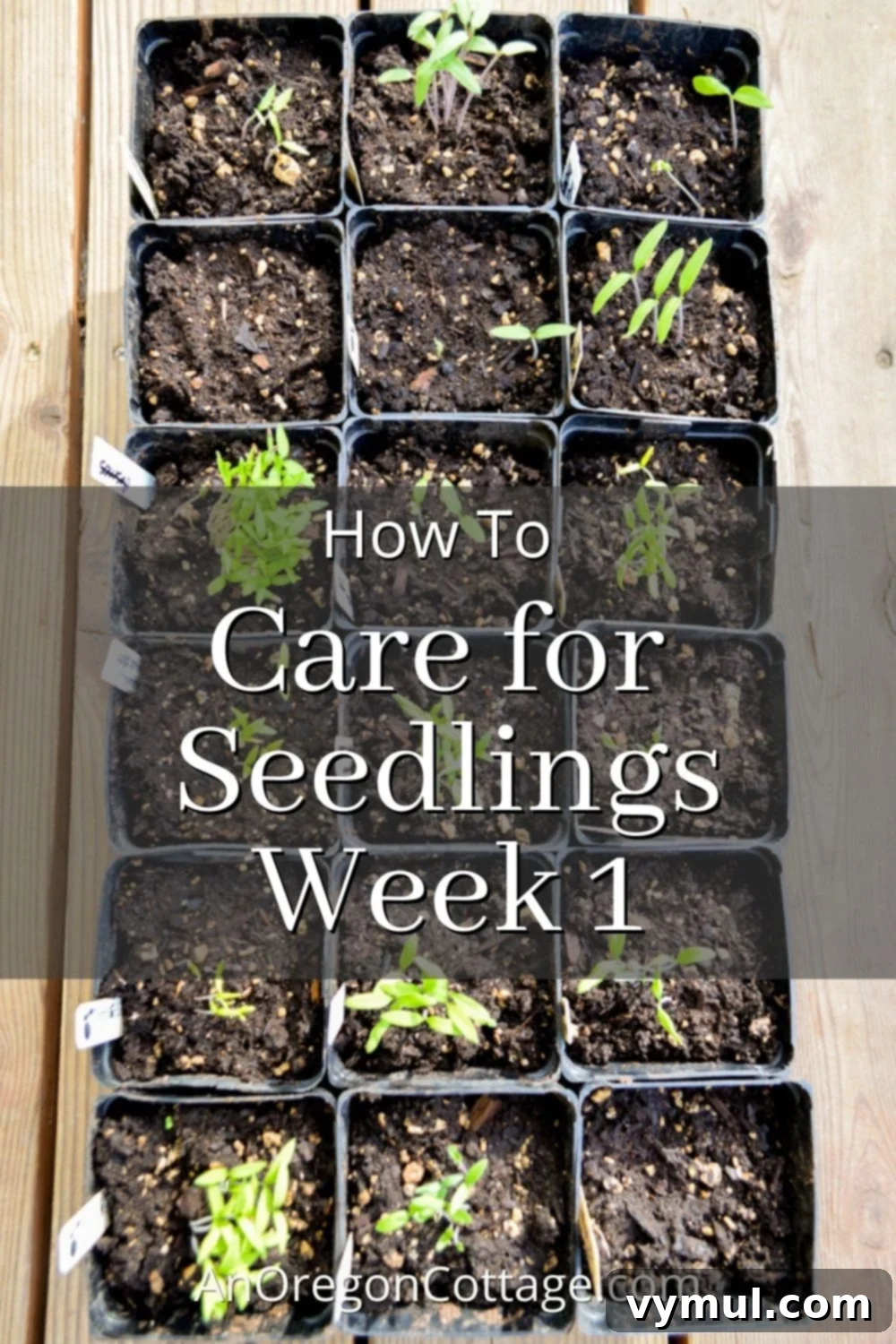
Ultimate Guide to First-Week Seedling Care: Nurturing Your Young Plants for Garden Success
Congratulations! Your garden journey has officially begun as those tiny seeds you planted just a week ago have burst through the soil, revealing vibrant new life. This complete, step-by-step tutorial focuses on the crucial practices for caring for seedlings after their first week of growth. Discover essential tips and techniques for thinning, transplanting, watering, and providing optimal light to ensure your baby plants develop into robust, healthy specimens ready for your garden beds.
For more foundational knowledge on starting plants from scratch, explore our comprehensive Seed Starting Guide.
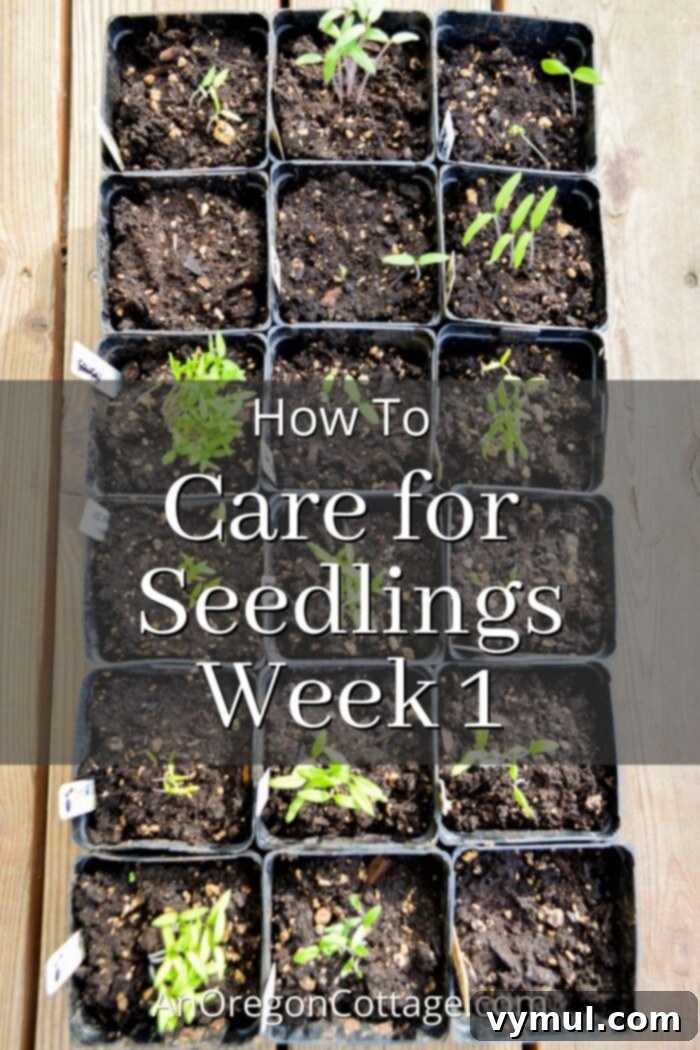
In this installment of our Vegetable Gardening 101 Series, we’re diving deep into the immediate care required for your newly sprouted seedlings. While the initial act of planting seeds is exciting, the subsequent care during their first week is paramount. This brief yet impactful period sets the stage for their entire growing season, providing them with the strong foundation they need to thrive. Proper care now means more resilient plants later.
Effective seedling care after their first week primarily involves:
- Thinning: Removing weaker or excess seedlings to prevent overcrowding.
- Transplanting: Relocating some seedlings to individual pots or to fill empty spots.
- Optimal Watering: Providing consistent moisture, often from the bottom, and potentially introducing light fertilization.
- Adequate Lighting: Ensuring they receive strong, consistent light to promote compact growth.
I’ll be demonstrating these critical steps using the same seed tray I prepared last week. This allows you to visually follow along and understand what your seedlings should look like before and after thinning, transplanting, and watering. Throughout this guide, I’ll also share valuable insights and practical tips gleaned from my many years of successful seed starting. A little spoiler: it’s completely normal for not all seeds to sprout, so don’t feel discouraged if some pots remain empty!
Essential Seedling Care at Week 1: Your First Steps to Success
1. Thoroughly Evaluate Your Seed Trays
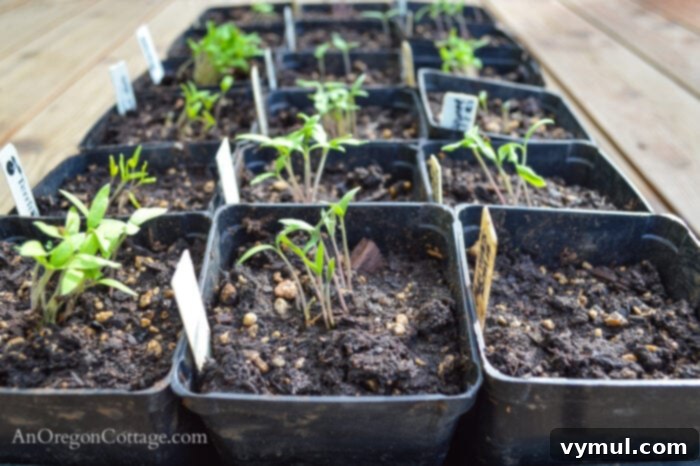
As you approach your seedling trays after their first week, take a moment to observe. The tray pictured above, for instance, contains tomato seedlings in 4-inch pots. Most of these tomatoes have sprouted vigorously, which is typical for this relatively easy-to-germinate plant. You might recall from our initial seed starting tutorial that I prefer planting tomatoes and peppers in larger pots from the outset, rather than in smaller 6-cell seedling trays. This approach allows them more room to grow indoors for an extended period, resulting in larger, more robust plants ready for the garden and ultimately eliminating one future transplanting step.
A Quick Note on Peppers: The peppers are not visible in this week-one photo, and there’s a good reason for that! Pepper seeds typically take significantly longer to germinate than tomatoes – often an additional 1-2 weeks. This means their initial care routine will commence a little later. Despite this, I still sow them at the same time as tomatoes. This is because I generally don’t plant peppers outdoors until the first week of June, as they absolutely thrive in reliably hot conditions. For more in-depth information on growing these delicious plants, consult our Ultimate Sweet Pepper Guide and Ultimate Hot Pepper Guide.
Upon inspecting your trays, you will likely notice two common scenarios:
- Seedlings Clumped Together: Despite recommendations to plant only 2-4 seeds per cell, you might find a dense cluster of sprouts.
- Empty Pots or Cells: Some areas might have no germination at all, appearing completely bare.
It’s vital to remember the advice of planting 2-4 seeds per cell or pot. This practice accounts for seed viability – the percentage of seeds in a batch that are actually capable of germinating. Not all seeds are viable, and planting a few extra ensures you have options. When using fresh seed packets (those recently purchased), I typically stick to planting 2-4 seeds, as illustrated by some pots in the photo that only have a few seedlings. However, as demonstrated in my guide on winter gardening and organizing seeds, you can absolutely save seeds from year to year. When a seed packet is more than two years old, it’s wise to increase the number of seeds planted to compensate for a potentially lower germination rate. The tomato seeds featured here were evidently still quite potent, resulting in more sprouts than strictly necessary, meaning I simply have more thinning to do.
And what about the empty pots? This is a perfectly normal occurrence in seed starting. Sometimes, seeds simply fail to germinate for various reasons – it could be an individual seed defect, inconsistent moisture, or even just bad luck. In this specific example, the empty pot wasn’t a surprise, as the seeds came from a seven-year-old packet (it’s always worth a try!). It was a different variety of Roma tomato, and I had also planted other Roma varieties from newer packets, anticipating that I might need to transplant from those if the older seeds didn’t perform. Additionally, remember that some seeds, like the peppers mentioned earlier, naturally take two weeks or even longer to germinate. So, an empty pot at week one doesn’t always signal complete failure – patience is a virtue in gardening!
2. The Art of Thinning Seedlings for Stronger Plants
The crucial step of thinning should ideally be carried out within the first couple of weeks of your seedlings’ life, before their delicate root systems become too intertwined. I understand that many gardeners struggle with thinning, often feeling as though they are “killing” or “wasting” plants. However, it’s an undeniable truth of starting your own seeds:
You must thin your seedlings now if you aspire to cultivate strong, healthy, and productive plants that will successfully adapt and flourish once moved outdoors.
Without thinning, multiple seedlings in a single cell will compete fiercely for limited resources – light, water, and nutrients. This competition leads to leggy, weak plants with underdeveloped root systems, making them highly susceptible to disease and stress when transplanted into the garden. While it might seem counterintuitive to remove healthy sprouts, leaving too many will ultimately weaken all of them. Consider the thinned seedlings as simply another form of garden waste, like spent leaves or trimmed branches, which can be added to your compost pile.
For fast-maturing plants like lettuce or spinach, which can be planted out when smaller, I sometimes permit two seedlings per 6-pack cell. However, for almost all other vegetable and flower varieties, the ultimate goal is to thin them down to a single, robust plant per cell or pot. This ensures maximum growth and vigor for your chosen survivor.
Here are some practical tips for successfully thinning your precious seedlings:
- Initial Thinning at Week 1: At this early stage, it’s a smart strategy to thin to 2-3 of the strongest seedlings in each cell. This provides a safety net; if you happen to lose one or two after this initial thinning phase, you’ll still have at least one viable plant to nurture to maturity.
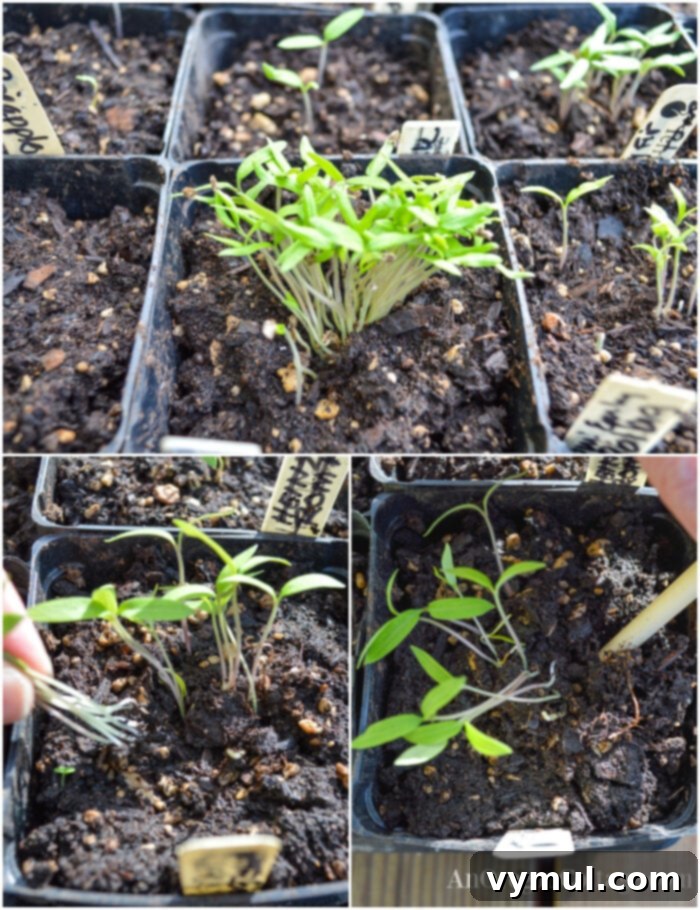
- Final Thinning (Week 2 or 3): When you decide to keep more than one plant initially, conduct a final thinning at week 2 or 3. At this point, carefully snip off the weaker seedlings at the base of their stem using small, sharp scissors. Avoid pulling, as their roots will likely have begun growing together, and you don’t want to disturb the root system of the strong plant you intend to keep. Precision is key here.
- Gentle Removal with Fingers: At the week 1 stage, the roots are still tiny and minimally intertwined. You can often use your fingers to gently pull out the unwanted seedlings. Start from the outside of the cluster and carefully remove a few at a time, being mindful of the ones you want to keep.
- Using a Narrow Tool: For more precision, especially with densely packed seedlings, a narrow tool like a chopstick can be incredibly helpful. Use it to gently dislodge and remove unwanted seedlings, working carefully to avoid disturbing the root balls of the plants you wish to retain.
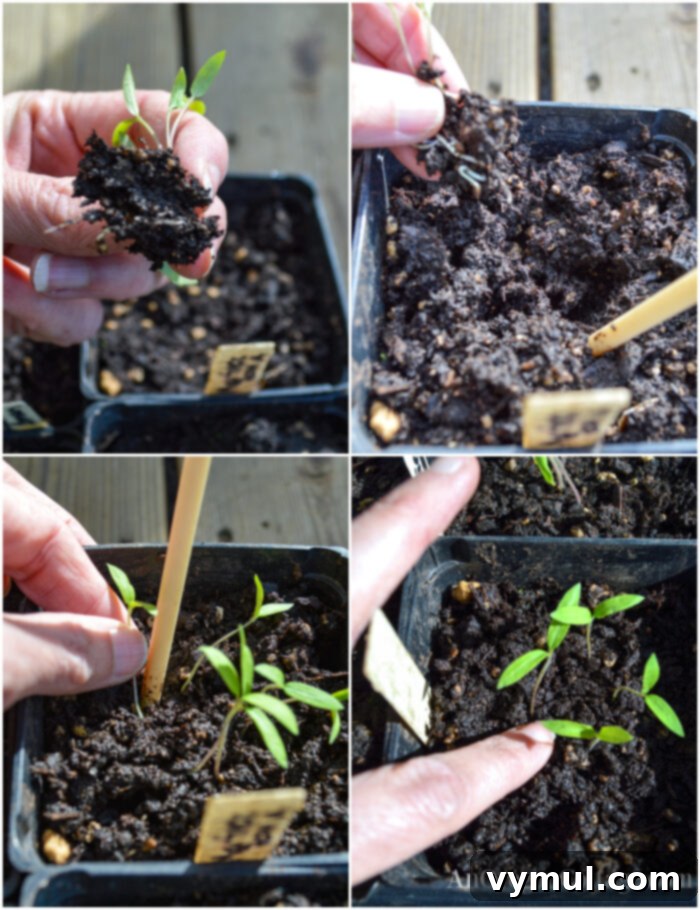
3. Transplanting Seedlings: Giving Them New Homes
While many of your thinned seedlings will be composted, some will be suitable for transplanting into other pots. This is particularly useful for filling in cells where seeds failed to germinate, or if you simply decide you want a few more plants of a particular variety. Transplanting at this early stage, when seedlings are still small and their root systems are less developed, minimizes shock and helps them establish quickly in their new environment.
A Step-by-Step Guide on How to Transplant Seedlings:
- Gentle Extraction: Use your narrow tool or chopstick to gently loosen the soil around the seedling you wish to move. Carefully push the roots up from the side, aiming to lift the seedling with a good amount of its surrounding soil and visible roots intact. The goal is to minimize disturbance to the delicate root system.
- Prepare the New Pot: In the destination pot or cell, use your tool to create a shallow, appropriately sized hole. This hole should be deep enough to accommodate the seedling’s roots without bending or compacting them.
- Careful Placement: Carefully place the seedling into the prepared hole. If transplanting multiple into one larger pot, ensure there’s adequate space between them. Use your tool to gently push the roots down into the hole, then carefully cover them back up with fresh potting soil.
- Firm the Soil: Use your finger to gently but firmly tamp the soil around the base of the newly planted seedling. This removes air pockets and ensures good contact between the roots and the soil, which is vital for water absorption.
It’s often a good practice to transplant a few extra seedlings if they are available. You can never be entirely certain how many will survive the transplanting process (and yes, even these transplanted seedlings might require further thinning later if they all thrive!).
Observe the transformation of the example tray before and after thinning and transplanting:
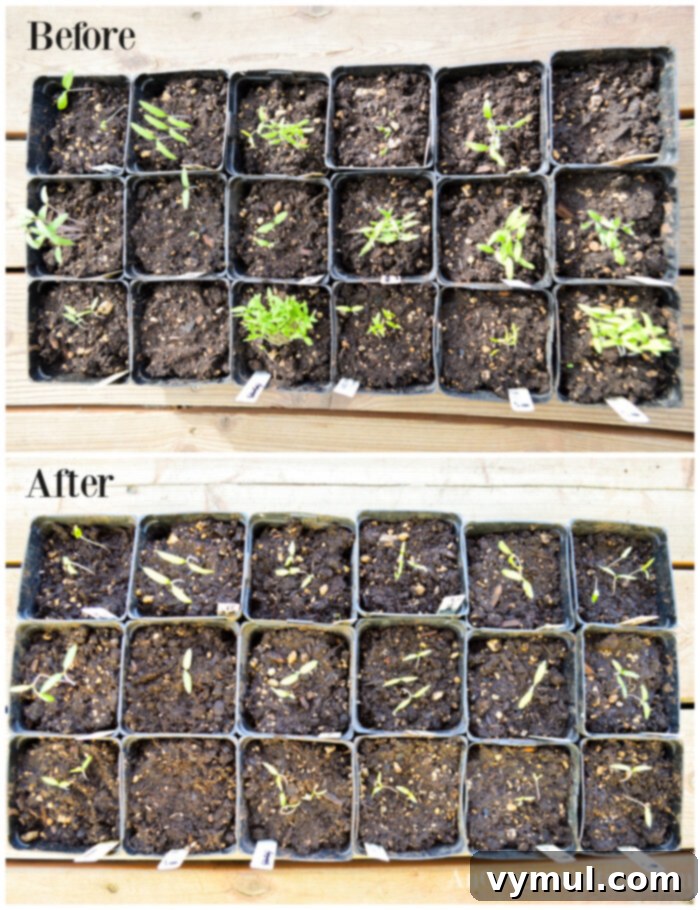
Ideally, your seedling tray at the one-week mark, after these initial care steps, should resemble the bottom tray in the image above, with only 1-3 strong seedlings per pot. For the empty pot in the “after” photo, I’ve sown a new seed of the variety that initially failed to germinate. This means I’ll need to wait another week or so for those new sprouts to emerge.
Here’s another illustrative before-and-after example, this time showing a tray of brassicas (including cabbage, cauliflower, and broccoli) in 6-cell trays:
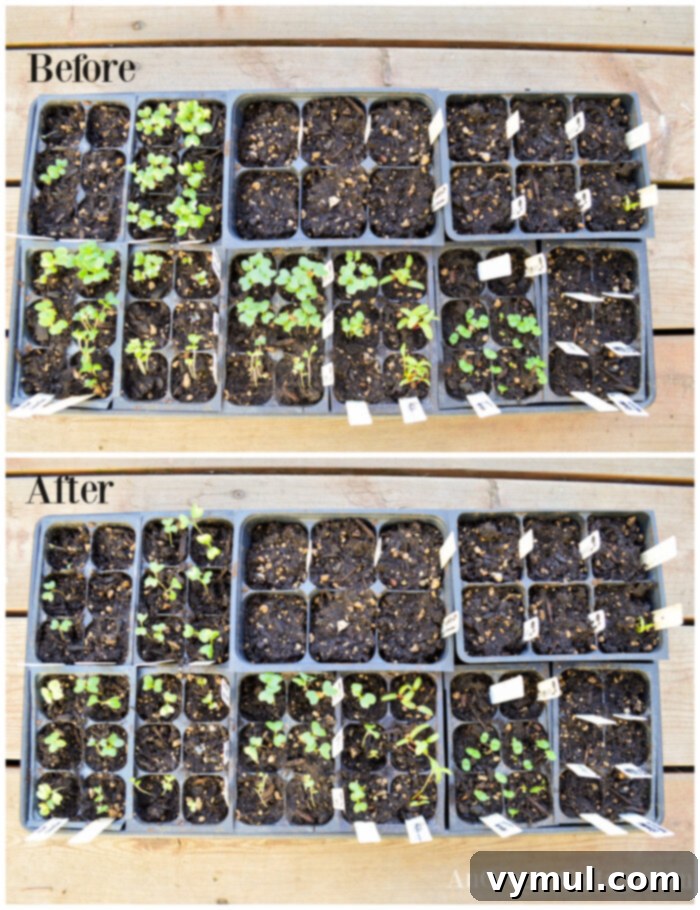
As you can observe, some cells in the “before” photo display an abundance of seedlings, much like our tomato tray, while others have just a few or even none. (Note: The slightly larger cells at the top right of this tray contain slow-germinating peppers, which, as mentioned, will require their first care in another week or two.) For cells teeming with seedlings, simply follow the same thinning and transplanting procedures we applied to the tray of tomatoes.
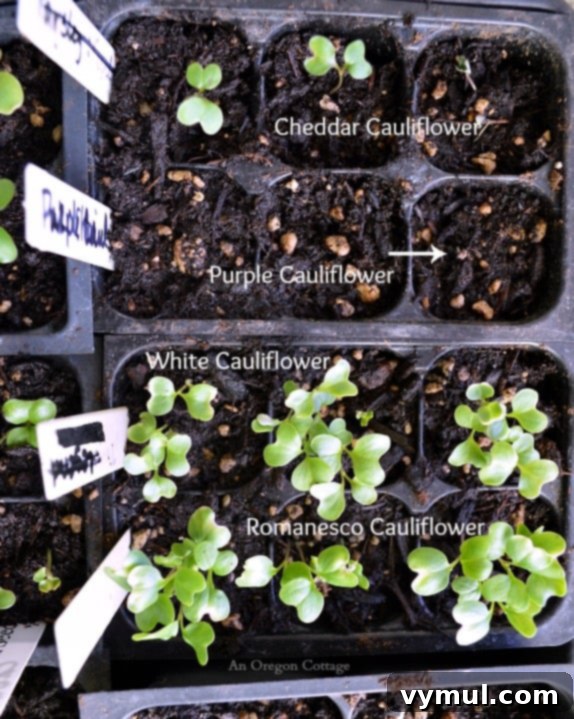
I want to highlight one of the inherent quirks of starting plants from seed, simply to reassure you that you haven’t necessarily done anything wrong if you encounter this:
Some seed varieties are naturally less viable or more temperamental than others – even when the seeds are perfectly fresh.
Take, for example, the two 6-cell trays of cauliflower seedlings pictured above. The Cheddar, Purple, and White cauliflower seeds were all brand new, while the Romanesco seed was actually three years old. Yet, I consistently experience challenges when starting Cheddar and purple varieties of cauliflower each year; they are simply a more finicky seed type. It remains to be seen if that tiny purple cauliflower sprout will truly grow and thrive, as sometimes these temperamental seedlings remain stunted and eventually disappear. So, don’t lose heart! If a particular variety proves difficult, simply try a new one next season, or focus on the vegetables and flowers that perform well for you and purchase nursery starts for the types that are harder to grow from seed. Gardening is a continuous learning process!
4. Watering Your Young Seedlings Effectively
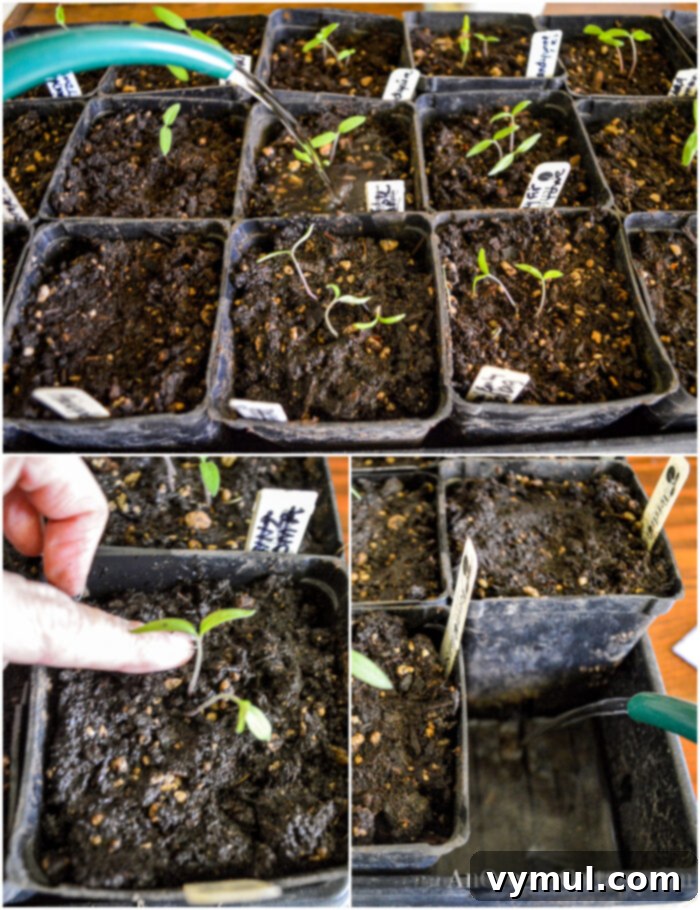
After the delicate processes of thinning and transplanting, it’s time to provide your seedlings with a crucial drink. When watering, always aim to water around the seedlings, never directly on top, using a very light, gentle stream. This prevents disrupting the tender soil around their bases and reduces the risk of damping-off disease, a common culprit for young seedling failure.
I personally prefer to use warm water, especially since I utilize a seedling heat mat to optimize germination and growth for plants like peppers and tomatoes. Introducing cold water would counteract the benefits of the heat mat, forcing it to expend energy reheating the soil. Warm water also helps to avoid shocking the delicate root systems of your young plants.
Even with the most gentle watering stream, some seedlings might lay flat on the soil. Don’t worry! Simply use your finger to gently lift them back up and re-firm the soil around their base. This provides crucial support, helping them to stand strong again.
The Superior Method: Watering From the Bottom
To ensure your seedlings receive consistent and sufficient moisture for the coming week, employ the “bottom watering” technique. This is by far the best way to water your seedlings from this point forward, as it actively encourages deep root development – a key factor in building strong, resilient plants. To do this, carefully remove one of the pots or cells from the tray and fill the bottom of the tray about halfway full with water. Then, replace the pot. The seedlings will absorb water from the tray through the drainage holes in their pots, drawing it upwards into the soil. Monitor the water level and replenish as needed, ensuring the tray never completely dries out for extended periods. This method also helps prevent soil compaction and surface algae growth, common issues with top watering.
What About Fertilizing Young Seedlings?
While optional at this precise week-one stage, introducing a very dilute fertilizer can provide an additional boost. If you choose to fertilize, I recommend using a half-strength organic fish fertilizer. It’s important to find an “odorless” variety; while it won’t be entirely scent-free, it’s significantly less potent than regular fish emulsion (this is a good option). However, I generally prefer to wait until about week three to introduce fertilizer. This timing allows all the seedlings ample opportunity to sprout and develop their first set of “true leaves” (the leaves that appear after the initial round, or cotyledons). Fertilizing too early or too strongly can burn the tender roots of young sprouts, so always err on the side of caution and dilution.
5. The Power of Strong Light for Compact Growth
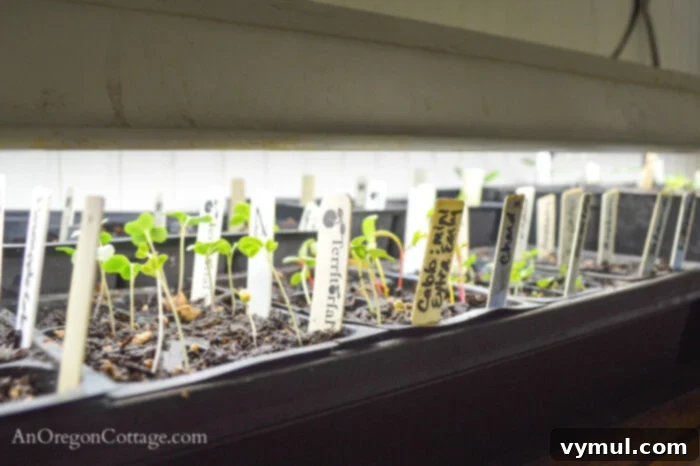
Once you’ve completed the thinning, transplanting, and watering, carefully return your seedling trays back under their dedicated strong light source. Providing adequate light is arguably one of the most critical factors for successful seed starting. Insufficient light is the primary cause of “legginess” – tall, spindly seedlings with weak stems that struggle to support themselves and are poorly equipped for outdoor conditions. Strong light, conversely, encourages compact, sturdy growth with thick stems and deep green leaves.
In the past, I relied on basic shop lights equipped with a warm bulb and a cool bulb to achieve a balanced light spectrum for optimal plant growth. However, these fluorescent options are becoming harder to source. If you’re looking for a modern and efficient alternative, this LED light is an excellent, similar option. Many gardeners now prefer LED grow lights, as they are energy-efficient, produce less heat, and are reported to cause less soil dry-out compared to traditional fluorescent lights.
The key to preventing legginess is to ensure that your light source remains as close as possible to the tops of your plants. Ideally, the light should be just a few inches (2-4 inches) above the highest leaves. This intense light exposure signals to the plant that it doesn’t need to stretch upwards to find light. Make it a habit to check your seedlings daily, and as they grow taller, diligently adjust the light fixture upwards to maintain that optimal, close distance. This continuous adjustment is fundamental for nurturing strong, stocky seedlings.
6. Let Them Grow: Ongoing Care for Thriving Seedlings
And just like that, you’ve completed the essential week-one care for your seedlings! This critical set of tasks—pulling extra seedlings, carefully transplanting some, providing their first proper watering, and positioning them under optimal light—typically takes only about 10-15 minutes. It’s a small investment of time for such significant rewards.
Over the next few weeks, maintain the health and vigor of your seed trays by:
- Consistent Bottom Watering: Continue to water exclusively from the bottom, keeping the reservoir tray about half-full. This promotes deep root growth and prevents many common seedling problems. Check daily and replenish water as needed, ensuring the soil remains consistently moist but not waterlogged.
- Introduce Dilute Fertilizer: At approximately week three, begin adding a half-strength organic liquid fertilizer (like fish emulsion) to your bottom watering solution. This provides essential nutrients as the seedlings grow their true leaves and deplete the initial nutrients in the seed starting mix.
- Ongoing Thinning and Transplanting: Keep a watchful eye on your seedlings. If any areas become overcrowded or if you wish to save more plants, continue to thin and transplant as necessary, always prioritizing the health of the remaining seedlings.
- Final Thinning to One Plant: Eventually, for most plant varieties, your goal is to have only the strongest seedling in each pot or cell. Identify the most robust plant and, if there are multiple, gently snip off the weaker seedlings at the base of the stem. This ensures that the chosen plant receives all available resources for maximum growth.
- Maintain Optimal Light: Continue to adjust your grow lights daily, ensuring they remain just a few inches above the tallest seedlings to prevent legginess and encourage compact, strong development.
Once your seedlings are properly established and cared for, the time commitment is surprisingly low, and the joy of watching your “baby” plants emerge and grow stronger is immensely rewarding! We’ll reconnect at the 6-week mark, when we’ll delve into the process of “hardening off” – gradually acclimating some seedlings for outdoor planting – and potentially transplanting others into even larger pots for continued indoor growth. Keep nurturing your sprouts, and look forward to a bountiful gardening season!
More in the Vegetable Gardening 101 Series:
- Caring for Seedlings at Week 6: Preparing for the Outdoors
- How to Plant Seedlings: From Pot to Garden Bed
- The Ultimate Seed Starting Guide: Everything You Need to Know

Note: This article has been extensively updated and expanded to provide the most current and comprehensive information. It was originally published in 2009, with updates in 2016 and again in 2022.
Disclosure: Please be aware that some links in this article are affiliate links. If you click on them and make a purchase, I will receive a small commission at no additional cost to you. This helps support the content I create. For a full understanding of my disclosure and advertising policy, please click here.