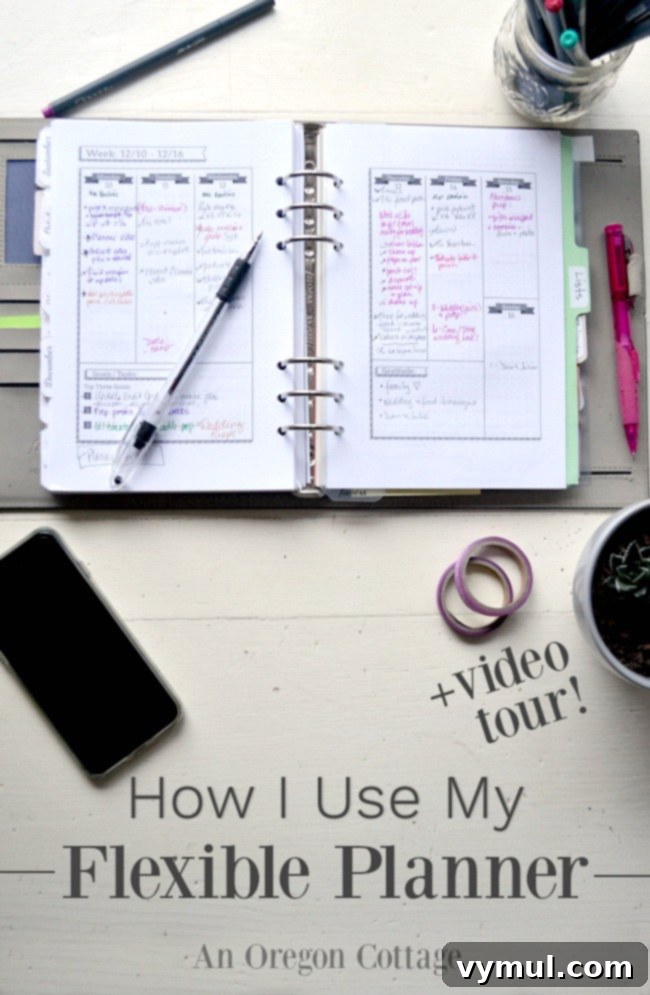
Mastering The Flexible Planner: Your Ultimate Guide to Organization & Productivity
Embark on a journey with me as we explore the transformative power of The Flexible Planner. This isn’t just a planner; it’s a dynamic system that truly adapts to life’s unpredictable shifts, seasons, and evolving priorities. Throughout the past year, I’ve seen firsthand how its inherent flexibility has supported my organizational needs, making it an indispensable tool for managing my schedule, goals, and daily tasks. This comprehensive tour will reveal how truly versatile this planning system is, offering insights into how you can make it work seamlessly for your own unique life.
Please note: Some links within this article are affiliate links. Should you click on them and make a purchase, I may receive a small commission at no additional cost to you. These commissions help support the content I create.
Even amidst the hustle and bustle of the holiday season, I wanted to take a moment to demonstrate how The Flexible Planner can be your steadfast companion through various periods of intense activity and beyond. What better way to illustrate its efficacy than to open up my own personal planner and provide you with a candid, real-world example of its application?
While my intention in sharing my planner is to spark ideas and offer inspiration for how you might utilize your own Flexible Planner, I do want to set some clear expectations:
- My planner was never intended for public display in meticulously staged photographs or professionally edited videos. Consequently, you won’t find the perfectly styled, artistic pages often seen on Instagram or YouTube. This is a reflection of genuine, everyday use.
- For privacy, the photographs are intentionally taken at a slight distance, causing some of the writing to appear blurry. This allows me to share the organizational principles and page layouts without revealing sensitive personal details of my life.
- This tour showcases my actual life. You will observe pages that are neatly filled out and others that are less so. The primary objective is to highlight how this planner functions for real individuals, rather than presenting an idealized version solely for aesthetic appeal.
- I have incorporated personal customizations, such as homemade divider pages, and adapted certain sections, like the monthly spread, to better suit my preferences. I share these modifications to demonstrate and inspire how The Flexible Planner can be tailored to optimally serve YOUR specific needs and workflow, ensuring you utilize pages that truly resonate with you.
With those disclaimers clarified, let’s dive into the tour! We’ll begin with a comprehensive video walkthrough, guiding you page by page, from the front to the back of my planner, including a look at the binder I use to house it. This video is completely unedited – it’s just me, sharing my thoughts, sometimes stumbling over words, and even making a comment about not using Post-it notes only to turn the page and find a stack of them! It’s an authentic glimpse into real life, offering a truly transparent experience.
In addition to the video, I’ve captured many of the key pages here in photographs, elaborating on their various uses and how they support my daily and long-term planning. Feel free to explore all the images and the video, or just focus on one aspect; either way, I sincerely hope you find this resource both useful and inspiring. May it ignite your enthusiasm for all the possibilities that await you and your organizational journey this year!
Essential Supplies for Maximizing Your Flexible Planner Experience:
- Filofax Domino A5 binder: This sturdy and elegant binder provides the perfect housing for your Flexible Planner pages, allowing for easy rearrangement and customization. Its durable design ensures your planner remains protected and organized. (And don’t forget a compatible hole punch, an unseen but essential tool for adding your printed pages!)
- Fineliner colored pens: Ideal for color-coding, highlighting important tasks, and adding a touch of visual appeal to your planner. These pens offer precision and a vibrant palette to make your planning more engaging.
- Pentel RSVP Pen: A reliable and smooth-writing pen perfect for daily journaling, note-taking, and keeping your entries clear and legible. Its consistent ink flow makes it a go-to choice for everyday planning.
- Planner stickers: A fun and functional way to mark special events, track habits, or simply add decorative elements to your pages. Stickers can enhance visual organization and make your planner truly personal.
- Thin Washi tape: Excellent for creating borders, dividing sections, or adding aesthetic touches without bulky lines. Washi tape is repositionable and adds a creative flair, perfect for customizing layouts.
Unlocking Your Potential with The Flexible Planner: A Detailed Tour
The Video Tour: A Real-Life Walkthrough
For those who prefer a dynamic demonstration, the video above provides an intimate, unscripted look into my personal Flexible Planner. Join me as I navigate through its pages, sharing candid insights and practical tips that highlight its adaptability. This video is designed to give you an authentic sense of how the planner functions in real-time, showcasing its practical application without any embellishments. It’s an honest portrayal of daily planning and organization.
The Pictorial Tour: In-Depth Page by Page Exploration
Beyond the video, let’s delve into the specific sections of The Flexible Planner with detailed images and explanations. Each component is designed to enhance your productivity and help you achieve your aspirations.
The Contents Page: Your Navigation Hub
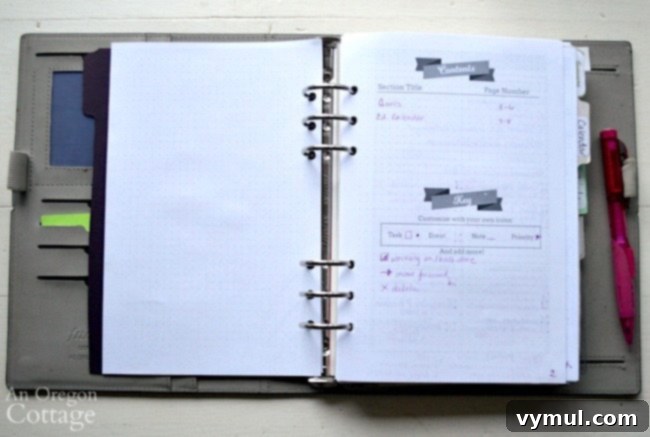
While the actual “beginning” of your planner journey might be one of the three beautiful cover choices or the goal-setting strategies introduced in the 2019 version, the contents page is where the tactical planning truly begins. It serves as your personal index, helping you quickly locate important sections and ideas.
Initially, I attempted to adopt the traditional Bullet Journal’s bullet symbols. However, after years of relying on simple checkmarks and lines, I consistently reverted to my established methods. This experience reinforced the core principle of The Flexible Planner: it’s about what works for YOU. Whether I use boxes, dots, or lines, and regardless of whether I strictly differentiate between tasks and events, the key is that it accurately reflects the “happenings in my world.”
One feature I particularly cherish is the “move it forward” arrow. At the close of each day, I review my list, and any task that wasn’t completed is marked with an arrow, indicating its transfer to the next day. This visual cue is incredibly effective. It provides immediate confirmation that all pending items have been acknowledged and accounted for, ensuring nothing slips through the cracks and fostering a sense of accomplishment for the day’s completed tasks.
Goals/Plans & Action Steps: Charting Your Course for Success
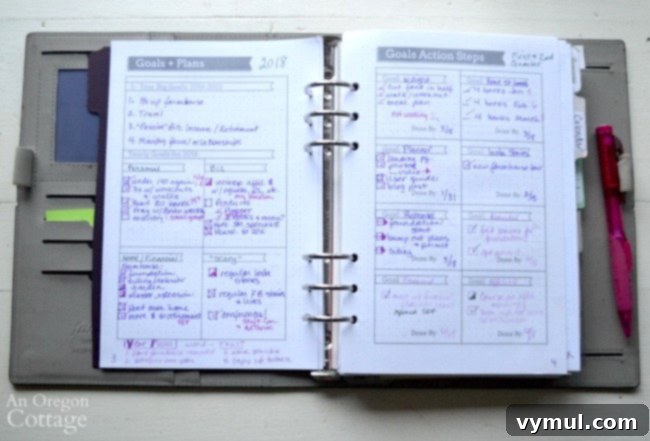
There’s a special joy in dedicating time to these pages at the commencement of a new year. I often set aside a peaceful afternoon, with soothing music and a warm cup of tea, to thoughtfully review the achievements and lessons of the past year and articulate my aspirations for the upcoming one. Reflecting on my longer-term, 5-year goals (some of which are shared with my husband, Brian) helps me distill specific, actionable steps I can take in the next twelve months to propel these ambitions forward.
For instance, “travel” is a significant long-term goal for us. This page prompts me to translate that broad aspiration into concrete travel plans for the year, identifying specific destinations or experiences we can actively pursue. It’s a powerful realization that without a deliberate plan, many goals remain elusive. In the past, years would pass without significant travel simply because we hadn’t consciously prioritized or planned for it.
This brings me to an important distinction about “goals.” I’ve encountered various philosophies on goal-setting – some advocate against them, suggesting alternative terminology, while others emphasize focusing on the present. Personally, I embrace the term “goals,” but fundamentally, they represent our priorities. Here’s a crucial insight:
Everyone has priorities in life, and these priorities unfold whether we consciously define them or not.
Without intentional reflection, your priorities often become whatever demands your immediate attention throughout the day: preparing children for school, commuting to work, preparing meals, or catching up on trending Netflix series. While none of these activities are inherently negative (and certainly, there are life phases where this level of focus is all we can manage), this passive approach is what I refer to as simply letting life happen to you. Time progresses, and often, one year blurs into the next, leaving us feeling as though we’re merely treading water rather than actively swimming towards a desired future.
Now, imagine the profound sense of accomplishment and satisfaction you would experience if, at the end of the year, you looked back and saw tangible progress on priorities/goals such as these:
- Nurturing Relationships: Spending genuine, quality time with your children. (Action step: Schedule weekly or monthly “dates” or dedicated activity blocks.)
- Career Advancement: Successfully creating a new project at work that leads to increased income or a promotion. (Action steps: Break down the project into manageable tasks, allocate specific time for execution.)
- Health & Wellness: Consistently eating healthier, perhaps focusing on home-cooked meals five nights a week. (Action steps: Compile a collection of easy, healthy recipes, create a weekly meal plan, grocery shop mindfully.)
- Personal Growth: Expanding your knowledge and perspective through books and shows you genuinely wish to explore. (Action steps: Set a target to read X number of books in a year; commit to watching one educational documentary per month.)
These examples demonstrate how goals don’t necessarily introduce new categories of activity but instead transform mundane routines into intentional actions. They elevate parenting, work, nutrition, and entertainment from passive experiences to enriching engagements, leading to a much more fulfilling and purposeful life.
It’s important to stress that these goals and plans are not meant to burden you or induce guilt. If you review the goals I’ve openly shared on AOC since 2010, you’ll undoubtedly find several that were not fully achieved. And that’s perfectly acceptable. If a goal remains important, it simply carries over to the next year’s list. If its significance has waned, I graciously let it go. For instance, my initial projection for building our emergency fund was a couple of years, but in reality, it took over five. There’s no regret or shame in that; having achieved it, albeit slower than anticipated, is infinitely better than merely wishing for it “one day,” isn’t it?
Therefore, leverage this page as a wellspring of inspiration and a canvas for your dreams. And for every goal you *do* accomplish? The feeling of achievement will be absolutely incredible!
Year-At-A-Glance Calendar: Your Annual Blueprint
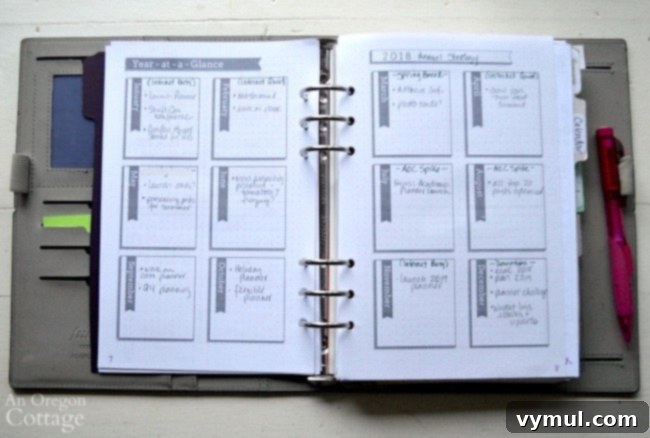
This annual spread is invaluable for developing a high-level strategic overview for my blog, AOC. Here, I delineate key events, promotional periods, and the thematic focuses I intend to prioritize throughout each month. It’s a bird’s-eye view that ensures my content aligns with broader objectives and seasonal relevance.
Beyond professional applications, this page offers immense utility for personal life management. It’s an ideal space to plot significant family events, birthdays, school holidays, children’s activities, or planned travel. Seeing your entire year laid out visually allows for proactive planning, helps identify potential conflicts, and provides a clear trajectory for your major commitments and aspirations.
Monthly Plan: Bridging Goals and Action
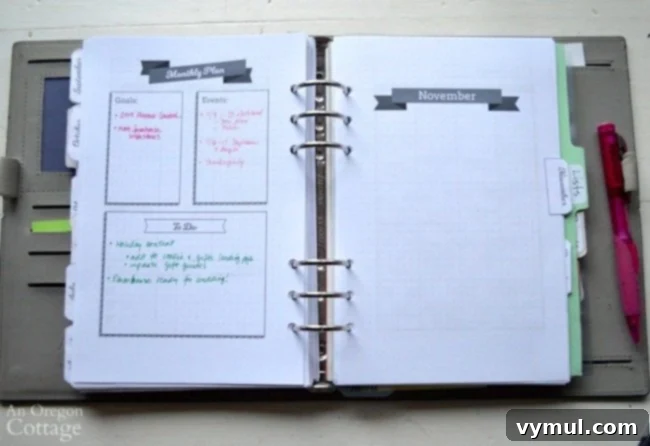
Most months, I leverage this page to translate my broader annual goals into actionable, monthly steps. It’s where I list specific events, deadlines, and the crucial to-dos required to advance those overarching objectives. This section acts as a vital bridge, connecting long-term vision with immediate tasks, ensuring consistent progress.
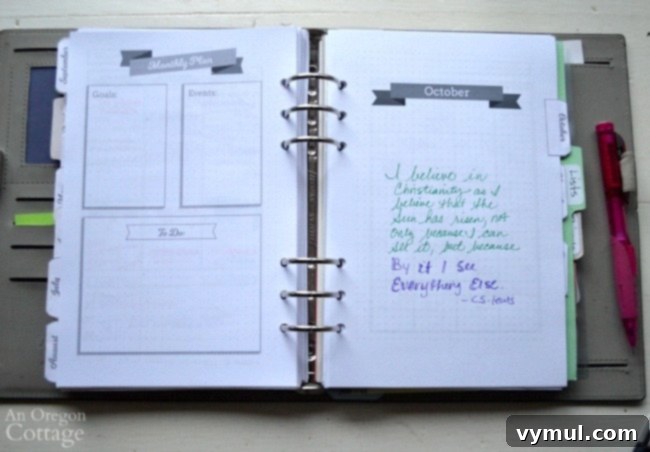
Occasionally, there are months when I don’t utilize this page as extensively, and that’s perfectly fine. Its presence alone offers reassurance and utility when needed, embodying the true spirit of flexibility. Another delightful adaptation, inspired by a fellow Flexible Planner user (thank you, Lena!), is to use the Monthly Title Page to record an uplifting quote or a meaningful Bible verse. This practice adds a personal touch and a moment of daily reflection, enhancing the planner’s role beyond mere task management to include inspiration and mindfulness.
The Monthly Calendar: Your Everyday Organizer and Record Keeper
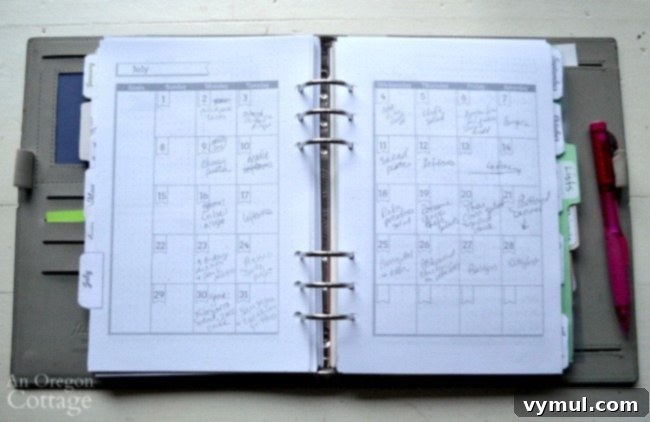
For me, the monthly calendar spread transcends its traditional role. I primarily use it as a comprehensive menu planner, meticulously recording our family’s meals for each day. This not only streamlines meal preparation but also serves as a valuable historical record of past menus, which I can refer to for future planning or when seeking inspiration. Alongside meal planning, I log significant family activities and appointments, providing a consolidated view of our household’s schedule.
Naturally, this versatile calendar can be adapted for conventional use, marking important life events, appointments, and social engagements. However, its potential extends much further. Consider using it for monthly strategic planning, outlining key project phases, tracking academic schedules for homeschooling, or even monitoring personal habits like exercise or meditation. Thinking creatively about its application will unlock its maximum utility for your specific needs, making it a truly powerful tool for visualizing and managing your entire month.
Three Adaptable Approaches to the Weekly Calendar: Tailoring Your Productivity
The weekly calendar in The Flexible Planner is designed with remarkable adaptability, allowing you to choose a layout that best supports your current workflow and life phase. Over the past year, I’ve cycled through three distinct methods, each offering unique benefits for managing my tasks and time.
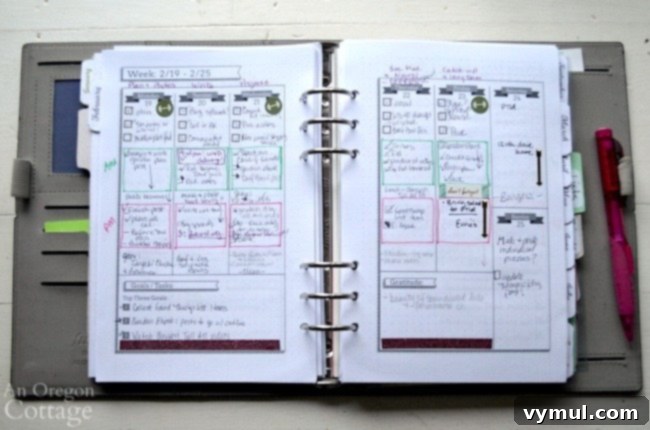
#1) The Focused Approach: 3 Main Tasks + AM & PM Blocks.
I adopted this layout during the initial 3-4 months of 2018, finding it incredibly effective for combating feelings of overwhelm and the pervasive “too many things to do, not enough time” mindset. The core principle here is simplicity: identifying just three main tasks for the day. Achieving these three priorities instantly qualifies the day as productive and successful, regardless of what else might transpire. This method significantly reduces mental clutter and encourages a focus on high-impact activities.
Complementing this, the morning (AM) and afternoon (PM) blocks provided a visual framework for estimating what could realistically be accomplished within those 3-4 hour periods. This time segmentation further helps in managing expectations and allocating efforts more effectively, preventing the common pitfall of over-scheduling and under-delivering. This approach is ideal when you need to streamline your focus and ensure essential tasks are consistently completed.
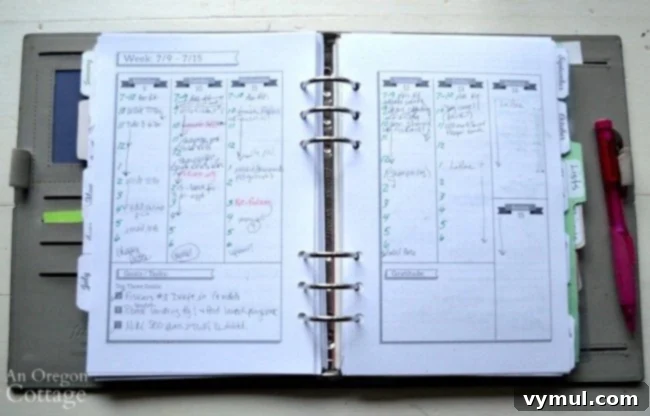
#2) The Analytical Approach: Time-Blocking the Days.
From late spring into summer, I transitioned to time-blocking, driven by a desire to gain a clearer understanding of how I was actually spending my time. This method involves allocating specific blocks of time to individual tasks or activities, providing a precise record of time usage. To enhance its effectiveness, I often used the Daily Planner Page (a bonus feature of The Flexible Planner) to list my daily objectives, then meticulously recorded the actual time spent on each task directly on the weekly spread. This dual approach allowed for both proactive planning and retrospective analysis.
On other occasions, I would simply outline my known commitments and then fill in tasks, using arrows to visually represent the duration of each activity. This helped me to integrate appointments seamlessly into my schedule and build my work around them. I’ve found this layout particularly beneficial during periods of heightened stress or when feeling overwhelmed, as it instills a greater sense of control and clarity over my day. It’s an excellent strategy for optimizing time allocation and identifying areas for greater efficiency.
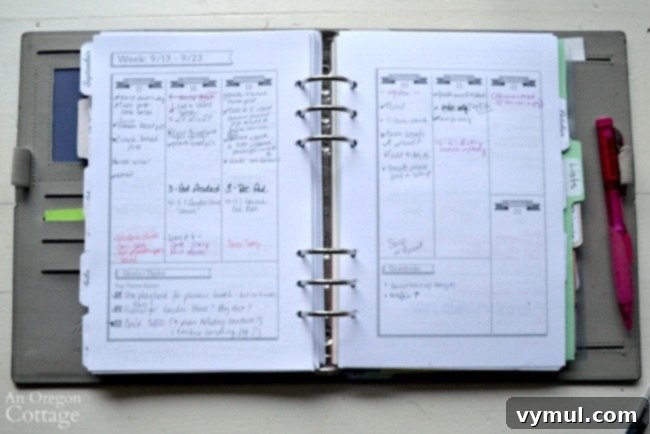
#3) The Streamlined Approach: Simple Bullet Lists.
For the past four months or so, I’ve embraced a more minimalist, bullet-journal-inspired method for my weekly calendars. This involves creating straightforward bullet lists for daily tasks. Each item is a simple entry, and once completed, it’s checked off. If a task isn’t finished, an arrow indicates it needs to be carried over to the next day. This method is incredibly efficient when your week has developed a predictable rhythm, and you have a clear understanding of your daily responsibilities. It’s a no-fuss, highly effective way to track progress and ensure tasks are addressed.
A Consistent Practice: Across all three weekly planning methods, a constant element is the addition of our evening meal at the bottom of each day’s entry. I transfer this directly from my monthly menu plan, allowing me to see at a glance what’s for dinner. This simple practice is surprisingly helpful, reminding me if I need to defrost ingredients, start a slow-cooker meal in the morning, or prepare anything else in advance, thereby simplifying evening meal preparations.
The Lists Section: Your External Brain and Idea Hub
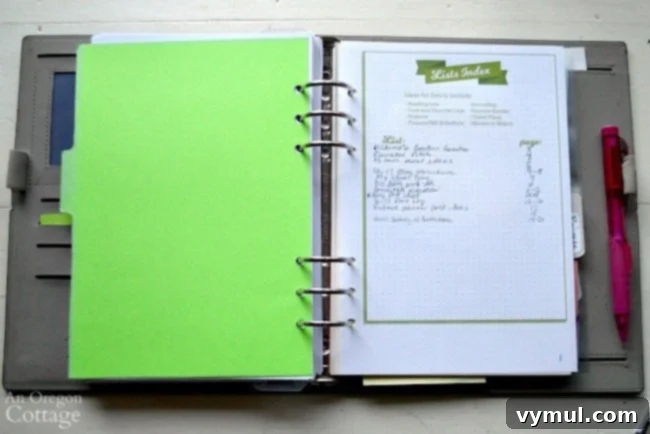
One of the most significant advantages of using The Flexible Planner within a binder, as opposed to a traditional bullet journal notebook, is the permanence of the Lists Section. As I periodically replace the dated pages each year, my invaluable lists remain securely housed within the binder. This eliminates the tedious process of transferring notes or, worse, the risk of losing important information. My lists section, which notably includes a green page from an early colored version of the planner (before I realized printing in color was more expensive and black-and-white pages made colored pens pop more effectively), is a treasure trove of information.
This dedicated section serves as my “external brain,” a repository for everything I want to remember or explore further. It contains a diverse array of content: general notes, innovative meal ideas, a detailed outline of my ideal productive day, nascent blog concepts, and much more. The possibilities are truly limitless. Imagine lists for books to read, movies to watch, a food log for health tracking, crucial notes from meetings, or even heartwarming quotes and anecdotes from your children. This section is designed to capture any thought or detail that frees up mental space, making it an indispensable part of your organizational system.
The Flexible Planner thoughtfully includes 12 blank dot-grid pages at the end, providing an ample starting point for your personalized lists section. You have the freedom to print these as needed, print additional copies, or even source extra dot-grid pages online, tailoring the quantity to your individual requirements.
Indeed, the entire planner is built upon a dot-grid foundation, a deliberate choice reflecting its hybrid nature between a bullet journal and a traditional planner. Dot-grid pages offer unparalleled flexibility: they provide a subtle guide for structured lists and notes without the restrictiveness of solid lines, while simultaneously offering a blank canvas for adding artistic flourishes, doodles, or color-coded systems if you so desire. This design ensures that whether you’re a minimalist organizer or a creative planner, The Flexible Planner adapts to your unique style.
Is The Flexible Planner the Right Tool for Your Organizational Journey?
My journey to creating The Flexible Planner was born out of years of frustration with conventional, pre-printed planners that often didn’t quite fit my evolving needs. I also grew weary of the repetitive effort required to recreate essential pages in my bullet journal. After several years of consistently using The Flexible Planner, I can confidently say it represents an almost perfect fusion of structure and freedom. It has undeniably empowered me to accomplish both significant goals and daily tasks, ensuring I am an active participant in shaping my life rather than passively observing it unfold.
If you find yourself constantly adjusting to rigid planning systems, or if you desire a tool that truly grows with you and your changing priorities, The Flexible Planner could be the transformative solution you’ve been seeking. It offers the best of both worlds: a clear framework for organization combined with the ultimate freedom to customize. It’s designed to bring clarity, reduce overwhelm, and actively support your journey towards a more organized and fulfilling life.
I sincerely hope it can provide the same profound benefits for you! CLICK HERE to access more detailed information and make your purchase today. As a downloadable file that you print at home or at a local print shop, it offers exceptional value and is remarkably affordable, making effective organization accessible to everyone.
Disclosure: This article contains affiliate links, which means I may earn a commission on sales generated through these links. Rest assured, this does not affect the price you pay for any products. For a comprehensive understanding of my disclosure and advertising policies, please click here.